Image

In Future Economies and Social Entrepreneurship, Iraz Şimşek Güneş and Erdem Cansızoğlu speak with Baran Örnek, founder of İklim Öncüleri (Climate Pioneers), social entrepreneur, climate action consultant, and activist, about the demands of youth climate movements ahead of COP31, climate justice, and young people's participation in decision-making processes. They discuss the role of young people in future economies through the lens of a just transition, green employment, and alternative economic models.
Iraz Şimşek Güneş: Hello, dear Apaçık Radyo listeners. Within Açık Gazete, this is the Next Economies and Social Entrepreneurship program. I'm Iraz Şimşek Güneş.
Erdem Cansızoğlu: And I'm Erdem Cansızoğlu.
I.Ş.G.: Yes. COP31 in Antalya, hosted by Türkiye, is less than three weeks away. That is the 31st Conference of the Parties under the UN Framework Convention on Climate Change. This week we look at the climate issue through the eyes of young people: What are young people asking for right now? What do independent youth movements stand for in this setting? And how are they making room for themselves in the next economies? And right here, we have a guest who is a voice of the young generation. Let me introduce him: Baran Örnek. Baran is the founder of “Climate Pioneers”, a strong youth initiative that brings together young people who are worried about the environmental and climate crisis, to create social change. Climate Pioneers represented Türkiye at the global climate conferences COP27 and COP28, and it works in partnership with nearly 100 national and international organizations, including the United Nations and the European Union. Baran is also a member of the Catalyst Now Türkiye Chapter, where he works on ecological transformation. He is a social entrepreneur, a climate action advisor and an activist who supports young people having a real say in climate policy.
Yes, welcome Baran.
E.C.: Welcome Baran.
Baran Örnek: Thank you, hello again.
E.C.: Then I'd like to start right away with our first question. Baran, at Climate Pioneers you're trying to build a social enterprise model that can stand on its own feet. I mean a scalable model that aims for long-term financial and operational sustainability. We know that youth movements that grow with volunteers, and climate advocacy initiatives, often get stuck in the grant cycle. So, how is Climate Pioneers funded? And drawing on your experience at Climate Pioneers, can you tell us a bit about the business models of initiatives like yours? How do they stay sustainable in the long run, and how do they survive while protecting their mission?
B.Ö.: Of course. Right now, Climate Pioneers is actually a civil initiative that has worked fully on a volunteer basis for 5 years to grow the youth climate movement in Türkiye. But we see the future, and a truly sustainable way of creating value, in social entrepreneurship. So we are working to build our own independent revenue model. Right now, though, we are a youth civil initiative with no full-time or part-time staff. We run fully on a volunteer team, we are led by young volunteers, and all our projects are created by young people. We believe that when an organization has its own revenue model, it becomes fully independent. It keeps its mission and its direction, it gets its own space to act, and so it is truly free in its work. But of course, without a revenue model, you depend on a single grant or a single institution, and your priorities change, whether you like it or not, based on how flexible that source is. Up to now, we have run all our projects with grant support from many local and international organizations. Like the European Union's Sivil Düşün Programme, the United Nations Environment Programme (UNEP), and the Heinrich Böll Stiftung. Thanks to partners like these, we have organized events that reached more than 25,000 young people. With our campaigns, we collected more than 150,000 signatures. We carried out dozens of projects with nearly 1,500 young volunteers from 50 different cities. But we talked about a revenue model. We still have a social enterprise model that we are trying to build. It is not live yet, but we have designed different programs for for-profit companies. We hope to launch them in the future. But especially in today's political climate, when civil space is under so much pressure, when grants are shrinking and our room to act is limited, we don't want to depend only on grants. This also has its own limits. We see similar groups working with many companies. But it is a bit hard for us to find companies that fully match our principles. There are also problems, like companies not being big enough to set aside a budget for this. We have an anti-capitalist stance. Because of this political stance, and because we are against consumerism, designing and selling products is also a limited area for us. Still, we think social entrepreneurship is the most effective way to create value. And at Climate Pioneers, we are working to turn a civil initiative into a social enterprise.
I.Ş.G.: So, Baran, in your earlier talks you described the goal of Climate Pioneers as raising awareness in Türkiye and influencing policymakers; and of course we can do this with many tools, like campaigns, strikes and conferences. On one hand, there is the “Local Conference of Youth” Türkiye 2026, which you also hosted, with 340 young people from different universities, fields and youth groups. It is held under YOUNGO, the official youth constituency of the UN Framework Convention on Climate Change, with “Let's Do It!”. On the other hand, the Ministry of National Education held youth climate workshops in 30 provinces, and there will be many more children's and youth climate conferences in the coming years... We know that all the declarations and youth proposals prepared in this process are carried into the international climate negotiations. And you have represented Türkiye at COPs before, as a youth climate organization. So, at a time when young people are invited this much, why do you think we still need an independent youth movement? For example, how do you see the difference between being invited and having a real say, or young people coming back from COP with concrete gains? We're curious.
B.Ö.: Sadly, inviting young people to international summits often turns into window dressing. For us, being invited is just like watching. Having a say is something completely different. Shaping the decisions and being able to change binding texts: that is what real participation means to us. In the negotiations, instead of making room for truly independent young activists, experts and researchers, we see that only spectators are let in, to approve decisions that have already been made. We also see that the young people who can take part here have a limited voice and not much real influence. And by the way, it has been like this at COPs for a very long time. I'm not only talking about the COP that will happen in our country this year. For a very long time, sadly, while the fossil fuel lobby and other groups have real power to shape the decisions, meaningful participation for young people has not been possible. We think that for young people to come back from COP summits with real gains, just sharing information or being a speaker on stage is not enough. A real gain, for me, is this: the demands young people have voiced for years, like the phase-out of fossil fuels, or other demands, are turned into concrete steps. Young people's participation becomes binding in nationally determined contributions. Young workers are clearly protected in just transition decisions. Demands like these can be approved and put into practice by young people. In other words, real steps that go beyond texts and empty promises. That would be a real gain for us. Independent climate activists like us, and different youth organizations... For example, we are a member of GO4. In GO4 there are also many youth organizations working in this field. Why is it important for each of us to take part in COPs? Because, sadly, the demands that truly produce independent policy and push for change, for system change, still come from us, the youth organizations. Compared to other youth groups whose voice is limited.

E.C.: I'd like to take it from here and bring it a bit into our daily lives. The Climate Law No. 7552, published in the Official Gazette and in force since July 2025, defined climate justice in law for the first time: it defines it as policies and practices that aim to remove the inequality caused by the climate crisis, and by the efforts to prevent it and adapt to it... You are also in the ‘Climate Adaptation and Climate Justice’ working group of the Youth Advisory Board of a municipal platform in Istanbul. Do you think climate justice for a young person is the same as this definition on paper? And if it's different, why does it mean something different in their daily lives?
B.Ö.: For me, climate justice is really about historical responsibility for global emissions. I mean, many of the world's developed countries are seen as the ones that really created the climate crisis. Yet the countries hit hardest by the climate crisis are the ones that caused it the least. Because they don't have the resources for that level of consumption, production... for emitting. And they don't have the budgets to protect themselves from the effects of the climate crisis. And I think climate justice is very important for us as young people too, because here again there is a gap. We are the last ones to step into this world, so the smallest share of emissions is ours, and the economy doesn't even let us consume enough to own property. So I expect our generation's emissions to stay the lowest in the future too. Even though we are the group that caused the climate crisis the least, we are again the ones who will be hit the hardest. Because, on average, we will live longer than other generations in this world shaped by the climate crisis. Also, as young people, we are in a much more fragile position. Our jobs, our homes, our lives... are much less resilient to this crisis. Today, for a young person in Türkiye, I think climate justice shows up in our access to clean food and water, in our city's green spaces, in the quality of the air we breathe, and in the deep ecological anxiety we feel about the future. And of course, it means having a real say in a city. Not just going to decision-makers' events to share an idea or be a speaker, standing there like an extra. For young people to truly have a say in a city, I think they need direct voting and veto rights in municipal councils, city councils, and transport and zoning planning, and real influence in these negotiations. I think it's about young people really shaping the city budget and the planning of how urban space changes.
I.Ş.G.: Yes, since you mentioned worries about the future, we can go on with a different question. We also know that at Climate Pioneers you are working on different sustainable transformation models, so that young people can take part in the future green economy and in climate diplomacy as active leaders, producers and decision-makers. As you know, one of the 10 priorities of the COP31 Action Agenda is ‘Youth and Education’. And the Presidency describes young people as the human capital of green skills and the low-carbon economy... in other words, not just as beneficiaries of climate action, but as actors who shape it. So a new transition mechanism is expected to come out of Antalya on this. So, for a young person in Türkiye today, is a ‘green job’ a real door to a hopeful future, or is it still a promise? And why? We'd love to hear your view on this.
B.Ö.: Of course, sadly, in Türkiye green jobs are still mostly a promise. But they are growing fast, and I think they now have the potential for a transformation that can't be avoided. Turkish industry and the business world now have to transform because of the EU Green Deal and carbon regulation mechanisms. But can we say this transformation has turned into jobs with real guarantees? I don't think we can. Of course it would be great if it were a field that protects the rights of today's workforce and offers decent work. But today's economy is still driven by consumption, focused on maximizing profit, run by the capital class, and based on fossil fuels. It doesn't care about ecology or life, it only cares about money. So I don't think truly green jobs can be created here without a system change.
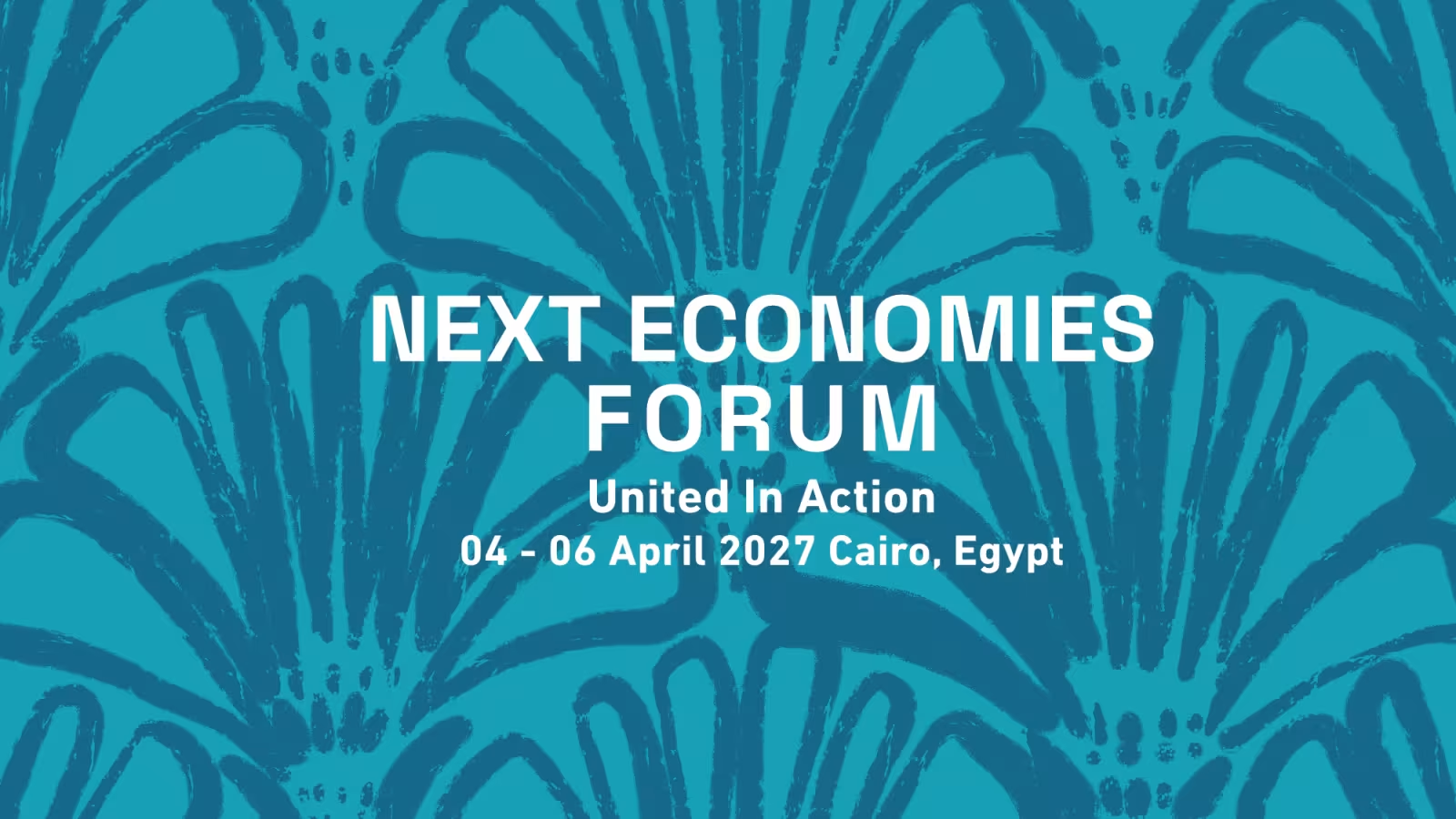
E.C.: Speaking of today's economy, I now want to take you on a journey that is also the starting point of this program, and you've known this process from the very beginning. In 2024 we were together at IPEC in Istanbul, and in 2025 at the Next Economies Summit. And in April 2027 you'll be with us at the Next Economies Forum at Heliopolis University in Cairo. At these meetings, you saw up close how a community talking about degrowth, the solidarity economy and the wellbeing economy has grown. As the founder of a youth climate movement, what do you think has changed along the way? Why should climate and youth organizations be part of this next economies debate? Why should they embrace these approaches?
B.Ö.: I think there have been very important shifts along the way. Because the climate struggle is no longer only about protecting the environment and nature. It is now seen directly as a question of the system, of a new economy. In the early years, our activism was more about raising awareness and getting people to accept that the crisis is real. Today we talk about system change... climate justice, financial mechanisms, carbon markets, just transition models. And I think youth organizations should be at the center of this new economic debate. Because these new economies are being built... We are the ones who will live with both the cost and the reward of this future economic order for the next 30 to 40 years. Looking ahead, I'm really excited about the Next Economies Forum in Cairo too. And of course it is even more important because it comes right after COP31 in Türkiye. On behalf of the climate youth in Türkiye, I already feel I'll bring this main question and demand to the table: In these next economies, which are decarbonizing and taking a new shape, will young people in developing countries be only cheap green labor, or will they be fair stakeholders in this new economic order, and makers of technology and policy? I think we, as youth organizations, need to dig into this question.
I.Ş.G.: Yes, you're really right, Baran. We're in our last minutes, but I want to ask one more question. It could be our last one. So, what do you think we need in order to turn the energy that draws young people to the climate movement, gives them hope and keeps them in it, into real change? How can we show them not only the problems, but also that a better future, and next economies, are possible?
B.Ö.: I think what really keeps young people in this movement right now is a sense of responsibility and existential worry. Because we are fighting for our own future, for the world that is our home. But I think what keeps us young people in this movement is definitely peer solidarity and acting together. Knowing we are not alone, standing side by side with people who share the same worry, and being able to create change, even a small one: that is definitely a huge source of hope. And to turn this energy into real change, I think we need this: to move from slogan activism to activism that designs solutions and systems. Always telling young people about melting ice at the poles or disaster scenarios turns, after a while, into burnout, eco-anxiety and exhaustion. But showing young people that an alternative is possible is definitely the most important way to create hope. I mean, putting concrete examples of new economies, of next economies, in front of us... Circular economy models, cooperatives, social entrepreneurship, the power of local communities, fair sharing mechanisms. If we can prove, maybe with projects, data or field experience, that these practices are not just theories on paper but models that really work and are also economically sustainable, then I definitely think young people will stay longer in this movement, work better, and keep fighting with hope instead of sinking into despair. Because someone who is part of the solution stays in the movement. A young person who feels they can really create solutions.
E.C.: Thank you so much, Baran. You've been listening to the Next Economies and Social Entrepreneurship program on Apaçık Radyo. Our guest was Baran Örnek, founder of Climate Pioneers. Ahead of COP31, we talked about the youth climate movement, climate justice, and the role and importance of young people in the next economies.
I.Ş.G.: If you want to listen to our program again, you can visit the Apaçık Radyo mobile app or website. We'd also like to sincerely thank our whole team. Let's say see you next week with another guest. Goodbye.