Image
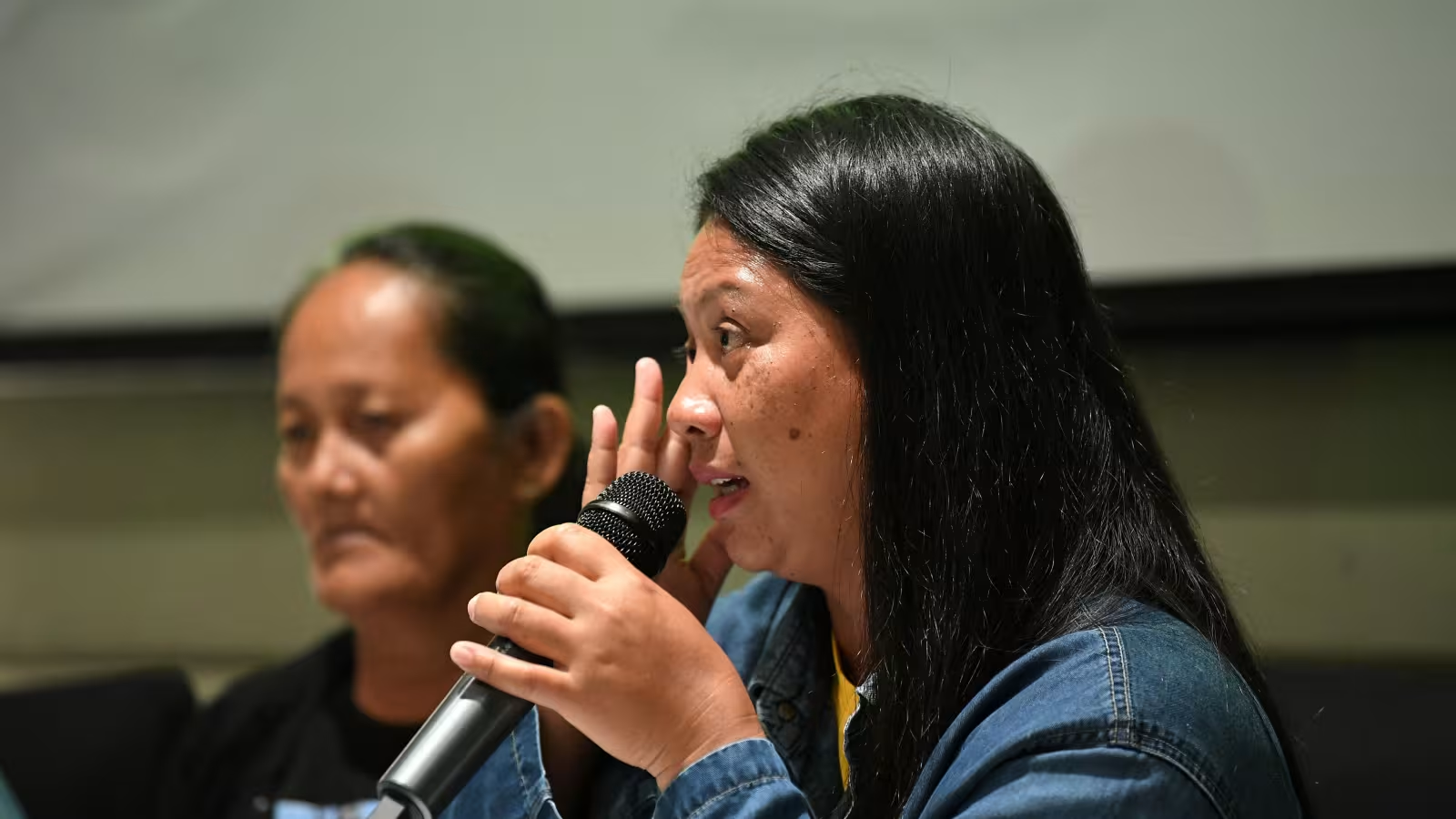
As part of COP31, we speak with Trixy Elle from Batasan Island in the Philippines about the devastation caused by Typhoon Odette, the impacts of the climate crisis on island communities and fisherfolk, their legal battle against Shell, and the importance of solidarity for future generations.
Eren İleri: November 10th, 2026. Eren İleri with Trixy Elle and Virginia Benosa-Llorin, providing translation.
Trixy Elle: I speak English.
E.İ.: Perfect. My first question is, can you introduce yourself? I know that you used to run a fishery. Can you tell us about your experience doing that?
T.E.: I am Trixie. I am a fisherfolk from Batasan Island, a small island in the Philippines. Our main source of livelihood there is fishing.
E.İ.: A few years ago, Typhoon Odette hit. How did that impact you?
T.E.: Oh, wow. That's a pretty good question. Typhoon Odette hit on December 16th, 2021. I was among the 131 families whose homes were considered totally damaged on our island. When we say totally damaged, everything is gone.
The Philippines is a country that experiences many typhoons, so we are very familiar with them, but Odette was a little bit different. We found out too late that it was a super typhoon, so we stayed on the island. By the time we knew, it was too late for us because there were no boats available to take us off the island. The LGU, the local government unit, had also secured the boats. So we just had to wait for the typhoon to come.
Around 6 p.m., it started. The wind was so strong, and there were huge waves. We were afraid we would get trapped in the house, so we decided to get out. When we opened the door, the water came in very quickly. It rose from my knees to my waist in just a few steps.
My father told us to hold hands because the water was so high, and we had to evacuate or we would be trapped in the house. He told us to hold hands because if we survived, we would survive together. If we died, we would die together.
So, holding hands, we swam. I don't know how or why we survived. We just found ourselves in a higher place, in a house on higher ground. When we reached it, I saw that my mother had a lot of cuts on her body. Her feet were bleeding. We stayed in that house, waiting for morning.
In the morning, everything was so unfamiliar. The house that my husband and I had spent so many years building was gone. Everything we owned was completely gone. The only things we had left were the clothes we were wearing.
Because we lived on an island, we were trapped. There was no help from outside, no help from the government, because our local government was also affected. We had to survive on our own.
As a mother, I had to find ways to feed my children and my family. I found some dead chickens, and that's what we ate for several days. If we hadn't, we would have died of hunger. We survived the typhoon, but we could have died of hunger.
Our neighbor also found a dead pig, so we shared it. The water we drank was a little salty because of the huge waves, but that was all we had.
E.İ.: And I understand if this question is too difficult, but what emotions were you experiencing as this was happening?
T.E.: I felt hopeless. I felt helpless. There were a lot of questions going through my mind. I asked, “Lord, why did this happen to us? The ocean should give us life, not fear, not threats.” Those were the thoughts going through my mind. But I'm still thankful that my family, my parents, and I are safe.
E.İ.: What you experienced is unthinkable. Thank you so much for sharing the emotional aspect as well, so that the people listening understand that this has a real human cost. Who's guilty? Who's responsible?
T.E.: I believe that there are corporations behind the climate change we're suffering from now. On our island, we don't just experience super typhoons like Odette. We also experience sea level rise and heatwaves. Fishermen are always on the front lines of the climate crisis. That's what I believe.
E.İ.: And you're suing Royal Dutch Shell right now, aren't you? Can you tell me a bit about how you made that decision and what you hope to achieve through the lawsuit?
T.E.: First of all, I was hoping for compensation. They have to pay for the damages they've caused. But it's more than money. This fight is not only for myself and my community, but for all communities around the world, especially frontline communities that are severely affected by the climate crisis.
Aside from the compensation they should pay us, they also have to acknowledge the people who have suffered because of their harmful business practices. We also demand that they stop their harmful business activities so that other communities that haven't experienced what we have might be spared from such disasters.
E.İ.: While all of this was happening, you felt hopeless. What gives you hope today?
T.E.: Of course, my children and the future of the next generation on our island. I want them to experience how beautiful it is to live on our island, how we see our island as a paradise. Our island was very abundant in seafood, and I want them to experience that.
I want them to know that Batasan is not just an island. It is our home, and it is our only home. That's what I always want to tell them: we have to preserve and fight for our island because this is the only thing we have.
E.İ.: I have one last question for you, and thank you so much for your time and for sharing your voice. Fisherfolk in Turkey are also suffering from the impacts of climate change. Do you have a message for the fishermen and fisherwomen in Turkey?
T.E.: To the Turkish people, especially the fisherfolk, I send my solidarity to those who are experiencing what we are going through. I want you to know that I feel you. I see you. And please, do not be afraid to speak up and stand up for your community, because if you don't, who will speak up for them?
So let's work together. Let's stand together, because I know we can make a change. By doing this, I believe we can save our planet for the next generation.
E.İ.: And the people of Turkey stand with you. Thank you so much.
T.E.: Thank you.
Who is Trixy Elle? Trixy Elle is a climate justice advocate from Batasan Island in the Philippines. Following the devastation caused by Typhoon Odette, she has been fighting for the rights of fishing communities and is involved in a climate lawsuit against Shell.
COP31'de neler konuşuluyor, hangi kararlar alınıyor? Resmî müzakerelerden alternatif zirvelere, iklim hareketinin seslerinden gezegenin geleceğini belirleyecek tartışmalara, Antalya'dan gelişmeleri COP31 Özel Yayını'nda takip ediyoruz.