Image
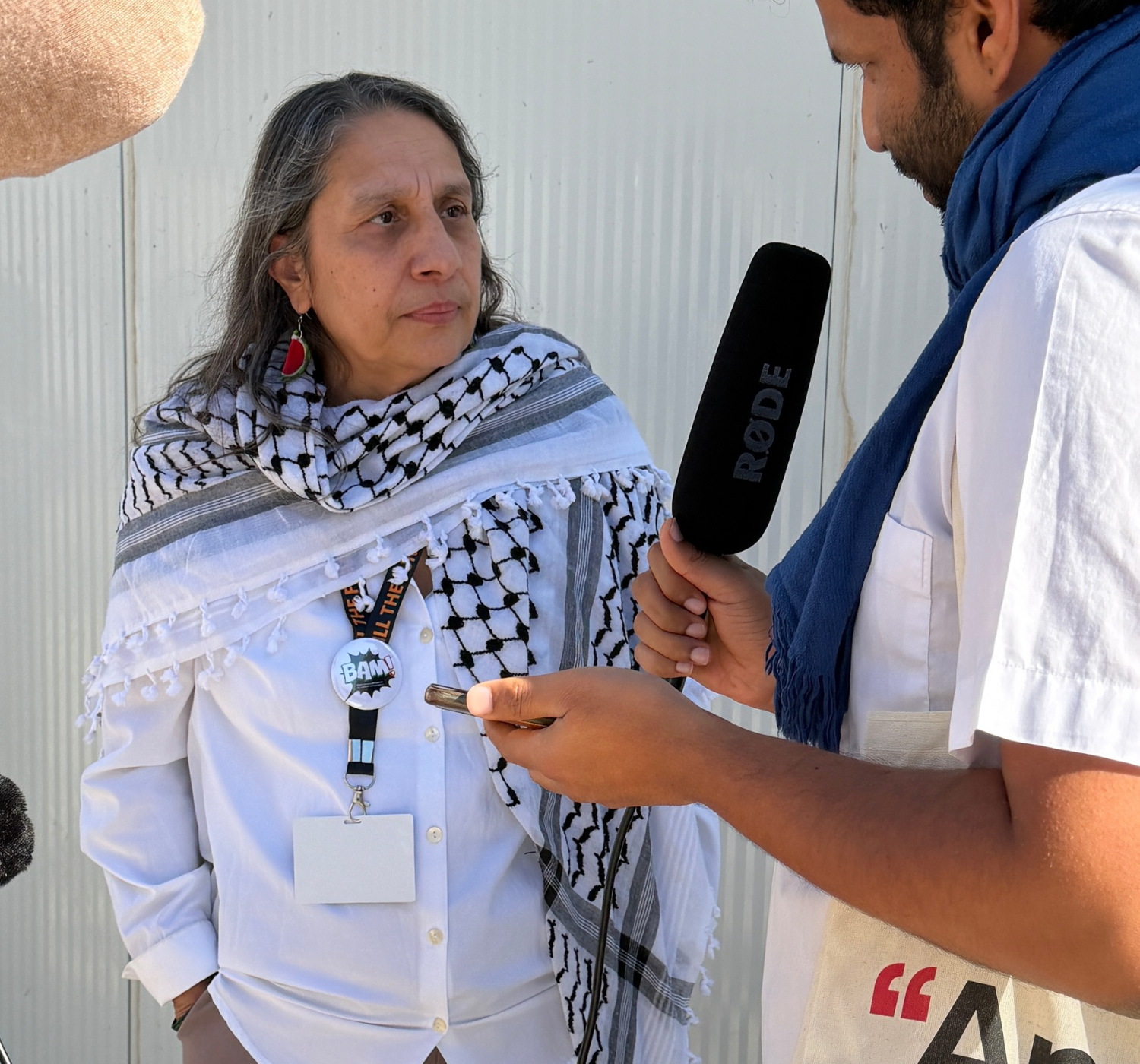
In an interview conducted by Waseem Ahmad Siddiqui with Tasneem Essop, a South African climate activist and Executive Director of Climate Action Network International (CAN International), one of the world's largest climate justice networks, we discuss the COP31 negotiations, the demands of Global South countries, climate finance, and the struggle for a just transition away from fossil fuels.
Waseem Ahmad Siddiqui: Tasneem, it was very important to hear you speak at the Climate Action Network (CAN) conference. What I want to ask you about is exactly what you were discussing: intersectionality. Given the relationship between the climate crisis, displacement, and war, how are these three issues connected? Is sufficient action being taken to address them? And is there enough collective action on this front? That's my first question.
Tasneem Essop: Yeah, look, I think one of the important tests of whether there's enough action to address massive human suffering and destruction is, of course, the fact that this world has not been able to stop a genocide, the apex crime against humanity. And this is the fourth year that we're entering into that genocide, and it's just across the sea from here.
At the same time, while the genocide is happening, they themselves are experiencing massive flooding. People are being displaced, and being displaced more than once, living in tents, experiencing heavy flooding, while there's a genocide and they're under siege. So, in one place, all of this comes together.
The fact that there's a genocide, with billions and billions being spent on that genocide by rich nations. Then we have the cumulative impact of the climate crisis. And in addition to that, the extractive resource theft by Israel. You know, very early on, Gaza's gas fields were taken by Israel. And so, in one place, all of these things come together. It's a very stark example of all of this.
But that's the story across the board. Across the board. You know, displacement is happening due to the climate crisis, but displacement is also happening due to wars and conflict. Again, the cumulative impact of the climate crisis, droughts, for example, in the Horn of Africa. There are wars and conflicts, and people are also displaced because of wars, conflict, and the climate crisis.
You cannot separate any of this. And there's one fundamental reason you cannot separate it: because the very systems driving these crises are part of the same system. Capitalism. That's it.
It's caused the climate crisis. Its extractivist model, its colonial model, has driven the climate crisis. And what we are reaping today is the result of that system. All of it. Wars, destruction, extractivism, and the climate crisis. You cannot separate them.
W.A.S.: Exactly. And I just want to add one more thing. That is, when you're talking about all of this, the point of reference is Gaza right now, and that's the reality. And it's at the very center of our world, I would say.
What I want to ask you, and this could be my last question to you, is: How do we protect this civic space for human rights defenders? You know, we know that what we have witnessed in terms of climate catastrophe has a name. It is ecocide, actually. But journalists are also dying in Gaza.
So how would you talk about this? This is not complex, but rather a multifaceted, seemingly endless point of reference: Palestine.
T.E.: I don't ever want to use the word "complex" when we talk about Palestine, right? And what Palestine has done is actually taken the masks off in the world. It's Palestine, but it's been the story of many. Palestine is the sharp edge of that system, a settler-colonial apartheid system of occupation.
And so what's happening, you know, is that those who are the big champions and voices of human rights across the world, their masks have come off. Not only because of what they're doing in Palestine and other places where they're waging wars and extracting resources, etc., but back in their own countries, protesters on the streets are getting arrested, getting beaten up by police.
And the images coming out of Germany, France, you know, the UK, where they arrest elderly people just for holding up placards. That's the story.
So the mask has come off those claiming to be human rights champions. We need to be very clear. This is what Gaza has done. Gaza has unveiled the system, and it has opened all of our eyes.
Many, many people who have taken to the streets, many who are standing in solidarity, they're doing that because Gaza has helped them actually see the raw system behind all of the suffering we're experiencing.
W.A.S.: Gaza is a central point, as you were saying, Tasneem. Thank you so much. You have given us strength, I would say. Thank you so much.
T.E.: Thank you very much.
W.A.S.: Can I ask you one extra question? How do we keep the adaptation agenda ambitious?
T.E.: Well, you know, the fight to triple adaptation finance is still ongoing. If we don't win it, negotiations will move to another track.
Tripling adaptation finance is a drop in the ocean compared to what we actually need. The UNEP report has shown us how much finance is needed, and even those estimates are conservative.
And so, if we don't win it here, the COP is coming to Africa next year. And my God, are we going to put up a fight for ambitious adaptation finance in Africa! It will happen there.
W.A.S.: Thank you, Tasneem.
T.E.: You're welcome.
Who is Tasneem Essop?
Tasneem Essop is a South African climate activist, environmental policy expert, and Executive Director of Climate Action Network International (CAN International), one of the world's largest networks of climate organizations. Essop began her activism in the anti-apartheid struggle in South Africa and has worked as a teacher, trade unionist, and politician. She has worked on global climate policy at WWF International and played an active role in United Nations climate negotiations. Her work focuses on climate justice, a just transition away from fossil fuels, energy democracy, climate finance, and the rights of countries in the Global South.