Image
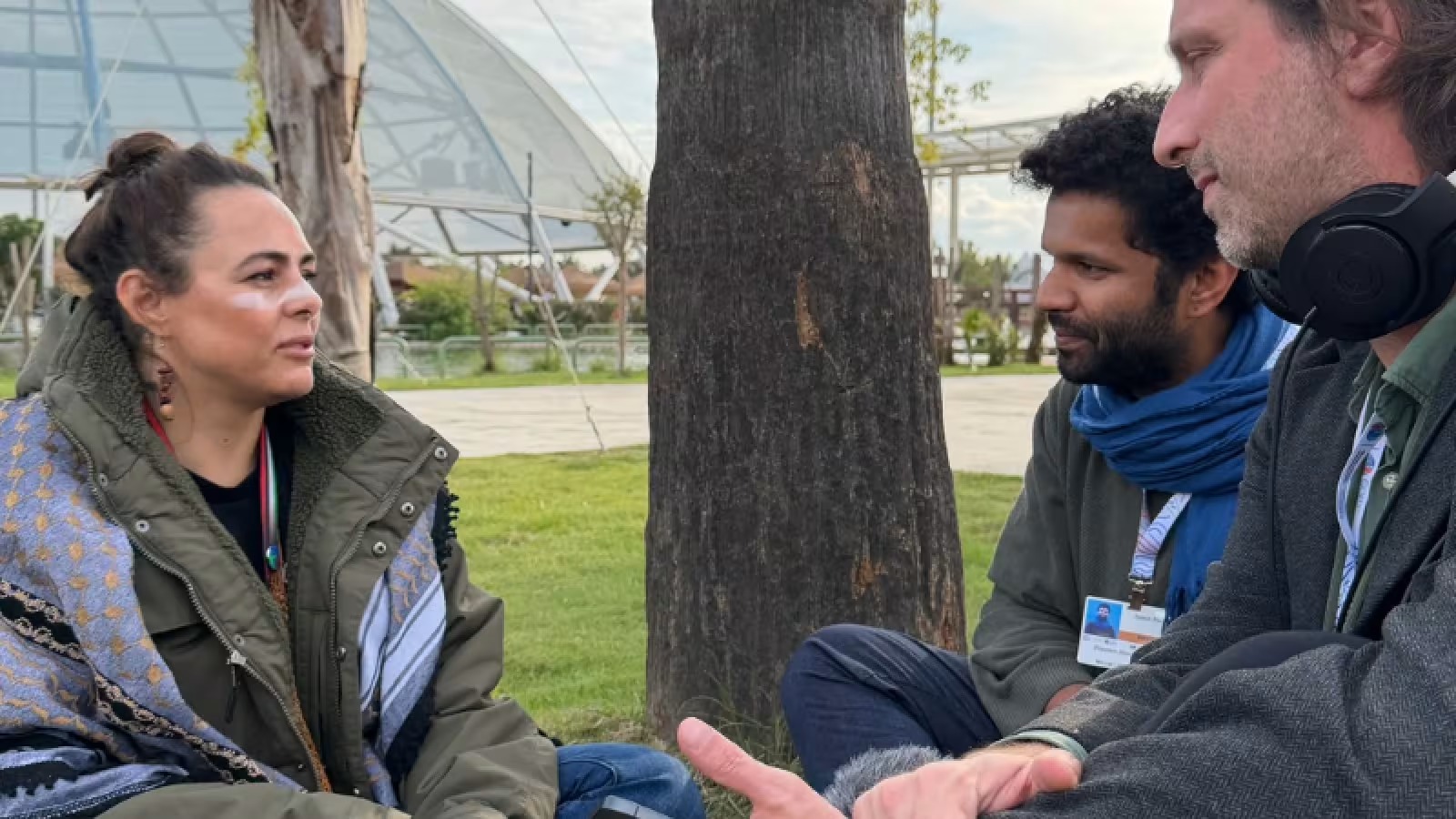
As part of COP31, we speak with Rikki Dank, a representative of the Gudanji and Wakaya peoples from Australia’s Northern Territory, about the ecological and social impacts of fossil fuel extraction and critical mineral mining on traditional lands, Indigenous peoples’ struggle for the right to have a say in and make decisions about their own lands, and the Australian government’s responsibility for the climate crisis.
Waseem Ahmad Siddiqui: Now, after Greta Thunberg and Mohammed Usrof, we have Rikki Dank with us. She was also part of the press conference titled “Frontline Communities Demand Climate Justice and Accountability,” organized by Greta Thunberg, I believe. Is that correct? Yes. So, Rikki, could you first introduce yourself and tell us about the work you do?
Rikki Dank: Yes, my name is Rikki Dank. My traditional name is Lhudi Noralima, and I'm a traditional owner from the Barkly Tablelands in the Northern Territory, Australia. My family and I have created an organization that represents our clan, and we are fighting against fracking on our country.
W.A.S.: In your statement at the press conference, you spoke about fossil fuel exports. The Australian government and the UN Human Rights Committee have acknowledged that your traditional lands are being subjected to hydraulic fracturing, which threatens water resources, sacred sites, and cultural heritage. Could you speak about fossil fuel exports and their impact on your community and land?
R.D.: Yeah, so you're right. Our country is being fracked through hydraulic fracturing, and it's being done by a company whose parent company is from the US. At the moment, they haven't laid the pipes to send the gas off-site, but what they're also talking about is sending that gas to a data center to basically power the data center outside Darwin, the capital city of the Northern Territory.
So, for us to see this gas and the way they have extracted it, knowing how detrimental the impacts will be to our country, and then knowing how that gas is being transported to other countries and the process it needs to go through to turn it back into gas, it really makes us sad and angry.
Because for us as Gudanji people, we believe that it is part of our role and responsibility to care for our country so that what happens on our country doesn't impact those outside our country.
And so, when we see that these things coming from our country are impacting other people, and that not only are we suffering but others are suffering too, this is what especially upsets us. This is what makes us fight even harder to try to shut down these operations.
W.A.S.: You also warn that the growing demand for rare earth elements and critical minerals could reproduce the environmental and social damage associated with conventional mining. Could you elaborate on that?
R.D.: Yes, you know, on my country, Gudanji country, we have a large zinc mine, I think one of Australia's largest zinc mines. We also have a diamond mine. And we're seeing all these other mines being opened up right across the Northern Territory on Aboriginal land, particularly for rare earth elements and critical minerals.
And we see that it's the same story all over again. We see the same things happening to Indigenous peoples, the same illnesses, the same ecological impacts. It's the same story playing out again.
These things aren't helping anyone. They might help people down the line, but they're still causing problems for local communities. They're still impacting the climate.
W.A.S.: İlksen had another question. Perhaps you can ask the second question.
İ.M.: Yeah, of course. Well, you told Prime Minister Albanese to stop speaking and start listening. But what would genuine listening actually mean? Is consultation enough, or should Indigenous communities have the power to say no to projects on their traditional lands?
R.D.: Historically, Indigenous people, particularly Indigenous women, have been sidelined. We haven't been given the space to speak out about our lands and our homelands because we simply haven't been allowed to. Historically, violence has been used against us.
We've always had a voice, but the Australian government has always refused to listen to us. So today was a chance for my family to voice our concerns.
When you saw me up there today, it wasn't just me. As I said, my grandmother, my clan members, my country, my daughter and my niece were all there with me. I don't just represent myself. I represent a lot of people, and I carry those people with me.
So when we have these opportunities, we stand up and say no to governments. For us, that's the first step towards making them at least recognize that we are in these spaces and acknowledge that we are here. And then we want everyone else to see us and recognize the fact that we are saying no.
İ.M.: You're also taking the Australian government to the UN Human Rights Committee over its fossil fuel exports. How does this case challenge the way governments understand their responsibility for climate change, especially when the fuels they export are burned elsewhere?
R.D.: You know, for us, we believe that the Australian government has not been taking climate change seriously for far too long. And for too long, I've seen politicians, particularly in the Northern Territory, changing laws and creating opportunities for gas companies, then leaving politics and walking straight into jobs with those same companies.
We need to start holding them accountable because they continue to get away with pocketing money from these gas companies, allowing them into politics and letting them influence decisions that affect everyday Australians. And it's everyday Australians who are suffering.
And so this is why we believe that we can no longer continue to trust our governments to act responsibly. As community members, we have to stand up for our communities and actually put a stop to this.
That's why I'm part of this case. I want the Australian government to be held accountable for the decisions it has made. And I firmly believe that we need to start changing laws in Australia so that politicians cannot change laws to create opportunities and jobs for these big oil, gas and coal companies, only to then leave politics and take jobs with those same companies.
So I guess, for me, being part of this court case is about making sure that we do our job as a community and look after our community.
W.A.S.: Rikki Dank, Gudanji and Wakaya traditional owner from Australia's Northern Territory. Thank you so much.
R.D.: Thank you so much for having me. And I just want to say thank you to your listeners. It has been a pleasure. Thank you for welcoming us to your beautiful country.
We have such a long history with the people of Türkiye. We came to your country many years ago, and there was a war, and a lot of Australians died here on these shores. And the thing that touches our hearts is that you've cared for our soldiers as if they were your own sons. We appreciate that, and we carry that with us.
So thank you, and thank you for caring for us while we are here in Türkiye.
İ.M.: Thank you.
W.A.S.: Thank you.
Who is Rikki Dank? Rikki Dank is a representative of the Gudanji and Wakaya Indigenous peoples of Australia’s Northern Territory and an environmental and climate justice activist. Known by her traditional name, Lhudi Noralima, Dank campaigns against natural gas extraction through hydraulic fracturing (fracking) and the ecological destruction caused by mining on her ancestral lands. She advocates for Indigenous peoples’ land rights and demands that the Australian government be held accountable for its fossil fuel exports.
COP31'de neler konuşuluyor, hangi kararlar alınıyor? Resmî müzakerelerden alternatif zirvelere, iklim hareketinin seslerinden gezegenin geleceğini belirleyecek tartışmalara, Antalya'dan gelişmeleri COP31 Özel Yayını'nda takip ediyoruz.