Image
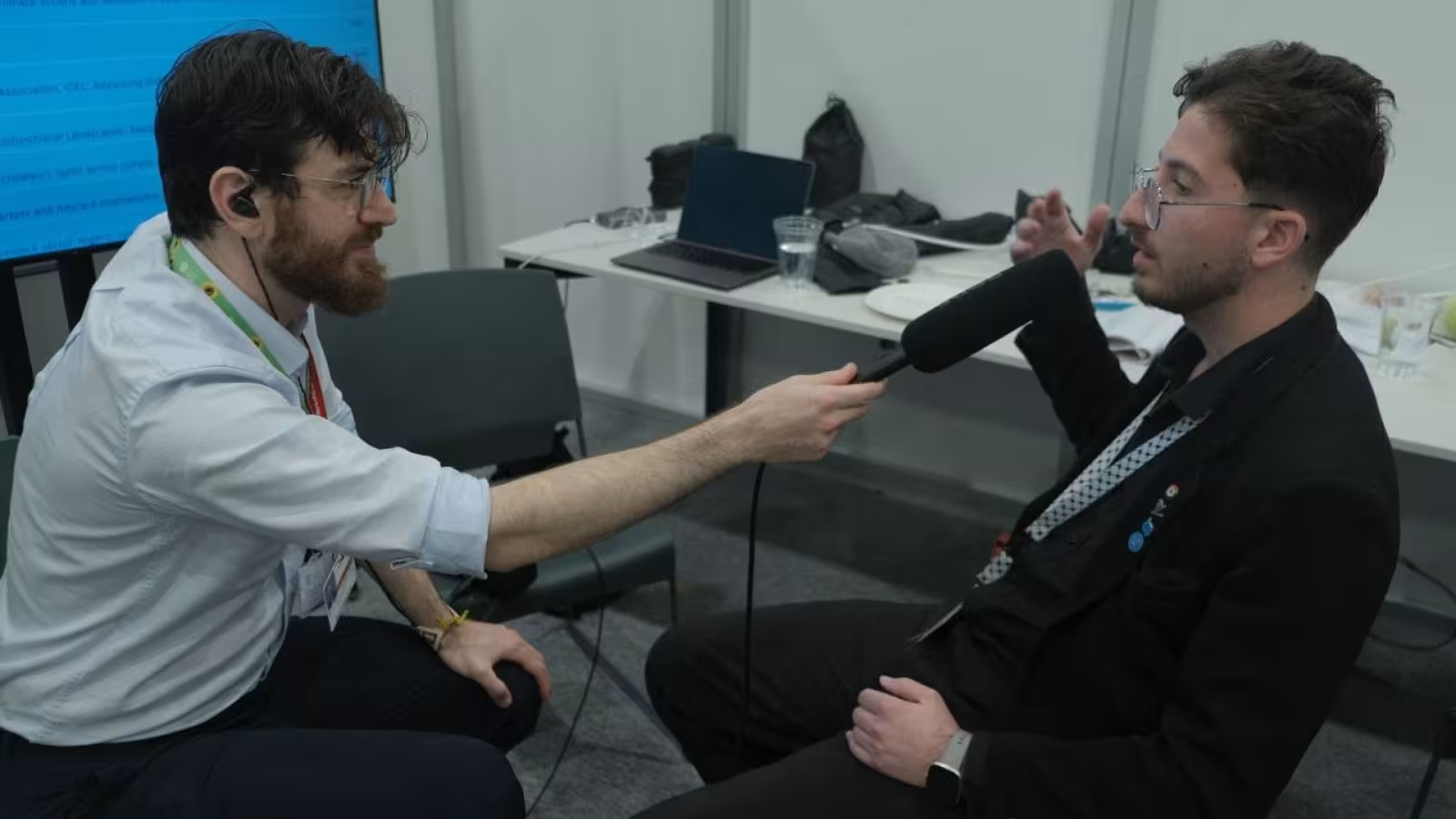
As part of COP31, we speak with Jordanian-Palestinian environmental activist Omar Yassin about the humanitarian and ecological devastation in Gaza exacerbated by war and the climate crisis, the water crisis in Jordan and the West Bank, the use of water as a tool of political coercion, ecocide in Palestine, and the importance of international solidarity in defending life.
Eren İleri: Hello. Can you start by introducing yourself—your name, where you're from, and what you do?
Omar Yassin: I'm Omar Yassin. I'm originally from Jordan, and my family came from Palestine. I'm an environmental activist, mainly focusing on the water crisis because of the situation in Jordan and the surrounding region. I completed my bachelor's degree in geology, applied geology, and environmental sciences, and I'm working toward my master's degree in water diplomacy to help address the challenges we face in Jordan.
I founded an initiative called Sapling, which focuses on bringing people together to work on environmental and climate issues. We had a lot of initiatives, but they weren't working together as one entity or group aiming to support each other. So that's a brief introduction to who I am.
E.İ.: So you're an activist, a coalition builder, and a scientist?
O.Y.: You could say that, but it's not as humble as it sounds.
E.İ.: Thank you so much for being here, Omar. You talked about the water crisis. We've seen harrowing footage coming out of Gaza over the past week of heavy rains and flooding. Have you been following the situation? Can you tell us a bit more about what's been happening?
O.Y.: Yeah, so the situation there is frightening, to say the least, because on the one hand, you see destroyed infrastructure. There is no sewage system to drain the water away. There is no strong infrastructure to withstand the harsh weather. And on the other hand, you have climate change, which causes intense rainfall and flash floods. So the rain comes with high intensity over a very short period, causing flash floods that can hurt people.
These factors combined are creating a horrific scene in Gaza because you see people running for their lives, but they have nowhere to hide. The tents that are supposed to shelter them are collapsing on their heads. Even people living in houses, and there are very few of them, face leaks due to the bombing. There is no safe haven in Gaza.
So both the bombing and the destruction of infrastructure, as well as climate change, are playing a huge role in destroying the livelihoods of innocent Palestinians who just want to live.
It's frightening to imagine what happens to them and to compare their lives to ours, where you can simply open an umbrella or take shelter in your house. They have nowhere to hide. Their belongings could be washed away, their clothes could be soaked, and their bodies could suffer from exposure to the harsh weather. It's very frightening and scary.
E.İ.: Thank you for sharing. I imagine that's hard to talk about as a Palestinian.
O.Y.: Yeah, it's very hard because, first and foremost, we're human. When you see a fellow human being hurt, it's very hard, especially when they speak like you, talk like you, have weddings like you, dance like you, and sing like you. It's very touching. And I find it very strange that some people still don't see the atrocities happening there.
E.İ.: You talked about the water crisis, and we know that water is used as a tool of control, from building dams and controlling water usage rights to, as we're seeing in Europe and America, the creation of mega-basins and mega-reservoirs to pump groundwater and privatize it for big corporations. How has the water crisis been affecting Jordan?
O.Y.: Jordan, as we all know, ranks among the most water-scarce countries in the world. Recently, due to the geopolitical situation with Israel, they cut off some of the water we were receiving under an agreement with them. They also moved into southern Syria, where the Yarmouk River provides Jordan with water, and there is a risk of contamination in that area, which is very concerning.
Jordan is currently projected to have about half the amount of water we have now, around 60 cubic meters per person per year, which is far below the water scarcity threshold of 500 cubic meters. So the situation is getting worse.
But we can also link Jordan to the West Bank and talk about what's happening there, because you can't separate the two. Both receive water from the same sources, and both are being denied access to water by the same actor, Israel.
In the West Bank, besides being forbidden from taking water from the Jordan River, it's also very difficult for Palestinians to build wells. Some wells are closed so that water can be pumped into illegal settlements. So you have water, but you can't access it because the occupation doesn't allow you to. Most of the water from springs and wells is pumped into settlements surrounding Palestinian communities.
And from the West Bank, we can move to Gaza, where, as we know, there is no functioning infrastructure. Clean water is barely available because of the current situation and the destruction of infrastructure. They can't desalinate water. Rainwater is contaminated because it mixes with sewage. And even when people find water, it's very difficult to obtain because demand is so high.
So the same actor is harming multiple places simultaneously, using different tools, and using water to pressure other countries. For example, in Jordan's case, the water agreement was broken after Jordan declared that annexing the West Bank would be considered an act of war against Jordan. So water was used as a tool to pressure Jordan into accepting Palestinian refugees who had been forced out of their homes.
We could talk about this for hours. It's not a complex concept, but it's a very big issue. Essentially, you have an actor using the necessities of life to pressure and harm other people, and you have victims struggling to maintain their livelihoods and live normal lives.
E.İ.: Thank you. The social scientist and movement theorist Andreas Malm says that the destruction of Palestine is the destruction of the Earth. We've heard a bit about how war, genocide, and militarism harm water resources. But can you elaborate on how this genocide has also been an ecocide?
O.Y.: Recently, I've seen figures showing how many olive trees have been destroyed over the past year. There were over a million olive trees. So you have a huge number of trees being destroyed. They produce fruit, they produce oxygen, and they provide livelihoods for the people around them. And when you remove trees from the equation, ecosystems are destroyed. You have desertification, and you have land that becomes uninhabitable unless you bring in resources from elsewhere, which isn't an option for many villages.
But the destruction goes beyond destroying trees and settlers violating Palestinian farmland. We can also see it in Lebanon, where a turtle conservation area was destroyed. It was bombed by Israel. So they don't care whether you're a human being, a tree, or any other form of life. Any sign of life is a threat to them. If you celebrate, it's a threat to them. If you plant something, it's a threat to them because they don't want life in that area.
With advances in technology, you see powerful weapons being supplied to Israel by companies like Lockheed Martin and many others, supported by numerous people and countries. You see destruction on a scale that humanity has never seen before, that the Earth has never seen before.
When you look at an area the size of Gaza, you can search for aerial footage and see the difference between before and after the war. Most of the greenery is gone. Most of the life is gone. There used to be life, trees, ecosystems, and animals. They've been destroyed.
And if we allow this to happen in one place, it will spread to other places. As they say, injustice anywhere is a threat to justice everywhere. So if we allow Gaza to be completely destroyed and erased by Israel, I think the same thing could happen anywhere. We've seen it in Ukraine, and we've seen it in many other places where war is destroying everything.
And the Earth is life. When you talk about the Earth, you're not just talking about rocks. You're talking about how they interact with other elements of the Earth to produce life, plants, and the conditions that sustain livelihoods.
So when we talk about destroying livelihoods and eliminating living things in one place, that threatens life elsewhere as well. We see this with deforestation. If one forest is destroyed, they'll move on to the next.
And the mindset of the Israeli government is to expand. So if they finish with Gaza and the West Bank, they'll expand into Syria, Jordan, Lebanon, and maybe Egypt. No place is safe when one place is not safe.
E.İ.: Do you have a message for our listeners in Turkey and around the world?
O.Y.: My message is to stay strong, support the cause, and plant more trees. For every tree destroyed in Gaza, another tree should be planted somewhere else. For every life lost in Gaza, another life should be saved somewhere else.
You should stop funding the companies that are destroying people's lives. It's very easy to access information about these companies, and it's not hard to stop supporting them. Pressure your governments to stop supporting Israel and other forces that are destroying the planet and people's livelihoods.
And most importantly, remember the people who died. Remember the families who were torn apart. They are not just numbers. They are people with names. They had names. Their lives were taken by machines, by heartless monsters.
These are not just numbers in some faraway land. This could happen to anyone else in the next few years.
E.İ.: Thank you so much for being here. Thank you so much for fighting for both our Earth and Palestine. We stand with you.
O.Y.: Thank you so much.
Who is Omar Yassin? Omar Yassin is a Jordanian environmental and climate justice activist of Palestinian descent. He studied geology and environmental sciences. Through Sapling, an initiative he founded, he aims to strengthen solidarity among environmental organizations. His work focuses particularly on the water crisis, the right to access water, and ecological destruction in Jordan and Palestine.
COP31'de neler konuşuluyor, hangi kararlar alınıyor? Resmî müzakerelerden alternatif zirvelere, iklim hareketinin seslerinden gezegenin geleceğini belirleyecek tartışmalara, Antalya'dan gelişmeleri COP31 Özel Yayını'nda takip ediyoruz.