Image
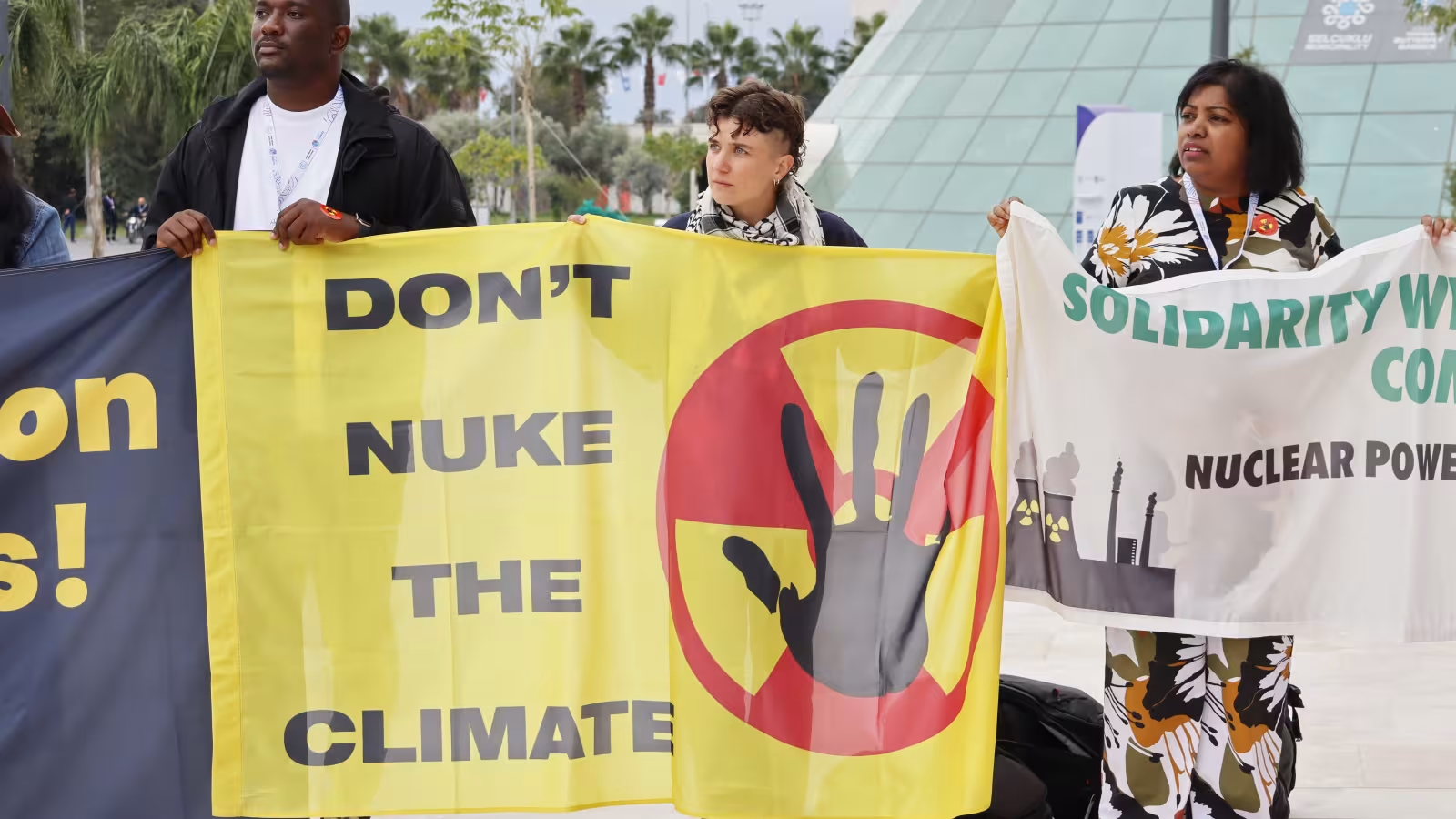
In the COP31 Climate Special Broadcast, Eren İleri speaks with Lise Masson of Friends of the Earth International about a feminist and just energy transition, climate colonialism, false climate solutions, the role of militarism in the climate crisis, and the Global North’s responsibility for climate finance.
Eren İleri: Could you start by introducing yourself and telling us about the work you do?
Lise Masson: My name is Lise Masson, and I'm the International Program Coordinator for Climate Justice and Energy at Friends of the Earth International.
Friends of the Earth International is a federation of over 70 member groups around the world, spanning all continents. We work on issues of climate justice and energy, economic justice, forests and biodiversity, and food sovereignty.
Our member groups are deeply rooted in grassroots movements. At the international level, we work closely with and within the federation to bring our demands for systemic change to the global stage.
E.İ.: You've mentioned two very important concepts that we've been discussing a lot today: climate justice and system change. Could you explain to our listeners what these concepts mean to you?
L.M.: For us, climate justice and system change are closely connected. I think it's really important, especially in spaces like this, such as the COP, to be very clear about what we mean when we demand climate action.
For example, when we talk about energy, we demand an end to fossil fuels. But when we talk about a just transition, we're not simply talking about switching from one energy source to another. We're not just talking about replacing fossil fuels with renewable energy.
We're talking about making that transition in a way that brings us closer to system change, that helps us dismantle the systems that oppress people. We're talking about capitalism, racism, patriarchy, and all these systems that put people on the front lines of injustice.
Our actions need to help dismantle these systems and achieve our vision of system change: systems that genuinely put people's needs front and center.
That's why, returning to the example of energy, we demand a feminist and just energy transition. It's not simply about switching from fossil fuels to renewables. It's also about building economies of care, recognizing care work, and ensuring decent and dignified jobs for everyone.
It's about making sure we don't create new sacrifice zones through the extraction of critical minerals for renewable energy technologies, simply to fuel luxury consumption in the Global North.
All these principles are essential to ensuring that climate action goes beyond simply reducing emissions. We need to take action in a way that brings us closer to achieving climate justice.
E.İ.: You actually got to my second question before I could even ask it. What does a feminist transition look like? You mentioned care economies. How does the climate crisis intersect with patriarchy, and how does it affect women differently?
L.M.: I think there are two aspects to this. The first is how the climate crisis affects women, particularly the intersections between climate impacts, climate injustice, and patriarchy.
We can see these intersections in very practical ways. For example, because women carry a disproportionate burden of care work, they are more severely affected by the climate crisis. Take the responsibility of collecting water for households. As water becomes scarcer, the daily journey to collect it becomes increasingly difficult. That's a very real, practical impact.
Women are also among those most severely affected by climate disasters. Women and queer people often face greater difficulties accessing shelter, support, and care during these disasters. All these impacts demonstrate how patriarchy intersects with climate vulnerability.
But our demand for a feminist and just energy transition goes beyond addressing these impacts. It's also about recognizing that feminism is essential to our vision of a just transition and to achieving system change.
A transition cannot be just if it doesn't address the burden of care work or provide decent, dignified, unionized jobs for everyone. It cannot be just if it fails to meet people's energy needs or establish economies of care.
And it certainly cannot be a just transition if it reproduces extractivism by creating new sacrifice zones for mining critical minerals simply to satisfy consumption in the Global North, ultimately perpetuating the same systems of colonialism.
So feminism can serve as a guiding principle in implementing a truly just energy transition.
E.İ.: Thank you so much. You mentioned the extraction of critical minerals, which is often presented as necessary for the energy transition. But that narrative seems almost mythical. Could you expand a little on what we mean by climate colonialism or extractivism in the name of decarbonization? What narratives are used to justify it, and how are we challenging them?
L.M.: I think this is where the distinction between climate action and climate justice really comes into play, particularly when we talk about what we call false climate solutions.
When we talk about climate justice, we're very clear about what genuine solutions should look like. We've just discussed the example of a feminist and just energy transition.
But when we look at what major polluters and Global North governments present as climate action and climate solutions, we see things like carbon markets and offsets, large-scale renewable energy projects designed to power AI and data centres, and a target of 35% electrification by 2035 without any climate finance to support it.
These are the so-called solutions being promoted by the Global North and major polluters. They're rooted in neocolonialism because they reproduce the same systems of exploitation, extractivism, and resource plunder in the Global South.
Take carbon markets, for example. First of all, the very idea that we can continue polluting and emitting greenhouse gases, and somehow simply buy our way out of those emissions by investing a few million dollars in a project, is completely absurd.
But we also need to examine what those projects actually involve. For example, a carbon offset project might consist of a monoculture plantation somewhere in the Global South.
And when you look at how these projects are implemented, you find that many carbon offset projects are associated with land grabbing, violations of Indigenous peoples' rights and human rights, and the displacement of local communities from their territories. In some cases, communities are even prevented from accessing their own lands.
All these projects perpetuate a system of neocolonialism that treats the Global South as an inexhaustible source of resources to be extracted and plundered for the continued development of the Global North.
E.İ.: Thank you. It's very concerning that these false solutions are taking up so much space in high-level multilateral discussions.
At the same time, we have federations like Friends of the Earth International, coalitions like Demand Climate Justice, and networks like Climate Action Network (CAN), which bring together civil society organizations and movements from around the world.
Do you think this kind of alter-globalization movement building and transnational solidarity can serve as an antidote to the false solutions we're hearing about here?
L.M.: I think movement building is absolutely essential to achieving climate justice and reclaiming our power. The multiple crises we're facing require us to come together across different movements, including climate justice movements, feminist movements, and food sovereignty movements, to demand a fundamental transformation of our systems.
And we need to unite not only across different issues but also across borders. Because the impacts our communities are experiencing, confronting, and resisting are global and interconnected.
The solutions, therefore, depend on our movements' ability to come together and develop a shared, collective political agenda that can genuinely challenge and dismantle the power of transnational corporations and Global North governments, and return that power to the people.
Because, at the end of the day, it's the people who have the solutions.
E.İ.: Thank you so much. While all of this is happening, we're witnessing a rise in authoritarianism, a new arms race, proliferating wars, and massive human rights violations.
The military-industrial complex has a threefold impact on the climate: through its greenhouse gas emissions, the environmental destruction caused by military activities and warfare, and the diversion of financial resources that could otherwise be invested in climate action and other essential needs.
Could you elaborate on the costs of militarism and how it's affecting our world?
L.M.: For us at Friends of the Earth International, it's really important to put things into perspective. One of the core values that guides our organizing and our vision is internationalist solidarity: coming together and standing in solidarity with one another.
Of course, for us, that also means recognizing that there can be no climate justice without Palestinian liberation, and that there can be no climate justice as long as imperialist powers continue to wage wars in the name of profit.
The COP is an important space for making these connections and putting things into perspective.
We believe that the only way to achieve progress in the halls of this COP, and to move towards climate justice, is for Global North governments to take responsibility for their historical emissions and acknowledge the climate debt they owe to the Global South.
This is not charity. They owe a climate debt to the Global South, and they must deliver climate finance.
We constantly hear Global North governments coming to these COPs and calling for greater ambition. But that ambition cannot be achieved as long as they continue to systematically block progress on delivering climate finance.
For 30 years now, we've heard wealthy governments claim that they cannot provide the necessary climate finance because they simply don't have the money.
That narrative has intensified in recent years. These governments use the same argument both here at the COP and back home, telling their own populations that there isn't enough money for public services or to guarantee everyone a dignified life and access to education, healthcare, food, and energy.
But if you look beyond these smokescreens, you'll see that global military spending has now reached $2.9 trillion a year.
That's an enormous amount of money. That alone could cover a substantial share of the climate finance needed to support greater ambition, adaptation, loss and damage, mitigation, and a just transition.
The money is there.
What we're witnessing is a political choice by Global North governments to direct trillions of dollars towards military spending, to wage wars, and to be complicit in what we describe as genocide in Palestine.
And then these same governments come back to the international stage and claim that they have no money to repay their climate debt. They return home and tell their own people that there's no money for public services.
So I think we need to be absolutely clear: the money exists.
It's not a question of identifying solutions or figuring out where to find the money. It's a question of political will and the choices that Global North governments are making.
E.İ.: Is there anything else you'd like to share with our listeners in Turkey, the audience of Apaçık Radyo?
L.M.: I think we've just touched on the issue of militarism, and we've both acknowledged the reality that we've been witnessing what we describe as a genocide unfolding in Palestine for several years now.
I find it quite interesting that, in spaces like this, we're often asked: Why do you bring up Palestine here? What does Palestine have to do with climate change, or even with climate justice?
I think this shows how important it is to make the connections between these issues and help people understand that climate justice is deeply rooted in, and dependent on, Palestinian liberation.
We've just discussed the cost of military spending, but these issues are connected in so many other ways.
First and foremost, it's a question of justice: whose lives are considered disposable? But it's also about identifying those responsible.
When we look at major transnational corporations, we see that the same corporations that have fueled the climate crisis for decades, and profited from it, are also involved in fueling what we describe as the genocide in Palestine.
At Friends of the Earth International, we've just published a briefing highlighting these connections, focusing on Chevron as one example.
Chevron is not only a company that has known about climate change and its devastating impacts on communities for decades and chosen to ignore them. It's also a company that has wreaked havoc in Ecuador, devastated entire ecosystems in the Amazon, and taken legal action against the Ecuadorian government for daring to stand up to it, while intimidating and threatening local communities.
Chevron is also the largest supplier of fossil fuels to Israel. So, from our perspective, the company is not only fueling the genocide in Palestine but also profiting from it.
We need to be very clear that there are numerous connections between the injustices of the genocide in Palestine and those caused by the climate crisis.
And identifying those responsible is key to understanding these connections.
If we dismantle corporate power and the structures responsible for these injustices, we can achieve system change and justice, both for communities on the front lines of the climate crisis and for the Palestinian people.
E.İ.: And one final question: What are your specific demands beyond climate justice and system change?
L.M.: Oh, we have many demands. But I would say that, in the context of this COP, there are a few key priorities.
First and foremost, we demand the delivery of climate finance. We've already talked about this extensively. Climate finance is essential across all areas, including mitigation, adaptation, loss and damage, and a just transition.
The Global North needs to repay its climate debt. And when we talk about climate finance, we mean public finance, not loans. We don't mean carbon markets. Don't try to sell us carbon markets as climate finance.
We demand that climate finance be delivered in accordance with countries' fair shares of responsibility.
We also demand that no space be given to false climate solutions, whether in the form of nuclear energy, hydrogen, or carbon dioxide removal, which we're increasingly seeing promoted at COP.
There is no substitute for reducing emissions. Carbon dioxide removal technologies are unproven at the scale required, extremely costly, and pose risks to our communities. So our message is clear: no false solutions.
We also demand justice for Palestinians and the dismantling of imperialism and the forces that wage wars around the world.
Another key set of demands concerns the just energy transition and the dangers associated with the kind of transition being promoted by corporate interests.
In the context of this COP, we particularly want to ensure that electrification targets are properly defined and qualified.
We cannot allow electrification to become yet another target imposed on the Global South without the necessary financing. We cannot allow it to open the door to nuclear energy or continued fossil fuel use.
Nor can we allow electrification to be used to justify luxury consumption, the expansion of electric vehicles, or the growing energy demands of AI data centres at the expense of meeting people's fundamental right to energy.
Ultimately, we're demanding climate justice. We're demanding that climate action serve people's needs, not corporate profits.
E.İ.: Ambitious demands, but nothing beyond what is necessary and sufficient. Thank you so much for joining us here on Apaçık Radyo. I wish you a productive COP, and thank you for coming to Turkey.
L.M.: Thank you very much.
Who is Lise Masson? Lise Masson is an environmental activist and researcher who serves as the International Programme Coordinator for Climate Justice and Energy at Friends of the Earth International. Her work focuses on opposing carbon markets and false climate solutions, advancing a feminist and just energy transition, and exploring the links between climate justice and Palestinian liberation. She is the author of the organization’s 2023 report, Opposing Carbon Markets.