Image
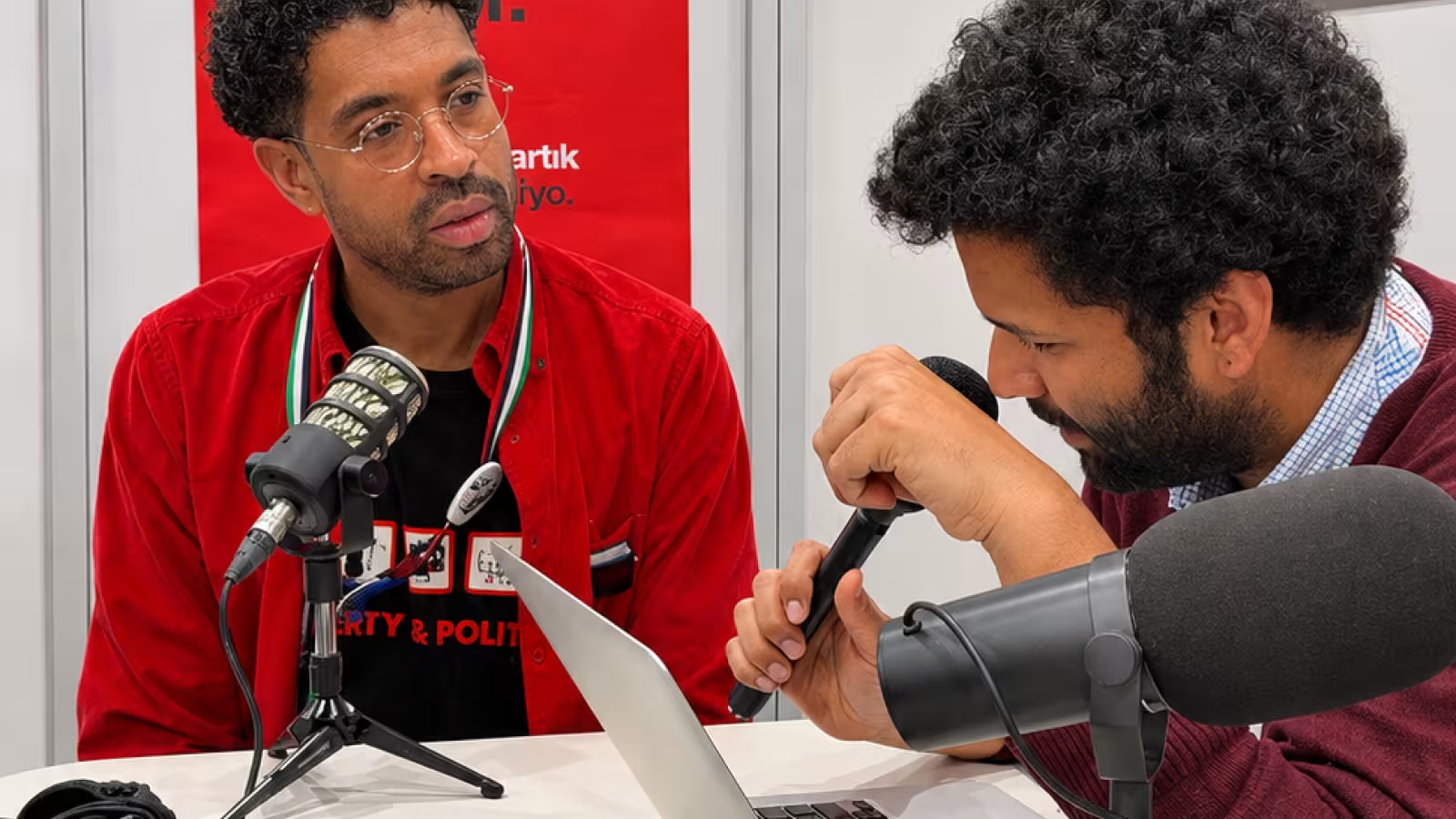
As part of COP31, we speak with climate justice activist and academic Leon Sealey-Huggins about the relationship between the climate crisis and structural racism, the historical legacy of colonialism, the struggle for a just transition, and the responsibilities of Global North countries regarding climate finance.
Eren İleri: Before we start what's your full name?
Leon Sealey-Huggins: I'm Leon Sealey-Huggins.
E.İ.: Welcome to Apaçık Radyo, Leon Ioseley-Huggins. Could you please introduce yourself and tell us about the work you do?
L.S.H.: Yeah, thank you. Thank you so much for inviting me to have this conversation. I'm a climate justice activist, organizer, campaigner, and scholar. My job title at War on Want is Senior Campaigner in Global Climate Justice and Just Transition, and I've been working on climate justice for the past 20 years.
At War on Want, I lead our work on just, equitable, and ecological transitions, which we call the Global Green New Deal. We have a systems-change focus, recognizing that the response to climate breakdown needs to be about more than just reducing fossil fuels and emissions, although that's obviously a key part of it.
It's also about providing the justice package, the redistributive elements, and addressing historical harms and injustices that would make support for climate action more popular.
So, yeah, that's essentially my role at the organization. I lead our advocacy in the COP space, and domestically, we're pushing for a just transition as well.
E.İ.: And how do we repair the harm that's been done?
L.S.H.: Yeah, I mean, there's a lot of harm that's been done historically. Trillions stolen from India when it was a colony. Millions of enslaved Africans trafficked and killed in what's known as the Maangamizi, which is another word for Holocaust, when they were trafficked from Africa through the Middle Passage and taken to the Caribbean and the Americas.
And those are just two examples. You can add the instances of colonial violence in Ireland or the domestic violence against the working classes and peasant populations of the British Isles. All of those harms are what need to be repaired.
So, given the scale of the harm, I think the only thing that can match that scale in terms of repair is to remake society, to fully transform the existing relationships between people, because only that can match the scale of the harm that's been caused.
So what do I mean when I say that? Well, firstly, it's redistributive. It's about ensuring that the wealth and resources that are currently hoarded and controlled by a tiny, tiny fraction of the world's population are distributed equitably.
Everybody has the right to a dignified life, to happiness, to freedom from concerns such as hunger, pain and suffering, freedom from arbitrary violence, and so on. All of those things, those relationships, are part of reparations, of reparative justice.
Rebuilding societies along the lines of care and repair. Properly valuing the care work that enables societies to function. People looking after each other, people providing food and comfort for each other. This is all part of the repair that needs to happen.
So it's a transformation. It's a full systems overhaul and reset that's required to undo the centuries of harm and the ongoing harm that persists.
E.İ.: And how do we build a mass movement around this? Is it through mutual aid? Is it through mobilizing? And what's the pitch when you go to people and say, "Join this movement"?
L.S.H.: Yeah, I mean, if I had the easy answer to that, we wouldn't be sitting here. We'd already be in that transformed society. So I'm not going to pretend that I have an answer or a model that works.
And I think one of the beauties of the movements that we're part of is that we have a diversity of tactics. We have to, by necessity, experiment with different organizational forms, different ways of convening and attempting to shift power. And in different contexts, it means different things. You know, I have certain freedoms in the UK that perhaps you don't have here. So your organizing context is going to be very different from mine.
Having said all of that, I think there's one principle that gives me a lot of hope, and that principle is that most people want to be free. Most people want dignity. I don't know that there are many, if any, people who enjoy being on the wrong end of inequality, not having power over their lives, or not having the power to make choices about the things that affect them.
So I think there's an instinct, an innate human instinct towards justice in that sense, that people want to be free. And I think what happens is that that instinct gets manipulated and twisted. People are fed a lot of lies based on fear, and they're told that if they don't support this unequal, hierarchical system, they're going to suffer and lose out.
So when they're told that lie, they become more susceptible to advocating for models of economy and society that are extremely unequal. But if and when we're able to convey that message of equality, justice, and dignity for all, I think most people are behind it because they don't like to see each other suffering either.
You know, another innate human trait is empathy, the capacity for empathy. And again, when we're not acting from a place of fear, when we're acting from a place of love and empathy, I think most people are incredibly receptive to the idea that we need to remake society and that, in fact, most of us, all of us, would benefit.
And not to shed a tear for those who are subjugating us, but even they suffer from this current system. They're incredibly afraid. They have a twisted and warped view of human nature. You think about people like Elon Musk and Peter Thiel. Their view and model of humanity is so twisted and degraded that they genuinely want to advance and accelerate towards some kind of post-human world because they think humans are so bad. That's their suffering. It's a form of suffering that they think that's a good model.
You know, Fanon talks about this, how the oppressor is also warped through the relationship between the oppressor and the oppressed.
That's not to say, again, to reiterate, that we should feel sorry for these people. Absolutely not. But it is to say that they too stand to gain from a vision and understanding of a world, and from enacting a world, that has equality, justice, and repair at its heart.
E.İ.: And how do we take this out of the sphere of the individual and bring it into the sphere of the community?
L.S.H.: Yeah, I mean, that's a really important question. It's an essential question here in the context of COP31, right? Because for the longest time, it took so much effort and organizing to get climate activists and environmental activists to take on board and share the message and understanding that this isn't about individual behavior.
And even still, people are so well trained as neoliberal subjects that they think it's all about not using a plastic straw or a plastic water bottle, not taking a flight, or not taking some other individual action.
I think people increasingly understand and recognize, because of the way in which the system is failing them, that this is a systemic failure, that these issues are above and beyond the level of the individual.
That's not to say that, as individuals, we don't try to lead ethical, good lives whose politics we can defend. But nevertheless, I think people recognize that you're not going to get very far on that track alone if you only think about your individual actions.
So I think because so many of the effects that people are experiencing are connected and systemic, when people experience them, and I think it is often experience rather than explanation that helps to shift people's minds, they begin to realize: "Oh, actually, I can't access healthcare, and at the same time, my government's spending money on wars and the military. Oh, and I don't have the rights that I used to have."
They can see that these things are all connected, and they realize that changing something in their individual lives is not going to affect those systemic issues. What they have to do is come together with other people and organize for the systemic change that's required.
Waseem Ahmad Siddiqui: I want to come to the issue you've already spoken about: fear and organization on the one hand, and dignity, empathy, and love for all on the other.
I believe you address this in the chapter you wrote, "The Climate Crisis Is a Racist Crisis: Structural Racism, Inequality, and Climate Change," published in 2018 by Z Books. It's a very powerful chapter.
You write, and I quote: "This chapter began life as a memorial to the death of someone whose work must be remembered for its tireless contribution to the pursuit of justice. His name is Deyika Nzeribe." Perhaps you could pronounce his name correctly.
Could you speak about him and about this chapter, which I found extremely important?
L.S.H.: Yeah, thank you very much. Deyika was someone I never got to meet, but we had a lot of mutual friends, and he unfortunately died very prematurely, at a young age, in his 50s, I think.
But he was a figure who was very prominent in so many different movements in the UK. He lived predominantly in Manchester, but his reach, engagement, and activism were much broader.
He was very involved in the radical wing of the Green Party in Manchester, but he also set up the Northern Police Monitoring Project, an organization that scrutinizes abuses of power by the police as an institution.
He was one of the very early pioneers of this kind of conjunctural analysis of racism, systemic racism, state violence, and environmental crisis and harm, including environmental racism and climate breakdown.
So he was a real thought leader and a leader in his organizing as well, bringing together these different threads.
Now, you know, we stand on the shoulders of giants. So it's much easier for me to make the case that the climate crisis is a racist crisis because of the work of people like Deyika, who were making that case when they would get shouted down, or environmentalists would say, "No, it's too important that we address the climate crisis to talk about racism. Don't complicate it by bringing in irrelevant issues."
In the piece, I think I try—and again, I'm drawing on the work of other groups and activists such as Black Lives Matter UK, who, in 2015, I think, don't quote me on the date, but around then, carried out a wave of actions across the UK under the slogan "The Climate Crisis Is a Racist Crisis."
And they enlisted allies, people who were less vulnerable to or less exposed to harsher sentencing than Black people in the UK, so white allies, who took actions like trying to ground a plane at London City Airport, which is an airport predominantly used by business travelers.
And it's business travelers who are the most frequent flyers and whose per capita carbon emissions are much higher than everyone else's.
So, going back to the individualism question that we talked about before, the way the media and mainstream discussions of climate action frame it is: "Oh, well, everybody has to stop flying."
And actually, when that message lands in the UK, for a poor family who perhaps don't have that many opportunities to travel, and then they're told, "No, this one flight that you would take to go on holiday once every few years..."
W.A.S.: Yeah.
L.S.H.: You can no longer do it. That totally neglects the fact that people who fly from London City Airport, for instance, are flying weekly. They go to New York or to business meetings in Tokyo, and they're just doing it, taking it for granted.
It's those people who need to curtail their emissions. It's the principle of equity, and that should also be at play here at the COP.
The other thing about London City Airport is that, as with so many polluting and harmful industries and sectors, it's located in one of the poorest communities in London, where emissions from those planes disproportionately pollute communities of color.
So, recently arrived migrants in the UK, people of color, whether they're Black, from Asia, or elsewhere, are disproportionately affected.
So that's what the chapter talks about. I think it tries to explain and draw the connections between these structural issues.
W.A.S.: Again, I want to stay with this title, "The Climate Crisis Is a Racist Crisis." As you've already mentioned, some people might see racism as irrelevant to the climate crisis. Why do you think that is?
Because this is where the question of intersectionality and the challenge of coming together arise. These issues might appear to be separate or even opposed to each other, but they're actually part of the same problem we're talking about. I think that also reflects the complexity of the times we're living in.
L.S.H.: So why might they seem irrelevant, or why do some people claim they're irrelevant?
Yeah, I mean, I think people don't understand race and racism. They don't understand that it's not just about prejudice. People think about racism as if it's prejudice. "Oh, this white person doesn't like Black people." Let's take a crude example.
That neglects the fact that the patterns of those relationships of dislike, prejudice, or even hatred, in some instances, are not random. They're produced by systems, and they serve systems. They serve power. They serve a hierarchical relationship between people.
Stuart Hall, the British sociologist and cultural theorist, said that race is the modality through which class is lived.
So, if you're working class, you experience a certain position in the hierarchy. But if you're Black and working class, your experience is amplified by the fact that racism shapes access to resources, your relationship to the state, and how the state treats you.
And so it's not just about an individual police officer who may well be racist and may not like Black people, and who might say or do things that harm Black people.
But if you replace that police officer with another one, it doesn't really matter whether or not that other officer is racist, because the institution of policing is set up in a way that functions to discriminate against Black people.
So the fact that Black people are much more likely to go to prison for certain crimes, much more likely to be sentenced more harshly, and much more likely to be targeted for arrest—all of those things happen regardless of the interests or opinions of any particular police officer.
And it's the same with climate breakdown. It's not because carbon emissions hate Black people. They're a gas in the atmosphere.
But the places that are suffering from climate breakdown first are in the Majority World. It's people of color. And the fact that not enough is being done to address that is because of the privilege of people in the Global North, who are predominantly white.
So obviously, it gets more complicated and more complex than that as well, but that's the basic argument.
W.A.S.: Would you like to add anything more? So, is that how you would sum up your work: climate justice from below?
L.S.H.: Yeah.
E.İ.: Thank you so much for being here and for sharing your work at War on Want.
We've just come out of a press conference about the ongoing negotiations, and what we heard was fairly concerning. We heard that developed countries, led by the European Union, have been blocking progress on the Just Transition Mechanism, loss and damage, and adaptation finance.
What's going on? What is the role of the Turkish and Australian leadership of the COP31 presidency in all this? What's their endgame if this is supposed to be the implementation COP?
L.S.H.: It's a COP of the Global North. The way the negotiations are being designed, the way this whole conversation around the cover decision is distracting from really important agenda items—all of that serves the interests of the Global North.
And on the issue that I follow, just transition, we agreed that we would set up a mechanism to implement just transitions. And here, all the rich countries are backtracking.
And it's not just that they're backtracking. They're backtracking with the support and collusion of the COP presidency, which is totally fumbling the ball. They're missing this historic opportunity to move things forward, to implement what has been agreed.
So, yeah, I think that's where we're at. And civil society won't stand for it. We're making a lot of noise about it. We're organized and resisting this failure. Because if they won't show leadership, we will.
E.İ.: And what do we do if they don't provide the funding?
L.S.H.: We will make them fill the funds. Domestically, we're campaigning for a wealth tax. We're also campaigning at the UN, particularly around the UN Tax Convention, with negotiations taking place either next week or the week after.
We're going to hold them to account. They cannot, and will not, be allowed to leave these funds unfilled. It's too important. There are too many lives at stake. There's too much harm being done for that.
E.İ.: Leon Sealey-Huggins, thank you for coming on Apaçık Radyo.
W.A.S.: Thank you so much.
L.S.H.: Thank you for having me.
Who is Leon Sealey-Huggins? Leon Sealey-Huggins is a climate justice activist, academic, and campaigner. He serves as Senior Campaigner for Global Climate Justice and Just Transition at War on Want. His work focuses on the intersections of the climate crisis, structural racism, colonialism, global inequalities, and just transition. He advocates for systemic transformation rooted in social and ecological justice.
COP31'de neler konuşuluyor, hangi kararlar alınıyor? Resmî müzakerelerden alternatif zirvelere, iklim hareketinin seslerinden gezegenin geleceğini belirleyecek tartışmalara, Antalya'dan gelişmeleri COP31 Özel Yayını'nda takip ediyoruz.