Image
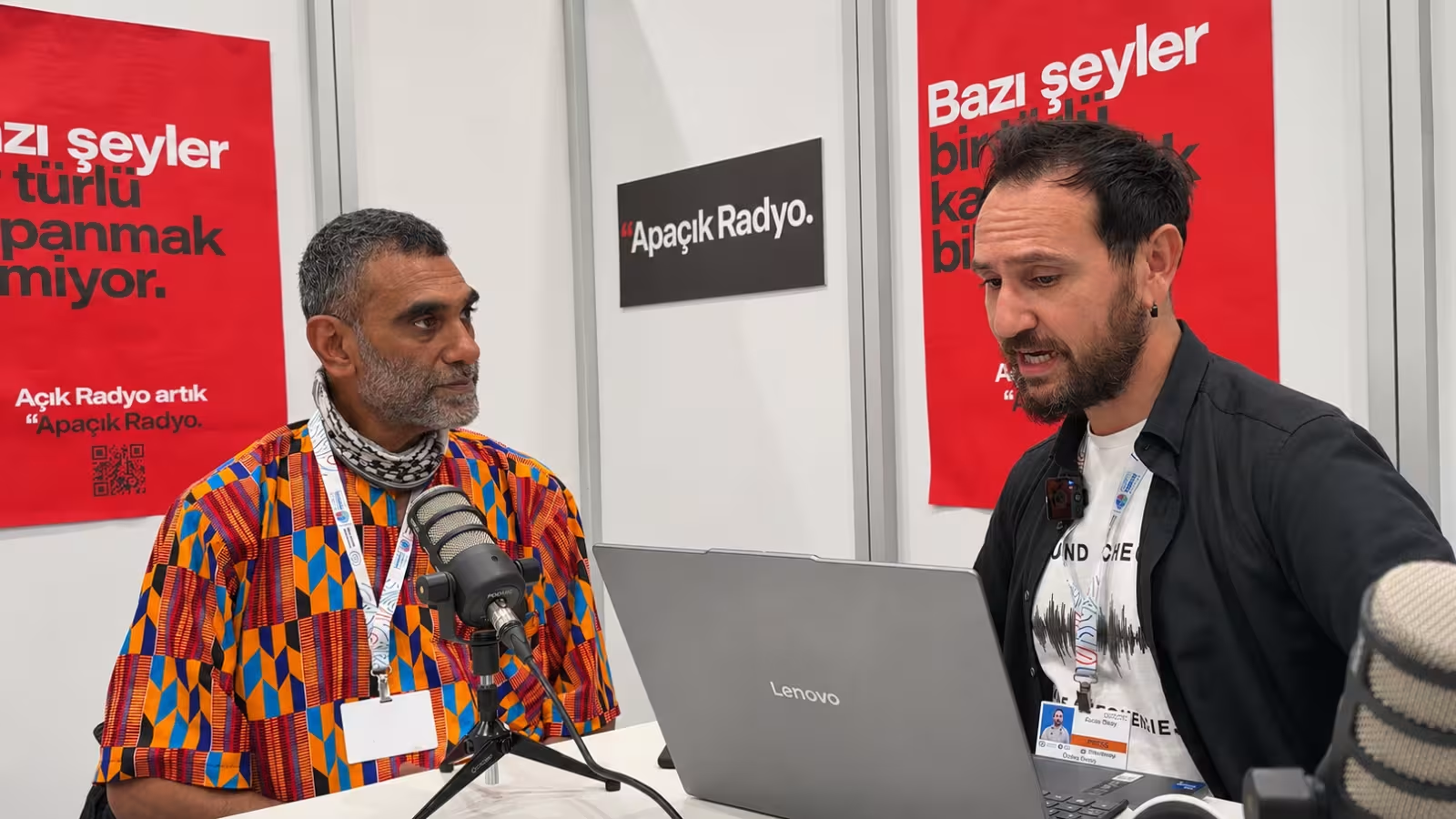
As part of COP31, we speak with Kumi Naidoo of the Fossil Fuel Non-Proliferation Treaty Initiative about the removal of references to fossil fuels from the summit’s outcome text, the shortcomings in climate finance and just transition, Panama’s objection during the negotiations, and alternative diplomatic processes for phasing out fossil fuels.
Özdeş Özbay: So today we are together with Kumi Naidoo from the Fossil Fuel Treaty Initiative, and this is going to be our second interview. Thanks again for this. So I would like to start with this: COP31 seems like another big failure for the planet and for the people. Could you briefly explain what is missing from the final text?
Kumi Naidoo: So there are three big issues. One is the most obvious, glaring issue, which is that there is no mention of fossil fuels, even though fossil fuels account for 86% of what's driving the problem.
People need to understand the significance of that, right? Because what we keep hearing is how renewable energy is scaling up, which is true. But renewable energy is actually scaling up to address increasing energy demands. So what's happening is that we're keeping fossil fuels largely intact while scaling up renewables, which means that we're not tackling the root cause of what's driving climate change. And according to the science, fossil fuels account for more than 80%, around 86%, of what is causing the climate emergency.
So that's the biggest glaring gap. Just the failure to even acknowledge the words "fossil fuels" tells you how strong the fossil fuel lobby is, how many governments here have been bought off by the fossil fuel industry, and how many governments do not have the backbone to stand up.
The good news is that, on that specific issue, Panama, Nepal, a range of small island states and least developed countries, I think, are going to put up a little bit more of a fight. But let's be blunt about it. The power of the dominant countries will probably override what is finally agreed at the end of the day.
I don't think, at this late point, we will succeed in getting it in, but I think having a spirited fight to try to get it back in at the last moment is something that Nepal, Panama and other countries should continue to do.
The second thing is finance, right? For so many years, decades, we were fighting for a Loss and Damage Fund. Loss and damage is basically about what happens when extreme weather events hit, like what happened in my home city in 2022, when 600 people died in two days in Durban, South Africa.
And the damage, even today, four years later, is still visible. The infrastructure has not been rebuilt, people are still homeless, and so on.
So essentially, given that historical emissions came from rich countries that built their economies on fossil fuel extraction, they finally agreed in 2022 that there would be a Loss and Damage Fund.
Now, agreeing to a Loss and Damage Fund and leaving it empty is like building a house and saying, "We won't put in taps, we won't put in a toilet, and we won't put in the things necessary to make it functional."
Ö.Ö.: It's just the walls, then.
K.N.: Yeah, it's just the four walls. So that's the second failure.
And then the third is that there's not enough commitment and clarity around the whole idea of how we plan a just transition.
We just want people around the world to understand that we're not saying we can switch off fossil fuels tomorrow. Of course we cannot. But we need to do it in a fair way, in a fast way, and funding needs to be provided, especially for poor countries that don't have the resources to transition.
On adaptation, which is basically about how we get countries like Bangladesh, for example, where sea levels are rising, to keep the seawater out, we know that places like New York and Miami will be able to secure financing to do that. Who knows, though? After Trump, there might not be any financing left even for them.
But to build that kind of infrastructure, you need financing and sometimes technical knowledge. Of course, we know that the Netherlands is one of the best countries in terms of its competence in dealing with sea-level rise, because Amsterdam is essentially built below sea level, and so on.
So there are competencies that exist in certain parts of the world that might not exist elsewhere. There needs to be skills and technology transfer, but all of that is meaningless if there isn't the finance to do it.
So these, I think, are the biggest omissions.
However, to rate this outcome document, you need to look not only at the omissions but also at the bad things that have been included.
Rather than investing in reducing our emissions, they've put false solutions into it, like CCS. So let's be very clear.
Ö.Ö.: Carbon capture and storage.
K.N.: Carbon capture and storage. We've been hearing about this with gusto since 2009, from the Copenhagen Climate Summit. And lots of money has been invested in a technology that has not delivered anything at scale.
Ö.Ö.: And which industry is this? It's also the fossil fuel industry, right?
K.N.: Of course, it's the same industry. But there are lots of false solutions around. And this declaration, at the moment, basically endorses false solutions, but also does not live up to the Paris Agreement and the commitments that were made in 2015.
Ö.Ö.: Okay. So in your last message, right after the latest draft, you mentioned that you stand with Panama in taking that position and urged other governments to do the same. By that position, you mean that Panama might block the outcome, the final text.
Nepal is being pushed to the point of walking out as powerful countries ignore the devastation its people have recently experienced.
And I asked the Brazilian Minister of Climate Change just a few hours ago whether Brazil would join Panama, and he said no, very clearly. He said no because, as he told me, COPs are for consensus-building.
I also asked the same question to the French environment minister just a few minutes ago, and surprisingly, she said, "We don't know yet. We will see." So it's still open. It's a question mark.
Do you think the other countries backing the Fossil Fuel Treaty, which number around 30 now, will join Panama at this COP?
I mean, the initiative was not started to create a bloc or an alliance against COP processes, but it should also be regarded as a contradiction for the Fossil Fuel Treaty countries to say yes to such a text without mentioning fossil fuels.
Could the countries involved in the Fossil Fuel Treaty Initiative create a bloc against such an empty text at COP31 or at other COPs?
K.N.: So firstly, I think it's important that we don't frame it as if Panama is doing something wrong. Panama is asserting its democratic rights within the flawed process that is the UNFCCC.
What we mean by that is that one country can stop it from moving forward. Like the Brazilian minister said, this is a consensus-based decision, right?
But let's be very clear. What consensus? A consensus that has actually seen us, since Paris—well, since we started at COP1 in Berlin until now—moving in the wrong direction.
If you look at that point, we were below 350 parts per million of carbon dioxide concentration in the atmosphere. Now we're shooting towards 440 ppm.
If we look at the accumulated degrees of warming, we were below one degree at that point. Now we are past 1.5 degrees since we started.
And if we just go back to Paris and look at where we were in Paris, where we fought so hard, especially small island states and least developed countries, to get 1.5 degrees as a threshold, after the dominant countries had actually been blocking that and wanted to keep it at two degrees to allow them to pollute more.
And if you look at the period from 2015 until now, just over ten years later, we can see it's all going in the wrong direction.
So a consensus that does not deliver the results that we want is fraudulent. It is a betrayal of our children's future and doesn't offer us a climate solution.
Then, as to whether other countries will join, I know that Panama right now is reaching out to other partner countries that are in the treaty, as well as some that voted in favor of the International Court of Justice advisory opinion, which said about a year ago that governments should take action, and if they don't, they're violating their legal responsibilities.
Politics is a strange thing, and this is a political process.
We are having this interview at two in the afternoon on the final day. The final plenary starts at around five o'clock and is supposed to go until about nine, but people are betting right now that it'll probably go until maybe 9 a.m. rather than 9 p.m., or maybe even continue on Sunday. Who knows? We'll see.
But the reality is that there have been other moments like this.
I can tell you that in Cancún, in 2010, the Evo Morales government from Bolivia insisted that we needed to have 1.5 degrees as a target.
And sadly, most of civil society did not support it, including Greenpeace, which I was leading at that time. I personally supported it, but my colleagues in Greenpeace didn't.
And we sold a developing country down the river when, in fact, it was taking the right position.
They were being called obstructionists. No, you're not obstructionists if you are saying what the science is saying, if you're saying what our children's future demands, and so on.
In fact, you're being heroic. You are speaking truth to power.
And I hope that, as complicated conversations are happening all around the venue here right now, when the plenary opens, significantly more countries will say, "No, this deal is no deal that we can feel proud of."
But knowing how COPs work, what happens is that a country gets "gavelled." Meaning, let's say in the final plenary Panama may be putting up its hand, saying, "We object."
And I've seen it happen. Whoever is in the presidency almost looks in the other direction and says, "Adopted."
And once the gavel goes down, the meeting is over.
So this is a bizarre process where the fossil fuel lobbyists are winning. Fossil fuel companies are benefiting from it.
And I take the view that it's not over until it's over.
Ö.Ö.: Yeah.
K.N.: So we will fight hard and support those governments that are saying the right thing to see whether we can actually get some shifts in the language.
And if we don't get that, when this is over, we know that we have not put all our eggs in this basket.
The second Transitioning Away from Fossil Fuels Conference will happen in two parts. The first part happens in Ireland around April, and then the second part happens in Tuvalu in July.
So we will build a coalition of countries beyond the 57 that we managed to get to Santa Marta, Colombia, hopefully closer to 100.
And then, once we cross the threshold of 100, we will have more countries within the fossil fuel phase-out camp than those that are blocking it.
Ö.Ö.: Yeah, actually, that was going to be my other question.
During our first interview this week, you reminded us of the Landmine Convention as an example. You said that the treaty was negotiated by 44 countries outside the United Nations system, which is actually being criticized by Panama right now, then brought to the UN General Assembly, resulting in the approval of the treaty.
So we were expecting stronger pressure on the COP negotiations from the Santa Marta Conference, to be honest.
K.N.: So was I.
Ö.Ö.: Yeah. New countries have declared their support for a Fossil Fuel Treaty even here, so the number has now reached 30 countries.
However, the final text still doesn't mention fossil fuels at all.
So what effect do you think COP31 will have on the second conference on the Fossil Fuel Treaty in Tuvalu next year?
K.N.: So let me give you a somewhat cynical answer to that question, right?
If I were somebody who thought—or if my colleagues in the Fossil Fuel Treaty and many of the other campaigns that are here thought—about the interests of their organizations rather than the interests of the people, then you could say, "Ha, we win both ways."
If fossil fuel language is mentioned in the outcome document in a substantive way, then finally we can say, "Okay, it's there. We'll make sure it doesn't leave." That would be a victory.
If it doesn't get mentioned, we can also say, "Ah, this proves our point, that they will never have the political will to address the phase-out of fossil fuels. Therefore, we need a standalone, parallel diplomatic process."
But of course, we are not in this for ourselves. It's for protecting humanity.
And I tell everybody listening here, oftentimes we say things like "save the planet," "save the climate," "save the environment."
The planet actually does not need saving.
If we continue on this suicidal path that we are on, we will warm up the planet to the point where we destroy our water, we destroy our soil, it gets too hot, and we cannot grow food.
When all of those things are happening, and we're moving in that direction, humanity will be gone. The planet will still be here.
So I say to all the people who say, "Save the planet, save the planet," don't worry. If we become extinct as a species, the forests will grow back, the oceans will replenish, and so on.
So we need to understand that this struggle is not some theoretical struggle. This is a struggle to protect our children and their children's futures.
And one of the important things about framing it that way is that, in every religion, in every culture, we all value our children very, very dearly.
And so I hope that the negotiators in this room can think about their own children, their own grandchildren, and so on, and understand that they are playing political poker with the future of our children and their children.
So right now, I think it's not likely that, even if by some miracle we get fossil fuel language back in, it's going to be anything on the scale of clarity and ambition that we would want.
But I do think the symbolic recognition that this is the driver is important.
And if it happens, it also gives us a boost to the second Transitioning Away from Fossil Fuels Conference. If it doesn't, it gives that next conference more meaning and purpose.
The one thing I would say is that critics can correctly say that negotiating the phase-out of landmines and negotiating the phase-out of fossil fuels are two completely different things.
Landmines are one weapon, and it's more discrete.
Fossil fuels are baked into every aspect of our lives, from plastics and packaging to the things we use in our kitchens, to our cars and more.
So when we make the comparison to the Landmine Treaty, I would just say to those who will come back with that critique: we're not saying that both things are equal in complexity.
What we are saying is that the methodology and the modality of how you can actually get an agreement and bring it back into the UN General Assembly process work, irrespective of what the content of the treaty is.
Ö.Ö.: And one last question. You have already seen the drafts.
Realistically, what should have been included in the text for COP31 not to be considered a failure?
I mean, because BAM is out, fossil fuels are out. But I'm not asking about an ideal outcome, just realistically.
Because France, for instance, when I asked, said that, for the inclusion of a just transition mechanism, they had mentioned that to the presidency, but we will see in the end.
So what do you think? What can be regarded as a success at this point?
K.N.: I think whatever happens here is going to be very, very far away from what science and extreme weather events are telling us we must do, and must do fast.
That's sadly the reality.
But given how bad the level of ambition and commitment is, and the blocking by powerful countries that depend on and benefit from fossil fuel extraction, what I would say is that right now, if we can get some clearer commitments on finance, both for the Loss and Damage Fund, for the Green Climate Fund, and other subsidiary funds that have been created; if we can get a just transition commitment and plan; and if we could get even a weak mention, at least an acknowledgement, that more than 80% of what's driving climate change is our addiction to and dependency on fossil fuels, I think all of those things are humanly possible.
I think all of those things are so obvious. And all that is missing is political will.
And thankfully, political will is a renewable resource. You can vote people out of power, as we saw in the United States recently.
And let's hope that we leave here not with a sense of defeat, but with a sense of optimism.
So I would like to say one more thing, if you don't mind.
Because you might not know this, but I'm also the co-director of the Global Artivism movement.
Ö.Ö.: Yeah, yeah.
K.N.: Where we bring arts, culture and activism together to help us communicate with more people, especially people who are directly affected by climate change.
And when we heard the Panamanian minister actually say that the oil companies have hijacked the process, the Global Artivism movement—
Ö.Ö.: Oil mafia.
K.N.: Oil mafia, actually. That's correct.
So the Global Artivism movement is going to put out a call today saying that we should show "proof of life," right?
So if you use the hijacking, kidnapping metaphor—
Ö.Ö.: Yeah.
K.N.: Our children's futures are being kidnapped and hijacked, our air quality, our water quality, our communities, our cultures, and so on.
And when somebody gets kidnapped, they say, "Before we pay the ransom, we want to see proof of life."
So what we are saying is that between now and the 10th of December, which is International Human Rights Day, we're calling for expressions of proof of life, meaning activism, election results.
I mean, I would say the midterm election results were proof of life that people are not willing to accept climate denialism, fascism and corruption that we're seeing in the US from the White House and Donald Trump.
We have been, from the 1st of November to the 10th of December, as a Global Artivism movement, having 40 days of activism—artivism, if you want—showcasing how arts and culture can help us communicate better.
And we have already had several hundred activities. By the time we finish, there will have been several thousand by the 10th of December.
So I would like to invite all your listeners and everybody hearing this: spread the word. Go to the Global Artivism website.
You can do something small. But basically, what we need right now is to show those in power that we're choosing love over hate, unity over division, peace over violence, and sustainability over greed.
So I believe there's a lot of proof of life. They might have kidnapped certain parts of our future, but they don't have a firm hold on it.
What we have to make sure is that we don't suffer from Stockholm syndrome, where we actually fall in love with our kidnappers.
What I see happening here at the COP is that it would appear that too many governments are suffering from Stockholm syndrome, where they have fallen in love with the very kidnappers who are kidnapping their societies' futures.
Ö.Ö.: Yeah, and did you see the latest declaration by the leaders of China, Russia and the United States?
They said that they are going to increase the supply of fossil fuels for the benefit of all countries.
And just the day before, the Panamanian minister said that we love our kidnappers, and now they are saying that they are doing everything for the benefit of all of us. They explicitly said it.
K.N.: And sorry, I'm drawing the Stockholm syndrome analogy from him because he said it. I want to give him credit. I'm very clear that we're giving him credit.
He's a courageous leader, not only of Panama, but I would say he's now one of the courageous leaders of the Global South.
We encourage him to continue to speak truth to power.
And listen, those statements coming out of that trilateral meeting—there are so many issues with them.
Donald Trump will forget half of what he committed to by the time he gets back to the White House.
Whether there'll be any consistent application of that totally remains to be seen.
And I have to say that the thing I found most compelling to come out of it was President Xi saying that the only ethical thing to do on nuclear weapons is for countries that have nuclear weapons, including China itself, to destroy them.
This is something people like us have been campaigning for years for: the destruction of all remaining nuclear weapons.
And I want to lift that up because, from what I saw, that was the one thing I thought came out of there that was of substance and benefited the interests of ordinary people and humanity in the long term.
Ö.Ö.: Okay. Thank you so much, Kumi Naidoo, for being with us once again.
K.N.: Thank you for the important journalism you are doing.
I realize that the world is a very difficult place, even for journalists.
We are seeing, in many countries around the world, journalists being thrown into prison, especially independent, alternative journalists who are not part of the so-called legacy media.
And I hope you'll continue to do the good work that you're doing.
Ö.Ö.: Okay. Thank you so much.
K.N.: Thanks.
Who is Kumi Naidoo? Kumi Naidoo is a South African human rights and climate justice activist. He became involved in the struggle against apartheid at a young age and has served as Secretary-General of CIVICUS (1998–2008), Executive Director of Greenpeace International (2009–2015), and Secretary-General of Amnesty International (2018–2020). He currently serves as President of the Fossil Fuel Non-Proliferation Treaty Initiative. His work focuses on a just transition away from fossil fuels, human rights, democratic freedoms, and global climate justice.
COP31'de neler konuşuluyor, hangi kararlar alınıyor? Resmî müzakerelerden alternatif zirvelere, iklim hareketinin seslerinden gezegenin geleceğini belirleyecek tartışmalara, Antalya'dan gelişmeleri COP31 Özel Yayını'nda takip ediyoruz.