Image
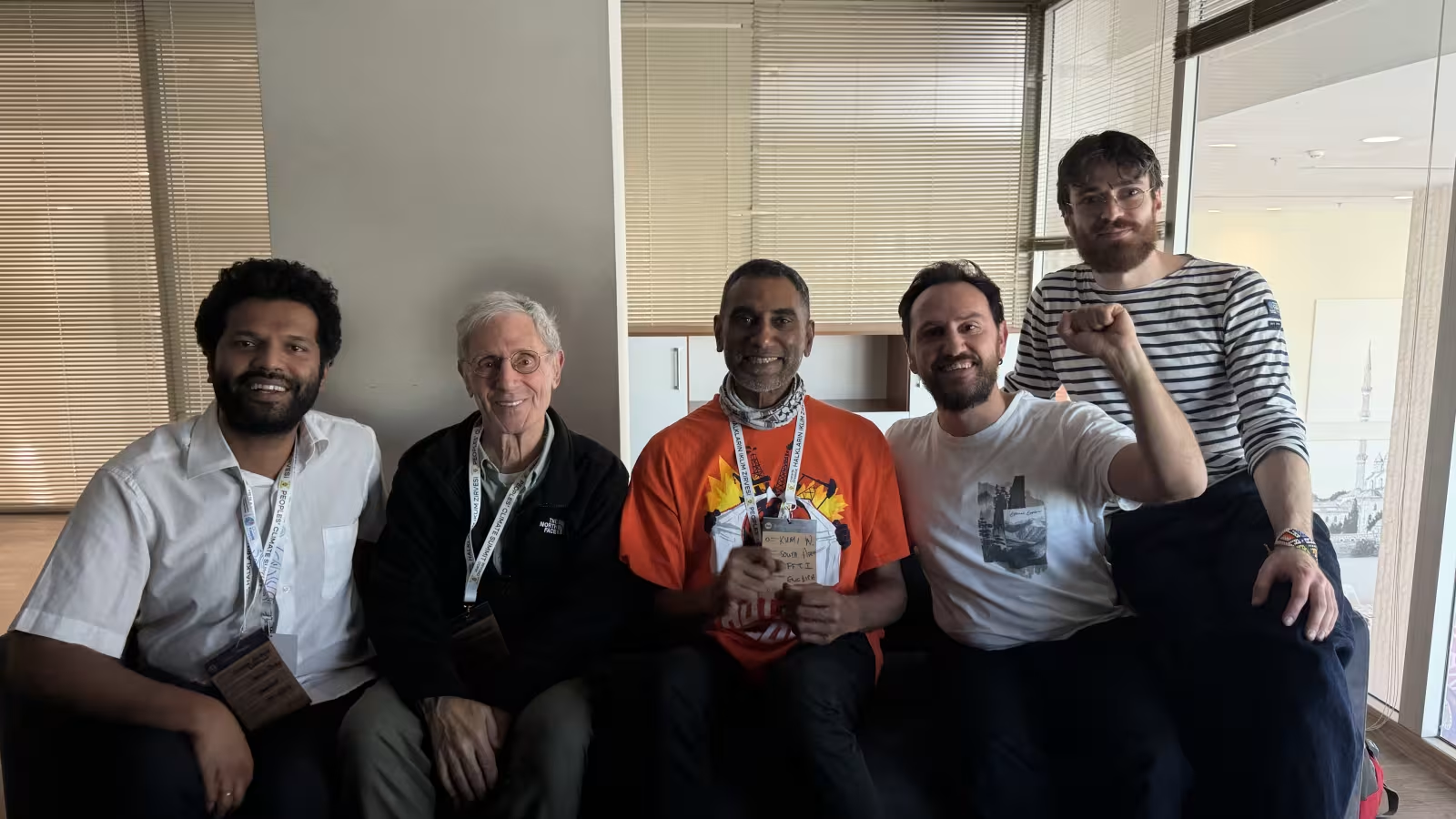
At COP31, we speak with Kumi Naidoo, President of the Fossil Fuel Treaty Initiative, about new pathways for phasing out fossil fuels, the deadlock in COP negotiations, the situation in Gaza, shrinking civic space, and the role of young people, art and civil disobedience in the fight for climate justice.
Özdeş Özbay: Okay, now we are joined by Kumi Naidoo from the Fossil Fuel Treaty Initiative. Thank you for being with us today.
Kumi Naidoo: Thank you for having me.
Ö.Ö.: We are conducting this interview right after your amazing speech at the People's Climate Summit. We are also joined by Waseem and Eren, who will be asking some questions as well. So, my first question is: Santa Marta was unique in our history. How do you think it will affect the official negotiations at COP31?
K.N.: At the end of COP30 in Belém, Brazil, President Lula had said at the beginning of the COP that we needed to have a fossil fuel phase-out plan. And yet again, fossil fuels were not even mentioned. The term was not even used. So, in the closing plenary, the COP presidency did say that the Santa Marta Conference, which the Fossil Fuel Treaty Initiative had been working in partnership with the Colombian government for years to make happen, would become part of the COP work program.
If there were a sense of urgency and a proper understanding of how bad things are, then let's hope that the fossil fuel phase-out plan that came out of Santa Marta, which is on the table here, will be addressed and become part of the negotiations.
So, am I very optimistic that it's going to go really well? From what I'm hearing, the dominant countries in the fossil fuel sector, such as Saudi Arabia and others, have been blocking everything during the first week.
But what I've learned through all these COP processes and other international processes is: never give up until it's over.
So I say to the delegates from countries whose people are already facing immense pain and threats, even though they've contributed the least to the crisis, like the people of the Pacific and the Caribbean island states: keep pushing, don't give up. We fight right until the end.
And the good news is, irrespective of where we get here, we have a plan. And the plan is that the Republic of Ireland and Tuvalu will host the second Transition Away from Fossil Fuels Conference.
And just for those of your listeners who don't know what Santa Marta is, that was the first fossil fuel phase-out conference. Importantly, we had 57 countries there.
And six weeks after the Santa Marta Conference, at the UN General Assembly, an idea inspired by law students in Vanuatu, who six years ago went to their law lecturer and said, "Shouldn't we take the world's biggest problem to the world's highest court, the International Court of Justice?" resulted in a very positive ruling.
So that ruling was put before the UN General Assembly, and 141 countries embraced it. There was a group of countries that abstained, and 11 countries objected. Interestingly, those 11 countries included Iran and the United States. They might be bombing the shit out of each other, but they're very united around fossil fuels.
And so, if we had 57 countries in Santa Marta, and if 141 countries embraced the ICJ decision, which says governments have a responsibility to make sure they phase out fossil fuels, let's hope that next year, when we convene first in Ireland and then in the Pacific, the number of countries committed to phasing out fossil fuels will grow from 57. And even if we don't make it to 141, hopefully we'll have more than 100.
Ö.Ö.: And about the Brazilian roadmap, I would like to ask you: what did you think of it? Because that was also a first. Now we have a roadmap for phasing out fossil fuels, let's say. More countries are expected to announce their roadmaps this week, and some of them may attend the next Fossil Fuel Treaty gathering in Tuvalu. But how do you evaluate the Brazilian roadmap?
K.N.: So, within the constraints of a flawed international negotiation process and institution, which is COP, let's understand that this is not ideal. Firstly, as Mary Robinson put it in 2021, after the Glasgow COP, she said, "These COP processes are male, pale, and stale," right?
And the fact that there's so much fossil fuel industry presence and lobbying here... Young people have been saying for more than 10 years now, "Get the fossil fuel interests out of the COP," right? It's just been holding us back in a very fundamental way.
So, given how hard it has been to talk about any fossil fuel phase-out roadmaps, even though the Brazilian version, and even what came out of Santa Marta as the phase-out plan, are far from perfect, let's be very clear: there are far too many dominant countries, so-called Global North countries, that are speaking with forked tongues.
On the one hand, they say they accept the science, and they say we have to phase out fossil fuels. And even the Dutch government, for example, which co-convened the first conference, is issuing new gas licenses. The courts told them, when young people brought a case, that they were not doing enough to phase out fossil fuels and that they needed to do more. What are they doing? Rather than respecting what the courts are saying, they are trying to appeal the decision.
So, the other big problem we have... The fossil fuel phase-out plan—it's better that we have it, of course. It's a movement. It tells us that finally we're focusing on the right issue.
But if anybody believes that this flawed COP process, which for 30 years hasn't delivered what we needed, is suddenly going to change... When this process started, right, we were not at almost 1.5 degrees, like we are now. We were below 350 parts per million. Over 30 years, things have been getting worse and worse, and it's been business as usual. We go through what is almost a ritualistic exercise here.
So let's not get carried away. This is not how global governance should work. But what it does do is bring fossil fuels into focus. So we welcome the Brazilian roadmap.
But the one thing that we will say very clearly as the Fossil Fuel Treaty Initiative is this: as Albert Einstein once said, "The definition of insanity is doing the same thing over and over again and expecting different results," right?
If we think that, after 30 years of trying to take on the core root cause, which is fossil fuels, we're suddenly going to see the dynamics change, when one country can block everything—Saudi Arabia, Russia, whoever says, "We don't agree," and even if every other country agrees, the decision-making here...
By the way, it's a problematic thing. That's another long story. They sort of make it seem as if everybody has to agree, but this issue has been outstanding since the first COP, which took place in Berlin, right? There was a rule about this.
And one of the things we need to do now, between now and the next COP, is to lobby for a reconsideration of the decision-making process at the COP, right? Because there was nothing formally agreed at that first meeting in Berlin that said one country could hold up everything.
So, therefore, we need a new multilateral process. You don't have to be a genius to know that, right?
And these dominant countries, especially the European countries, are basically wanting to say now, "Oh, we take the fossil fuel phase-out and put it back into the UNFCCC," when it has failed us so brilliantly over the last 30 years.
So, the bottom line is that we need a new multilateral process.
The treaty approach at Santa Marta received a very positive response. And just to explain to your listeners what that means, let me give you an example.
To get the Landmine Treaty, for example, that treaty was negotiated by 44 countries outside the United Nations system in Ottawa, Canada, and then brought to the UN General Assembly. It was put there, and they said, "Okay, put up your hands now and say, 'I want landmines, I want landmines.'" Of course, it passed.
We believe that if we can get a group of ambitious countries that accept the science, that are serious, and whose people's lives are on the line, like the people in Tuvalu and other Pacific Island states, we can get that treaty, take it to the UN, and then let's see who tries to stop it.
Of course, I think public opinion is shifting in our favor. People now understand that fossil fuels are the major driver. And I hope that this message means more and more governments will come under pressure to be honest about the situation.
And let me end by saying this: any government that invests in new fossil fuel projects is essentially investing in the deaths of the children and grandchildren of that country. It is a suicidal decision. It is a decision that shows no intergenerational solidarity with future generations or current generations.
And I believe that the momentum is building slowly, slowly, slowly, and it's going to reach a crescendo.
And hopefully, people like yourselves, who are bringing alternative ways of reaching the public through more progressive, alternative media and so on, are also part of the solution.
Waseem Ahmad Siddiqui: Gaza: A Moment of Truth at COP31. This is the fourth COP during the genocide in Gaza. A Palestinian father whose nine-month-old baby had died in a displacement tent in Gaza said, and I quote, "I woke up to find my son frozen to death from the cold."
Climate Action Network International's Executive Director, Tasneem Essop, began an extraordinary intervention at last Friday's press conference by speaking about the continuing devastation in Gaza. She challenged governments and journalists to confront what is happening just 621 kilometers from Antalya: "We cannot sit at the COP and pretend that a genocide is not happening."
Could you speak about the genocide and what has been happening over the last two weeks, particularly the floods? How are these crises intersecting? Thank you for your time.
K.N.: The Palestinian people have been dispossessed, occupied, and have suffered the catastrophe of the Nakba. And the dominant nations of the world, which have given us a military-industrial complex and a fossil fuel industrial complex, have betrayed the basic human rights of the Palestinian people.
This is an apartheid state. Amnesty, as well as the prominent Israeli human rights organization B'Tselem and the UN, have all called it apartheid for a long time.
I mean, when I addressed the UN General Assembly in 2018 during the Mandela Peace Conference, which marked the start of the General Assembly, I said, as the then Secretary-General of Amnesty, that Gaza was an open-air prison, right?
I mean, basically, you know, even in a concentration camp, right? Or even if you're in... And then people said, "No, you shouldn't say it's a prison because at least when you go to prison, you sometimes know when you're going to be released," right?
Yeah, it's a permanent state. So people have suffered a lot.
What has happened in the last four years... The full story of what happened in the run-up to it is not yet known.
I said in an interview with some young people, actually from Pakistan, who were supporting the young people in Gaza, "I'm surprised. How is it that the most sophisticated state in terms of intelligence gathering, technology, and so on didn't know that something was being organized literally less than 50 meters from the border of Israel?"
And, of course, it's become very clear now that they knew, right?
And Netanyahu, like Trump, is someone who has abused power to stay out of prison, right?
And I believe that this, by the way, does not serve the average Israeli citizen and certainly does not serve the Palestinian people.
But the complicity of the United States and the UK in arming that massacre and genocide against the Palestinian people means that we must also say that we cannot direct all our attention simply at the Netanyahu regime.
We need to draw attention to the fact that Trump, for example, told the world, "Oh, we've got a peace deal."
How many people have died, not only in Gaza but also in the West Bank, right?
So the failure of the international system to protect the Palestinian people, historically and presently, has been absolutely shameful, right?
But within all this pain and tragedy, we must recognize that there is one positive thing.
Public opinion has shifted decisively everywhere toward supporting the legitimate demands of the Palestinian people for their right to enjoy basic human rights, not to live under apartheid, and so on.
Let me give you an example.
In the Democratic Party in the United States in 2014, if you surveyed its members, there was at least a 40-percentage-point difference in favor of supporting the Israeli state rather than Palestinian freedom.
Now, if you conduct the same survey, survey after survey has shown that it's flipped completely the other way, as you can see in the midterm elections, right?
And so it's hard to tell a father who has lost his child there, or the many parents who have lost their children, to draw comfort from that.
But to those who are struggling and fighting on a daily basis for justice for the Palestinian people, especially those on the ground in Gaza and the West Bank, I just want to say that their sacrifices over the last four years, and the fact that they continue to rise up against this genocide, have inspired so many people around the world.
And I want to believe, as Mandela once said to us as South Africans...
Why was South Africa the country that took Israel to the International Court of Justice? Because we fought, you know, we struggled together for our freedom.
And Mandela said, "South Africans will never be free until the Palestinians are free."
That's right.
And I want to say something to the Arab nations, which share the faith of the majority of Palestinians. And bear in mind that Palestinians are not just Muslims. There are Christian Palestinians and so on. But, of course, a large number are of the Islamic faith.
I say to the Arab nations of the world: you've been pathetic. You've been pathetic in terms of how you have failed to stand up and support the people when they were facing a genocide.
And even when South Africa brought that case, how many of them immediately said, "We will join," right?
Because they were worried about their funding deals and their corrupt deals with Trump and the West. That's what they're doing.
And they will opportunistically use the Palestinian cause sometimes to curry favor with their own citizens and keep them under control.
But I'll tell you this: the Palestinian people, from everyone I've spoken to, especially those in exile, feel deeply betrayed and deeply hurt by countries that call themselves neighbors, countries that said, "We stand with you," but when that solidarity was needed most, it wasn't there.
Eren İleri: You used to be the head of CIVICUS and Amnesty International. And at the end of your intervention at the People's Climate Summit, you dropped to your knees and made a heartfelt plea to President Erdoğan to release political prisoners.
We see that civic space for contestation in general has been shrinking at an alarming rate. This applies to the anti-war movement, the anti-extractivist movement, and the climate movement.
How do we defend civic space as it continues to shrink, so that we can push forward a people-led transition?
K.N.: So sadly, this problem affects virtually every country around the world. CIVICUS tracks the shrinking of civic space, and it's happening everywhere.
I mean, listen, think about it. In the United States, you've got masked police officers going around killing people in the streets, arresting citizens, deporting them, and so on, right? Countries that were supposedly committed to human rights and so on.
And I would say something very unpopular. Part of the problem here is that democracy has been stolen. The idea of democracy has been undermined. Because basically, when I look at the United States today, I would simply say this: the US is not a democracy. It's a liberal oligarchy, right? You have the form of democracy, elections, without the substance of democracy.
And it seems that in the midterm elections, people in the United States have woken up to that because you've got some really good young candidates who are saying that this doesn't make sense. You've got people at the top who are extracting wealth on a scale that was unimaginable even 10 years ago, right?
So how do we address the problem? First, call it out. And again, I hope I'm still here by the end of the conference.
Basically, what does history teach us? When humanity has faced deep and profound injustice or challenges, those struggles have only moved forward when decent women and men stood up and said, "Enough is enough. No more."
And they said, "We're prepared to go to prison if necessary. We're prepared to lay down our lives if necessary," and so on.
Peaceful civil disobedience must now be undertaken on a scale we have never seen before. However, that must be accompanied by what I would call creative activism, or artivism, right?
Because basically, I'll tell you this much, and people won't like me saying this truth. Most of us here at this People's Summit, if we're asked, and if we're honest with ourselves... Let me just put this to the people who are here.
When this finishes, you go home two weeks from now, right? And you're with your extended family and friends. If they ask you, "Can you explain to me simply what went on there?" how many of us feel confident that we can do that?
If we cannot explain to our own families what this is about, how do we bring ordinary people into the struggle, right?
So it's critically important that we recognize a major failure in how we have communicated.
And I'll answer this in a personal way. After Archbishop Desmond Tutu passed away, our son, a very popular musician in South Africa, a hip-hop artist and rapper, sat his mom and me down and said, "Guys, you're really not good at what you do. You've been fighting for human rights, democracy, gender equality, sustainability, and all these things since you were teenagers. And I look at the world, and it's all going in the other direction, right? So why don't you just chill and accept that you're failures?"
I mean, he was playing around with us, right? Ouch! But he was making a point, and I said, "Absolutely, I agree with you."
And then I asked him, "Why is it that we're failing?"
He said, "Very simple. You aim all your messages and narratives at the brain, and you ignore the heart, the body, and the soul."
And then he said, "Look at what Trump does. Trump bypasses the brain. He goes straight to the heart and weaponizes all sorts of hate," and so on.
Now, obviously, we must not deviate from the truth. We must start with what the science says. But a song is going to travel much further than a policy paper or a scientific statement, right? You know what I mean?
So we have to start humanizing the way we communicate with people.
What is needed is courage, creative civil disobedience, and a massive increase in how we embrace the power of arts and culture.
And let me just say this: harnessing the power of arts and culture on its own will not deliver our salvation from the climate crisis and intersecting crises.
However, I am very clear: if we fail to harness the power of arts and culture, we are guaranteed to fail.
And here's the terrible tragedy. Steve Bannon, Donald Trump, and that group understand this so much better than we do, right?
Do you know who Steve Bannon's major theoretical inspiration is? Not for his philosophy, but for his organizational strategy. The Italian socialist Antonio Gramsci, right?
You know, the whole notion of hegemony, right? Hegemony. And the idea that you must look at the different subsets of society and so on.
And oftentimes, when we're organizing and mobilizing people, our messages are as if everybody is at the same level, right?
But the last thing I would say is that in many of our struggles, particularly the climate struggle, we talk about the issues in a way that doesn't connect with people's day-to-day lived experiences.
So unless we start talking about climate change in terms of your water, your food, your children's education, the quality of the air, whether you can have a decent job and not have to go down a coal mine and die early because you're polluting your lungs, right?
So for all these reasons, I would say that people should not feel down. History has shown us that every struggle has required sacrifice.
And I'm very clear about that. I'm very inspired by so many young people because my generation has failed them so badly.
So many young people are coming up with new ways of thinking, new ways of organizing, and new ways of mobilizing.
And I think the most important thing my generation can do right now, politically... Just look at the average age of the negotiators here. You know, all the heads of state around the world today. I mean, in many countries, they're over 80. They're making decisions whose consequences they will never have to face.
So we need a much more intersectional approach to our struggles.
Somebody came up to me afterwards and said, "Oh, I thought you were a climate activist. Why are you focusing on LGBTIQ issues?"
I mean, the LGBTIQ community, every religious community, all of us are going to be impacted by the climate catastrophe.
And just to end on a naughty note, people like myself have said, "Save the planet, save the environment, save the climate."
The truth is, the planet actually does not need saving.
Think about it. If we continue on the path we're on, if we maintain our dependence on fossil fuels, we will warm the planet to a point where we cannot actually grow food.
In Africa, in parts of Africa, it's already happening. Areas are being depopulated because soil and water have disappeared.
In the end, when that becomes a global phenomenon, the result will be that humanity is gone. The planet will still be here.
And the good news for everybody who's concerned, especially the folks in the Global North who sometimes care more about animals than they care about human beings, is this: once we become extinct as a species, the forests will grow back, the oceans will recover, and so on.
So we need to understand that the struggle to avert catastrophic climate change is nothing more and nothing less than protecting our children and their children's future.
And the last thing I would say is that we are the many, even if they have the money, right?
We have the numbers. Our numbers can overcome their money, whether it's in terms of getting our message across, putting pressure on them, and so on.
And we must not underestimate the fact that every religious tradition in the world is with us in terms of its teachings. And when I say that, I also include people who are agnostic and so on.
The science is with us. Justice is with us. History is with us, even if a corrupt set of oligarchic leaders have been captured by big corporations and are doing their bidding, whether in Gaza or anywhere else in the world.
But I think this moment we find ourselves in indicates that people are shifting.
And it depends on us as activists who've been fighting this fight for a long time. We need to be humble. We need to create spaces for new leadership to emerge. We need to make sure young people emerge as leaders.
And I would also say to young people: many of the political systems we operate in, in different countries, including South Africa, are far from perfect. They're illegitimate. Money is polluting elections and all that.
But okay, be that as it may, get smart, get creative, take power, right?
Don't abandon the space of political power, right?
And I have to give credit to some of the candidates who got elected in the US. The mainstream of the Democratic Party wrote them all off.
By the way, the problem in the US is that the Democratic Party is a big part of the problem because it's controlled by the same oligarchic interests as the Republican Party.
And on a lighter note, the president of Tanzania, Julius Nyerere... This is just a joke, not for the interview, but you can use it.
When Tanzania gained independence, an American delegation came to Tanzania to see, you know, what was happening with the natives.
And the journalists in the group asked, "So don't you think it's a contradiction that you always said you were fighting for democracy, and you ended up with a one-party state?"
So Nyerere explained, "No, you know, we had to take on the might of the British colonial state, which was brutal and a million times stronger militarily, economically, in terms of communications, and so on. So we had to unite the people under one banner. Eventually, political parties emerged."
And then he said, "But I'm surprised you're asking me this question because when I look at the United States, unlike most Western European countries at that time, which had at least one party standing up for working people and one party standing up for the business class, sometimes more than one on either side, both your parties are explicitly there to stand up for the interests of the capitalist class."
And then he said, "In that sense, the United States is also a one-party state, but in typical American extravagance, you have two of them."
Ö.Ö.: Thank you, Kumi Naidoo. Kumi Naidoo, activist and head of the Fossil Fuel Treaty Initiative, we are so proud to have you with us today on Apaçık Radyo. Thank you for joining us.
K.N.: Thank you so much for having me. Thank you very much. And good luck with the work you're doing, because journalism is a central part of the solution. I hope journalists continue to be brave and give a voice to those who are not normally heard in these times.
Ö.Ö.: Yes, thank you so much.
Who is Kumi Naidoo?: Kumi Naidoo is a South African human rights and climate justice activist. Having joined the struggle against apartheid at a young age, he went on to serve as Secretary-General of CIVICUS (1998–2008), Executive Director of Greenpeace International (2009–2015), and Secretary-General of Amnesty International (2018–2020). He currently serves as President of the Fossil Fuel Non-Proliferation Treaty Initiative. His work focuses on a just transition away from fossil fuels, human rights, democratic freedoms and global climate justice.
COP31'de neler konuşuluyor, hangi kararlar alınıyor? Resmî müzakerelerden alternatif zirvelere, iklim hareketinin seslerinden gezegenin geleceğini belirleyecek tartışmalara, Antalya'dan gelişmeleri COP31 Özel Yayını'nda takip ediyoruz.