Image
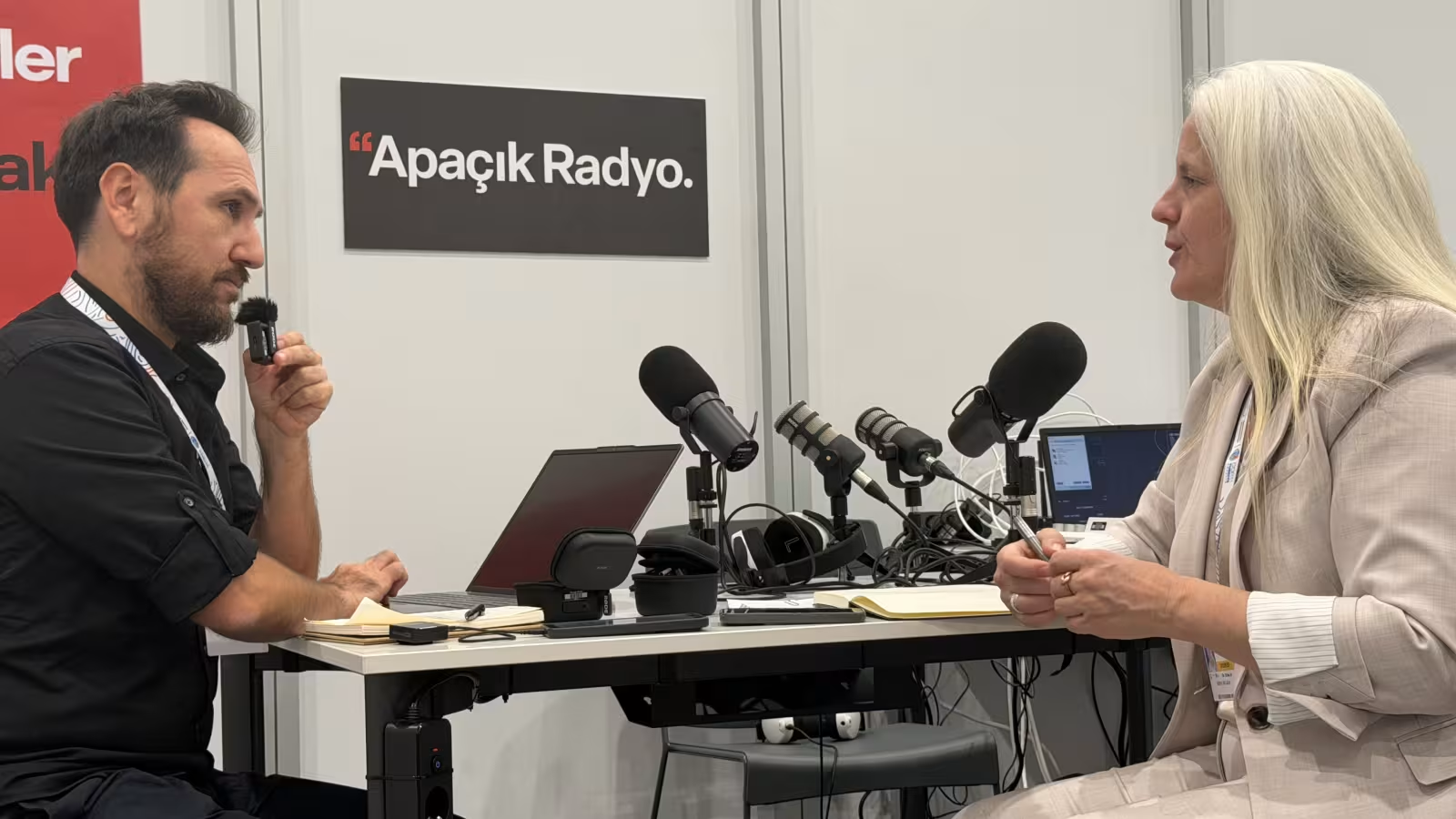
In our COP31 Climate Special Broadcast, Özdeş Özbay speaks with Kathryn McCallum from Climate Action Network Australia about Türkiye and Australia’s shared leadership of COP31, the two countries’ climate and electrification targets, just transition mechanisms, and Australia’s policies for transitioning away from fossil fuels as one of the world’s leading coal exporters.
Özdeş Özbay: Okay, now we are together with Kathryn McCallum from Climate Action Network Australia. Welcome. Thank you for being here.
Kathryn McCallum: Thank you very much.
Ö.Ö.: So, let's start with the COP presidency because, as you know, for the first time in COP history, we have two COP presidencies. How do you think this arrangement will work? I mean, what is expected from the Australia–Türkiye partnership in terms of the summit's outcomes under this shared leadership?
K.M.: Yeah. So, according to the arrangement that Türkiye and Australia agreed on, Türkiye is the COP president and host, and also has responsibility for the Action Agenda, which covers all the momentum-building, implementation-focused conversations. Australia's Minister for Climate Change and Energy, Chris Bowen, is the President of Negotiations. So, he has responsibility for steering the negotiations.
Now, that's how it works on paper—a really clear division of responsibilities. In practice, I think we're going to see an interesting couple of weeks as we see how this arrangement evolves, with Australia and Türkiye working together. Both will want the COP to be seen as a success, so I think they'll both have an interest in a range of outcomes.
Ö.Ö.: Oh, okay. What are Australia's goals for this COP summit? Has Australia announced any strategy for COP31 so far? Because, you know, Türkiye, for instance, has mentioned a target of 35% electrification by 2035. But we haven't heard much about Australia's targets or commitments. Has Australia announced anything similar?
K.M.: Yeah, yeah. Australia has been quite reserved about articulating a public vision for the COP. Australia has also been talking about electrification. They've announced that they want to take on the COP presidency.
Ö.Ö.: I mean, Australia is backing this electrification initiative.
K.M.: They're backing Türkiye's efforts on electrification under the Action Agenda, but they're also considering bringing it into a cover decision, which is a presidency-led decision. And they're exploring the idea of including electrification in that, as well as potentially some other issues, including responding to the Limiting Overshoot report that came out from the United Nations Environment Programme, particularly regarding the scale of climate impacts. So they're discussing what kind of response might be needed.
Now, as civil society, we've been pushing for them to articulate a more ambitious public vision. We think they need to take on the two big conversations at the COP. The first is delivering public, grant-based climate finance. That means developed countries like Australia providing the climate finance they've promised at previous COPs. And that's really key to enabling this process to succeed.
The second big conversation is around the just and equitable transition away from fossil fuels. We think that's particularly important because Türkiye and Australia are both quite fossil fuel-dependent economies.
Ö.Ö.: Indeed.
K.M.: And Australia is a massive exporter of coal and gas. So, we think it's in Australia's national interest, as well as that of all countries, to work together and cooperate globally on what is a global problem that needs to be addressed equitably.
Ö.Ö.: Yeah. So, one of the most important issues at this COP summit is the just transition mechanism. Have there been any preparations regarding this mechanism since COP30 in Belém? And what progress, if any, has been made over the past year?
We haven't heard much about it, but it's one of the most important issues for us.
K.M.: Yeah, the Just Transition Mechanism could be a flagship outcome of COP31. At COP30, the parties agreed to establish the Just Transition Mechanism, with really strong protections for the rights of communities, First Nations peoples, and different constituencies.
So, they agreed to establish it, but now they need to actually put it into practice. That means creating the structures, institutions, and governance arrangements that will allow the Just Transition Mechanism to do its work: supporting communities and ensuring that information and resources reach them.
There has been some progress since Bonn, particularly on the Just Transition Mechanism. There was an intersessional meeting in Sydney where very constructive discussions took place about overcoming what are mainly technical barriers.
There is quite broad political support for the mechanism, although some countries don't fully understand what's being proposed. So, there's been some work to explain how it would function and to clarify its governance arrangements.
We really hope that the mechanism will be formally established and that it will retain its strong language and structures protecting community rights. Communities need to have a say in the transition process, and we know that this is also what will build the social licence and participation needed for the transition to succeed.
Ö.Ö.: And personally, do you expect the Just Transition Mechanism to be one of the outcomes of this COP?
K.M.: I'm hopeful that we'll see a strong Just Transition Mechanism emerge from this COP.
Ö.Ö.: Okay.
K.M.: So, yeah, we'll see how the next two weeks unfold.
Ö.Ö.: Okay. All right. So, the next question is: What kind of relationship do you think the COP presidency will maintain with the countries that joined forces in Belém to phase out fossil fuels? I mean, what impact do you think they will have on this COP summit?
K.M.:
Yeah, so this conversation about transitioning away from fossil fuels has been contested in the COP process by a small number of countries that have blocked progress. But we're seeing progress and momentum across several different tracks, and that momentum needs to continue.
In the negotiations, we want to see the Mitigation Work Programme continue. We also want to see the Brazil Roadmap, which was a COP30 presidency initiative, built upon, acknowledged, and taken forward. We want Australia and Türkiye to keep that work alive because Brazil has led some really substantial, action-oriented, problem-solving work. And that work needs to be put to use.
It's about the how. It's not about whether we should transition away from fossil fuels. We agreed at COP28 that this was necessary, alongside expanding renewable energy and improving energy efficiency.
So, the roadmap is about how to make that transition happen. Different countries have different circumstances. How can they make that transition in a way that works for their national economies and communities, and that is fair and just?
We want to see the momentum behind the Brazil Roadmap continue, potentially carried forward by the COP30, COP31, and COP32 presidencies.
We also have the Santa Marta Conference on Transitioning Away from Fossil Fuels, led by Colombia and the Netherlands. The next conference will take place in our region, hosted by Tuvalu and Ireland, in the middle of next year.
So, this is an ambitious track of growing momentum. It's like a coalition of countries taking action, saying, "We're actually doing this, so come and join this conversation." And that's putting pressure on the UNFCCC to address the issue.
There's also a track of legal accountability. We saw the International Court of Justice's advisory opinion on the obligations of states in relation to climate change, which made a very powerful statement: 1.5°C is the global temperature goal, and licensing, exploration, and subsidisation of fossil fuels may constitute internationally wrongful acts.
That legal clarity, which has emerged through the International Court of Justice's advisory opinion, is now starting to influence legal cases.
A lot of our members in Australia are pursuing legal cases challenging the Australian government's approval of new coal and gas projects for export. We've been pursuing these cases for a long time, and we've been losing them. But as the law evolves and greater legal clarity emerges, I think we can start to expect that we'll win some of those cases.
Ö.Ö.: Yeah.
K.M.: And that could actually force governments to recognise that they can't just keep expanding and approving new coal and gas projects. There is accountability under the law.
Ö.Ö.: And Australia and Türkiye also participated in the Santa Marta Conference, although perhaps that was because of their roles in the COP31 presidency. What is the relationship between the Australian government and the countries involved in the Santa Marta initiative? And do you think Australia is planning to join this group, this so-called coalition of the willing?
K.M.: Yeah, look, Australia secured an invitation to Santa Marta because, in Belém, it signed on to the Belém Declaration on fossil fuels. So that was essentially its ticket to the conference. I would say Australia was possibly the weakest link at that conference.
Ö.Ö.: Okay.
K.M.: As a wealthy country and a major fossil fuel exporter, Australia was pretty quiet at the conference. They didn't say much at all. Their submission was only about one and a half pages long.
Ö.Ö.: Notes.
K.M.: Yeah, it was a great process, with civil society, governments, and experts all at the table, but we didn't hear very much from Australia.
So it's hard for us to judge when we're not hearing public statements of ambition or seeing momentum. If we're not seeing sensible plans for a national roadmap that actually faces up to reality, then we have to assume those plans aren't happening, and we'll keep pushing for them.
For Australia to show up in Tuvalu with nothing would be untenable. The Pacific really matters to Australia. It's our neighbourhood, it's our region, and we need to see Australia come to that conference having at least started the process of developing a national roadmap for transitioning away from fossil fuel exports.
Ö.Ö.: Neither Türkiye nor Australia has a particularly strong track record when it comes to phasing out fossil fuels. So, what approach is the Australian government taking to climate change?
Both countries seem to be making progress on electrification and renewable energy, but at the same time, they remain dependent on fossil fuels. Australia, as you mentioned, is a major fossil fuel exporter. Türkiye is in a different position, but it also aims to become an energy hub, connecting pipelines from the Middle East to Europe.
So, how would you describe the Australian government's strategy in this regard?
K.M.: Yeah, I mean, at the domestic energy system level, Australia is genuinely a leader in renewable energy. We now have over half of our main electricity grid running on renewable energy. One in three households has rooftop solar panels, and that community-led participation in the energy system is actually driving old coal-fired power stations out of the grid because they're too expensive and can't compete with cheap solar energy.
Australia has introduced a range of policies to support households in this transition, as well as major industrial policies and initiatives such as the Clean Energy Finance Corporation and Future Made in Australia.
So, on the domestic side, Australia is showing some leadership. But there's a really stark contrast with the export situation, where we have colossal fossil fuel exports. These are multinational companies exporting Australian coal and gas, mainly to East Asian countries such as Japan and South Korea.
And they pay very little tax, cause a lot of harm, and it's the communities that end up paying the price for that harm.
Ö.Ö.: Okay, so my last question is about Australia's relationship with the Pacific Island nations. Australia proposed an unprecedented co-hosting arrangement with Pacific Island countries to amplify the voices of some of the world's most climate-vulnerable communities and act as a strong advocate for its neighbours.
How did that proposal come about, and how would you evaluate Australia's approach in this regard?
K.M.: Pacific nations have been global leaders in climate advocacy. Their extremely articulate leadership in the COP process has contributed to achievements such as the inclusion of the 1.5°C temperature limit in the Paris Agreement.
They also bring incredible technical expertise. They have amazing scientists, including Indigenous scientists, and they're making a significant contribution to climate action globally.
Australia did propose to host the COP together with the Pacific nations. But when Australia failed to reach an agreement with Türkiye, the consolation prize, in a sense, was that the pre-COP would be hosted in the Pacific, which we just saw take place in Fiji.
Ö.Ö.: Yeah.
K.M.: I mean, Australia does show up in the Pacific with strong words about protecting the 1.5°C limit and limiting temperature overshoot. What we need to see, though, is the action required to actually make that happen, which means stopping fossil fuel expansion and transitioning away from fossil fuels.
Pacific leaders have been calling Australia out on this for many years. So, yeah, we would love to see Australia actually step up and turn some of the words it has expressed through its partnership with the Pacific into concrete action.
Ö.Ö.: Kathryn McCallum from Climate Action Network Australia, thank you for joining us today.
K.M.: Thank you so much for having me.
Who is Kathryn McCallum?: Kathryn McCallum is the Director of Strategy at Climate Action Network Australia (CANA). Her work focuses on Australia’s climate policies, phasing out fossil fuel production, the just energy transition, and international climate negotiations. She has been particularly critical of Australia’s continued approval of new coal and natural gas projects while leading the COP31 negotiations, advocating for concrete action on climate finance and a just transition away from fossil fuels.