Image
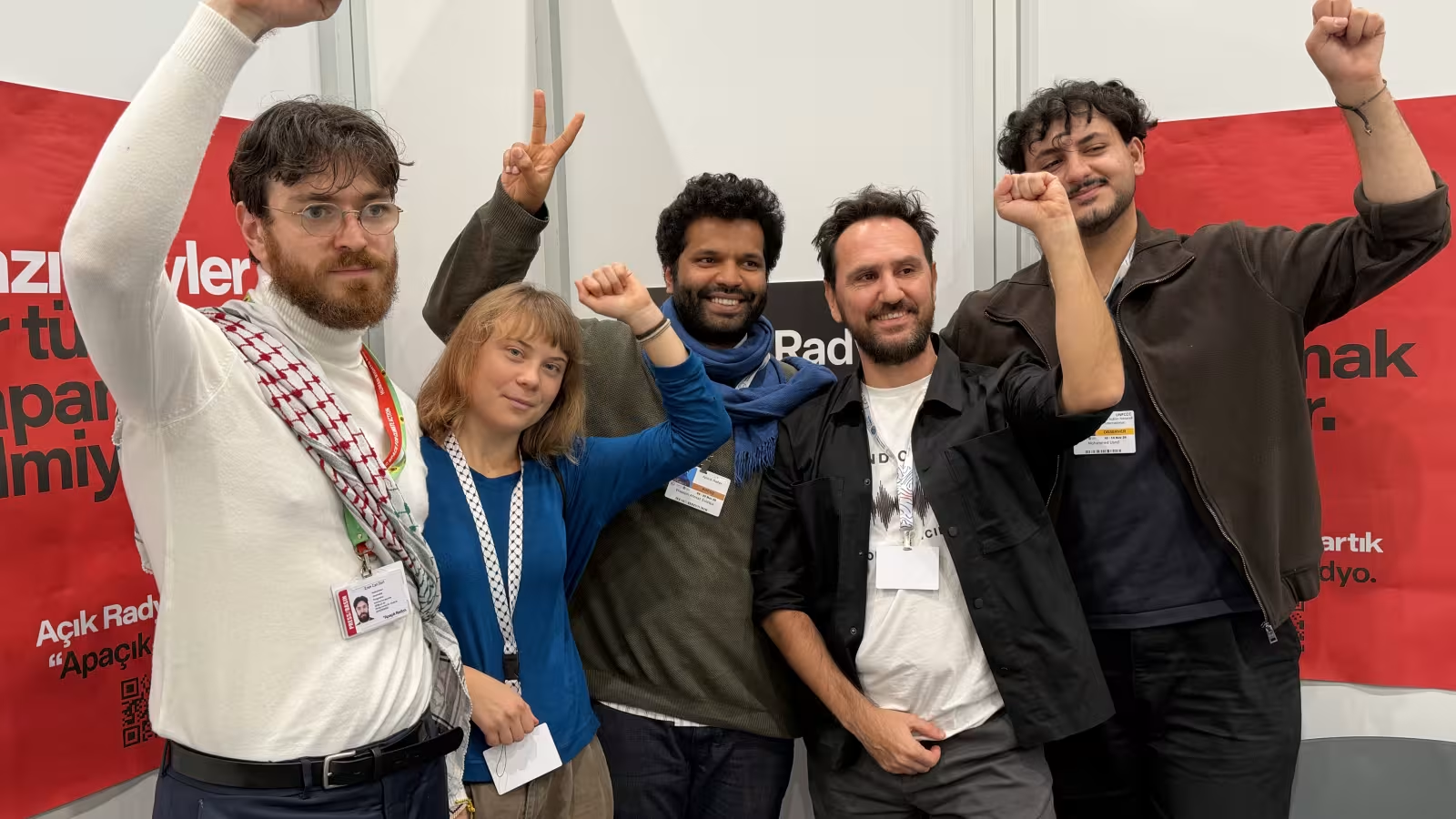
At COP31, Apaçık Radyo spoke with climate activist Greta Thunberg and Palestinian researcher Mohammed Usrof about the meaning of hope amid the ongoing destruction in Palestine and the climate crisis.
Waseem Ahmad Siddiqui: So, we have just come out of a press conference titled “Frontline Communities Demand Climate Justice and Accountability.” And now we have two very important guests with us: Mohammed Usrof and Greta Thunberg.
My first question is for Mohammed. Let’s consider the deep cartography of the area, from Gaza’s subterranean tunnels to its militarized topography, unique soil, settlements, and barriers. The Israeli campaign of violence and displacement has reshaped the region in an effort to make Gaza and its surroundings unlivable. The long-term siege has been in place since 2007, and we know that the genocide began with the Nakba and never ended. Why did people only start to recognize this as genocide after October 7? Could you speak about the relationship between the militarization of Gaza’s geography and genocide?
Mohammed Usrof: Thank you very much, Waseem. That’s a really good question. To answer it, I think we need to go back in history and first understand how we understand complicity.
You asked a few things. First, why are people recognizing it now, after October 7? And second, there is the question of topography, the tunnels, and the system that Palestinians live under today, specifically in Gaza.
I mean, Gaza has always been a significant historical trade route between Africa and Asia and the Mediterranean.
In terms of the ongoing genocide, we recognize that it is not simply three years old; nor did it begin in 2007 or even in 1948. The Palestinian people are an agrarian, tribal people who have lived on this land for millennia. Of course, societies change and transform, as they do all over the world.
Palestinians have long resisted much of the infrastructure we are calling out at today’s press conference. Let’s go back, for example, to the late 1800s or early 1900s. We're calling out Turkish pipelines. Yeah. But Palestinians in the 1920s resisted against electricity grids, against pipelines. Palestinians in the 1920s resisted against Pinhas Rutenberg's concession—an electrical grid that was co-opted by the Palestinian Electricity Corporation. So that was Zionism in its inception as a political ideology with some initial Jewish settlements all the way back in the 1920s and even before. In the 1930s, Palestinians were blowing up pipelines.
The Kirkuk–Haifa pipeline, which at the time was owned by BP, or the Anglo-Iranian Company, was also significant for Palestinians. They resisted BP’s infrastructure, which had been established by the Ottoman Empire during World War I not only to transport coal but also to transport soldiers.
That infrastructure remained. This is how Israel was able to inherit much of what was left by the British Mandate in 1947–1948. The British Mandate of Palestine was under the authority of the British state, and its legacy was subsequently inherited by Israel. And then between the 1940s to the 1970s, we saw American imperialism inheriting kind of the responsibility of nurturing the Israeli state into what we see it developing into today.
Obviously, colonialism has shifted, mutated, and transformed into many different forms. In the past, colonialism was considered acceptable; today, it is frowned upon. Yet its essence remains unchanged, and we can clearly see its consequences in climate change, imperialism, and devastation.
We see presidents being taken away from countries such as Venezuela by the American regime. Political leaders in Iran and Palestine are assassinated, imprisoned, or killed. So we see the campaign to free Marwan Barghouti, but also the assassination of, for example, Palestinian Hamas political officials in Iran, for example, Ismail Haniyeh and Sinwar, et cetera.
Now, the point that I'm trying to make here is that the struggle is not recent. The struggle has been ongoing for more than 100 years. And in Gaza, the most recent mutation and transformation of that is obviously the case of de-development.
We’ve seen how the humanitarian sector has become extremely politicized. We saw a lot of the killing of Palestinians by the Gaza Humanitarian Foundation, which is also controlled and funded and managed by a lot of the global capitalist banks, whether it's JP Morgan. The Board of Peace is managed by JP Morgan. It's also consulted or managed by consultancy firms like Boston Consulting Group or a lot of these other consulting groups like PwC, EY, et cetera. Yeah.
So what I'm trying to say overall is that what we see today is nothing new. We just see new evolutions of it, new forms of climate technologies, for example, that are simply connected to the IDF, like solar geoengineering technology, which is an injection into the air to so-called reflect sunlight. But that's a false solution to distract us from the key issue, which is fossil fuel expansion and the infrastructure that creates forms of dispossession. These new forms are emerging in connection with the IDF, surveillance companies, and AI industries, all of which are being used for militarization during the genocide.
So we cannot continue dismissing the fact that a lot of people in this conference, besides the fossil fuel lobbyists, are also connected to these empires and military-industrial complex regimes and so on. So I'll stop there.
G. T: Well, we know that the people in power do not have the interests of people and the planet in mind. Whenever they have a chance to prioritize people and the planet over short-sighted economic profits and the maximization of geopolitical power—even when it comes to the very easiest steps—they fail to take it.
And we know their intentions. There have been 31 of these COPs, and emissions are at record levels. Obviously, the systems we have in place and these negotiations are rigged. We are facing existential crises, and science tells us that we are heading towards the collapse of the very life-support systems we all depend on to survive.
International law has become a graveyard. At best, human rights are talked about as a distraction from the human rights violations that those in power are committing in their own countries and around the world through this new imperialism.
In no way are we translating any of the things world leaders are saying on stage into action. So the hypocrisy is clearer than ever. And what is so scary is that people, many people still fall for these lies. And they think that the situation is somewhat under control.
Then you come to these spaces and see that, at best, people merely mention fossil fuels one of the main causes of these crises. It is completely detached from reality.
M. O: So to just echo what Greta said, the low-hanging fruit is clear.
We saw this in our campaigns in 2024, when COP was hosted in Azerbaijan. Azeri and Kazakh oil flows through the Baku–Tbilisi–Ceyhan pipeline, the BTC pipeline. TPAO, the Turkish state-owned oil company, is one of its co-owners, and BOTAŞ also has a major stake in the pipeline.
As far as we understand, 48.6% of Israel’s crude oil imports come through the BTC pipeline, via Ceyhan port, and are shipped directly to Israel. This is not something we can dismiss.
Initially, we thought we had some success in Azerbaijan during the COP because Turkey, after global mobilizations, announced a huge trade suspension. And then there was also the other trade suspension in May 2024.
But how can you claim to have suspended trade while collecting so much revenue from the BTC pipeline, and especially from the Caspian Pipeline Consortium (CPC) pipeline, which also carries 28.6% of Israel’s crude oil imports?
If we look only at the revenue that the Turkish state energy company BOTAŞ collects from the BTC pipeline, it receives $1.27 per barrel. In 2025 alone, that amounted to $43.6 million.
As for the Turkish Straits, through which oil from the CPC pipeline passes, the fees have increased eightfold since 2022. In 2026, we expect the revenue to reach at least $254 million.
The same applies to South Africa. It claims not to supply coal to Israel, but in reality, it does. It's this idea of absolving your responsibility because corporations now run it. It's the same patterns that we see 100 years ago. It's the same idea that colonialism now, in terms of responsibility, is either transferred to the middlemen or the corporations as to hide that responsibility.
That is why international law is so ineffective: the Global North has mechanisms for evading responsibility.
So I think the material infrastructure that enables genocide is extremely crucial. That is how genocide is happening.
I think one thing people have realized since October 7 is that they are all complicit. We're all complicit. We all live in this capitalist world. We're all complicit through our ownership of pensions or ownership of investments in fossil fuel companies, in military companies, our institutions, whether you work for a press institution that normalizes and allows for these narratives, whether you work for a school that has investments in these companies, whether your job itself is a complicit agent of genocide, it's really crucial to call that out.
And people since October 7th have realized that the genocide is an absolute act of impunity where states are acting with no shame and acting in the killing of the Palestinian people. So I think it's really crucial to understand how the logic of colonialism functions today. And I think people have begun to realize that, and that's what has got people in solidarity because they understand that they're part of the problem.
Greta Thunberg: Can I also add that, according to international law, when there is even a risk of genocide, all actors complicit in it have a legal obligation to end their complicity?
And yet these same people who are actively driving the genocide are using the, the sort of arguments of maintaining law and order shamelessly to silence and criminalize people who are calling out this hypocrisy and saying “you are the ones violating basic international law.”
Eren Can İleri: My question is about colonialism and narratives. The Zionist entity, and I'm sorry to replicate one of their narratives, has been using this hegemonic state ideology that Palestine is a, quote, “land without a people for people without a land.” I do not agree with this. It's a gross saying. This sounds a lot like the Doctrine of Discovery, right? That we heard Europe push during the colonization of Africa and the Americas. Yeah. Saying that Christians aren't— non-Christians aren't human, and thus their land can be taken.
How do we fight these colonial narratives? How do we break these understandings, and how do we help people understand the connection between land and culture and humanity? Yeah.
M. O: You mentioned the connection between land, culture, and humanity. As I said at the press conference, the media has played a role in supporting a colonial narrative that erases Palestinians from the equation. You act as if Israel has the right to commit such genocide, it has the right to innovate and create these new cultures of capitalism, to normalize, to produce, to expand. It's these narratives and slogans of high-tech, sustainable, modern progress. It's these colonial narratives that Europe was pushing earlier on, as I said, when colonialism was their brand. Yeah.
Israel continues, shamelessly, to promote the idea that Palestine—the Holy Land—was “a land without a people for a people without a land,” as if it were empty and available to Jews displaced from Europe who needed a safe place.
So, first of all, there is a complete erasure of history. But history is only one part of it. I am not saying that everyone in the world must learn history, or specifically the history of Palestine. People should, however, understand their own countries’ colonial histories and legacies, and the role those countries played in violently subjugating people across the global majority.
Another aspect of colonialism today can be seen in Israel’s pavilion at COP29 in Azerbaijan. It was covered with slogans such as “Let’s make the desert bloom.” It was quite literally a desert with a rose, a desert with this, and then going from a desert to modern cities like Dubai or New York or whatever. So it's the fact that Palestine is not that. We shouldn't transform Palestine into another Silicon Valley or another Times Square just for the sake of capital.
If you remember, around the time Kushner’s Board of Peace project was announced, some slide decks were leaked. I don’t think they were from JP Morgan. And it was like this— Yeah. Gaza Riviera and so on. So we know that the idea is to transform Gaza into another capitalist city.
And this is not just about exploiting people or stealing the gas off their shores. There is also the narrative that Israel withdrew from Gaza in 2005 as a strategic move. But we know that this was not the case. It's just that they had already taken all that they needed from Gaza. They've turned it into a wasteland. We had rivers from Mount Hebron all the way to our shores, but that has been absolutely wasted because of the Israelis at the time, the settler colonials, which, in which, if you know the Palestinian geography, Gaza and the West Bank are completely separated by settlements all over the country.
Today, we can understand how colonialism shapes topography and geography, and how Palestinians continue to experience the expansion of settler colonialism. As I said, Palestinians in the West Bank still face displacement time and time again. Settler settlements are still expanding in the West Bank, and OCHA has all the information on that.
My point is that the erasure of Palestinians can only be challenged by having media platforms through which Palestinians can share their stories.
Another thing I haven’t mentioned is that the genocide since October 7 has been extensively documented. Everyone had a phone, and people were able to share videos of airstrikes as they happened. It is a livestreamed genocide. The world was able to see it because the attacks were livestreamed on Instagram.
But we have not even seen 1% of what happened on the ground or of the suffering Palestinians have endured, because not everything can be livestreamed, and not everything can make it into the mainstream media.
What we need to understand is that, as I said when I called out the media during the press conference, the media plays a huge role in the dehumanization of Palestinians—and it could play an equally important role in humanizing them. That is how the media functions: it manufactures consent, creates false narratives, and enables settler colonialism in 2026.
W. A. S: A very short question. Okay, sure. If you, if you allow, huh? Thank you. Özdeş? So the Israel occupying forces likes landscapes because there are hills from which they can control area with tanks, missiles, and similar vehicles. They continue to remain in the region which is surrounded by mountainous landscape.
The landscape that they have created consists of the rubbles of people's lives, and there are bodies amid those rubbles. The entire city is now filled with rubbles.
Please speak about how has the Zionist entity shaped the geography and topology of Palestine.
M. O: I really want to quote a passage from an article by the Palestinian scholar Nadera Shalhoub-Kevorkian, titled “Ashla’ and the Genocide in Gaza.” She draws on the voices of many Palestinians. It is a much-discussed article, written during the genocide, and it examines the concept of ashla’.
Ashla’ refers to the limbs and body parts of Palestinians. The author says that ashla’ has become part of everyone’s life in Gaza and offers a vital concept for understanding the situation. Speaking about ashla’ is a refusal to remain passive in the face of horror: the exploded, shattered, decomposed, and unidentified body parts collected by Palestinians expose the inhuman brutality of the assault.
Haneen, haunted by cracked bones and bleeding flesh, feels the need to rescue the ashla'a, the limbs of her loved ones, from being eaten by dogs and cats.
As her family’s body parts are collected for burial, little Lina holds her cat in her lap, pleading with it not to eat her if her family is bombed and she is turned into ashla’.
In the act of speaking to her cat, Lina, a child, creates a space of respect for life and dignity during an ongoing genocide in which the colonial state and the global community are failing to protect even dismembered bodies.
When you say that Palestinians are living among the rubble of their family homes, I think of my aunt, for example. In March 2024, we lost 22 members of our family—my entire father’s side of the family, except for my father’s sister, my aunt. She survived because she had been displaced and was staying at her husband’s house. But then her husband also lost his family, and they lost the house they had taken shelter in. So she had to move back and live on top of the rubble. That is an extremely harsh reality for anyone to face.
That is the part of the livestreamed genocide that it does not capture. How do you go about your daily life in Gaza as a Palestinian when the entire Strip is filled with the bodies of dead Palestinians? How can we ever recover the memories, stories, or identities of all the Palestinians killed by Israel?
So this is quite literally the definition of genocide. And ecocide should be the idea of making the land uninhabitable, but this is just much more beyond that. This is absolute destruction of life, a deformation of the land. There's no geography anymore because Gaza has been absolutely decomposed of any conditions of life.
There is no land left to farm. According to figures from May, as far as I remember, only 3% of Palestine’s cultivated land remains suitable for agriculture.
And, again, Palestinian society is not free of class hierarchies or social divisions. There is significant internal fragmentation, especially under the conditions of genocide. The basic rules of social life are breaking down; there is no law and order.
So how can Palestinians continue to sustain social life? People are still living there, but they have no access to water or healthcare. And that creates clear disparities with the Palestinians whose families might have hoarded food.
Another issue is that the distribution of humanitarian aid is itself a political choice. Some families have no money at all, so they have to sell the food parcels they receive, creating a market. Humanitarian aid, whose calories are calculated by Israel before it is allowed in, is then redistributed. Not every child or every family receives the same amount of food.
So that's kind of what I just wanted to say. And at the moment, I think we need to recognize kind of the state of rubble and collapse as a society.
Ö. Ö: Okay, one last question. It is about hope. You know, you say that hope is found in action, that hope emerges through action. And it seems like this Palestinian resistance is the millennium's Vietnam War. It's awakening the oppressed all around the world.
And last week in France, there was a general strike. People were waving Palestinian flags as well. Yes. And in Spain, just yesterday, there was a strike. People were waving Palestinian flags as well.
We are in the midst of a climate catastrophe, as you know, and we are not expecting much from COP31. So what would you say about hope? Do we have hope still?
G. T: I am so frustrated with the jargon and discourse around hope. What does hope mean? Hope for whom? Hope for us privileged white people living in the so-called Global North? Hope that we can continue reproducing this destructive system that we know will lead to our demise? There is no hope in that. The only hope of creating something else lies in actually doing it. What do we mean when we talk about hope?
I also get angry when I see people from backgrounds similar to mine saying, “Well, there is no hope, so we might as well give up.” There are some reports saying that, oh well, it's, it's already too late. You do not have any right to say there is no hope left, let's give up, because you are not the one living through the direct and harshest consequences right now.
And, as we just heard Mohammed say, the world has already ended for many Palestinians, and yet they continue. So who are we to say, oh, it looks too dark, I'm not gonna get involved? Of course not. That's just a complete betrayal of everything humanity supposedly stands for, everything we have accomplished so far.
And yes, of course, we have always experienced different crises. Human beings have existed for around 200,000 years, and throughout that time we have faced emergencies, crises, and humanitarian disasters.
But the difference now is that humanity is entering uncharted territory. We are dragging every species with us on our way out of what scientists refer to as the corridor of life, which is around 14 degrees Celsius—the average temperature on Earth over the last three million years. We are leaving that.
We are playing with forces so beyond human control, which will impact the whole of humanity from now on. It is what we do now or don't do now, which will determine the rest of humanity and also the entire biosphere.
Ö. Ö: Yeah.
G. T: In these crises, we know that we will face catastrophes either way. The question is how we deal with them and how much we can mitigate them.
Every life we can save is worth saving. Every catastrophe we can prevent is worth preventing.
And this false dichotomy—that we can either carry on as we are or make a transition—is not real. Either we make as much change as we can, as quickly as possible and on our own terms, to protect everything we hold dear, or we will be forced to change as the systems around us collapse. Those are the options before us, and what we do, or fail to do, now will determine which path we take.
And we are all political agents, whether we march or not. If you remain silent in the face of injustice, you are choosing the side of the oppressor.
We are living through extremely difficult times, under an extremely radical ideology—whether you call it neoliberalism, imperialism, or capitalism. Somehow, the idea that a very privileged few have the right to sacrifice the global majority and the entire planet just so they can continue making a little more money has become accepted as truth. That is an extremely radical idea.
And being silent and just accepting that as the reality is an extremely strong political statement.
Ö. Ö: Okay.
E. C. İ: I have one for you. You talked about resistance, and it is our duty to resist in the Global North, obviously, especially when our countries are responsible for the pain that is suffered all over the majority world.
Some of the most impactful campaigns over the last couple of years have been Palestine Action, have been Les Soulèvements de la Terre.
Do you think our tactics need to continue evolving and escalating to dismantle destructive machines, whether the war machine, whether pipelines, whether AI infrastructure?
G. T: I think it is inevitable that they will. I'm surprised that we aren't seeing more disruptive activism happening now. But we know that if we continue like now, of course, people are going to have to respond accordingly.
Throughout history, we have never won our rights by asking nicely. We have won them through continuous, long, and often harsh struggles.
So I don't think we have any other choice. And again, the changes are going to come whether we like it or not. It is just about how we adapt to them and how much we can mitigate them.
But we know that the people currently in power, as we have said and as we have been shown time and time again, will not come to our rescue. They are not acting for the benefit or protection of humanity.
Ö. Ö: Okay, comrades Mohammed and Greta, thank you for joining us today at the Apaçık Radyo office at COP31. It has been a great pleasure to have you here.
W. A. S: Thank you all. Thank you, Mohammed Usrof and Greta Thunberg. Thank you so much.
W. A. S: Empower all of us. Empower all of us.
COP31'de neler konuşuluyor, hangi kararlar alınıyor? Resmî müzakerelerden alternatif zirvelere, iklim hareketinin seslerinden gezegenin geleceğini belirleyecek tartışmalara, Antalya'dan gelişmeleri COP31 Özel Yayını'nda takip ediyoruz.