Image
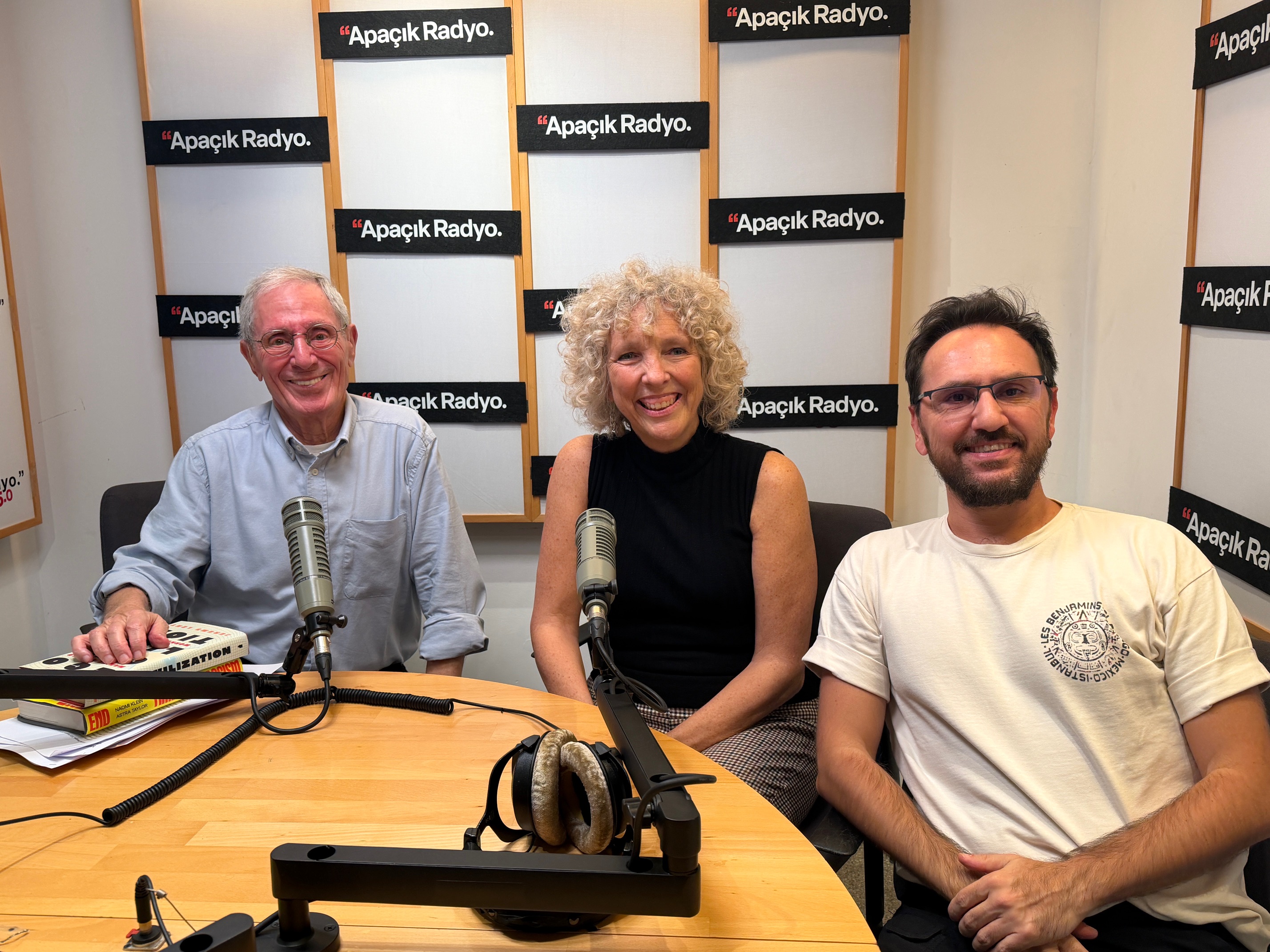
On Açık Gazete, Ömer Madra and Özdeş Özbay speak with Jennifer Morgan, a leading figure in climate diplomacy, about expectations for COP31, the phase-out of fossil fuels, just transition mechanisms, and the importance of taking concrete action to address the climate crisis.
Ömer Madra: We will be speaking with Jennifer Morgan, who has more than 30 years of experience in international climate and energy policy, diplomacy, and civil society leadership. She is a 2026 Mercator-IPC Senior Fellow. She currently serves as a Senior Fellow at the Climate Policy Lab at Tufts University's Fletcher School of Law and Diplomacy and as a researcher at the Hertie School in Berlin.
Previously, she served as State Secretary and Special Envoy for International Climate Action at the German Federal Foreign Office. During her tenure, she played a key role in the establishment of the Loss and Damage Fund and in securing decisions aimed at ensuring a just transition away from fossil fuels.
Before that, she served as Executive Director of Greenpeace International, Director of the Global Climate Program at the World Resources Institute, and Director of the Global Climate Campaign at the World Wide Fund for Nature (WWF).
And now, we have the opportunity to speak with her. It's quite an interesting day to be recording this interview, isn't it?
Özdeş Özbay: Yes, Jennifer Morgan gave a speech on Friday at an event titled “Pre-COP: Final Preparations Before Antalya,” organized by the Istanbul Policy Center. Following that event, she is now here with us in our studio.
Hi Jennifer, welcome to our show.
Jennifer Morgan: Hi there.
Ö.M.: Welcome.
J.M.: Very happy to be here.
Ö.M.: Thank you. We're very happy to have you here.
Ö.Ö.: First of all, in your speech at the conference today, you mentioned that COP31 will be jointly presided over by two countries. You also pointed out that the partnership between Türkiye and Australia could bring certain advantages to the COP process. Perhaps we could start there. What are your expectations for COP31? In other words, what decisions do you think need to be made for the summit to be considered a success?
Ö.M.: After your response, I'd also like to ask a question on this topic.
J.M.: Great. I think COP31 will be considered a success if, by the end of the summit, there is a clear message to the public, businesses, and governments that the future lies in clean electricity, and if it is made clear that the world will accelerate its transition away from fossil fuels.
But what does that actually mean in the midst of complex diplomatic negotiations? I think it means continuing the process of bringing together countries that want to make progress in transitioning away from fossil fuels and forming a kind of coalition of countries willing to take action.
I hope that some countries will come together and support the creation of an alliance to advance the transition to clean electricity.
There are also certain decisions that need to be agreed upon through the negotiations. For example, the Just Transition Mechanism. How are we going to ensure that this transition is carried out fairly, and what exactly will this mechanism cover? These are questions that also need to be resolved.
Another important aspect of this COP is the impacts of the climate crisis being felt around the world, from Istanbul to Nepal, as we approach the summit. That is why I think that, by the end of COP, there needs to be an agreement on clear indicators for increasing resilience, whether in terms of food security or infrastructure. How can we make our economies more resilient to the impacts of climate change?
In addition, there needs to be clarity on how wealthy countries will fulfill their financial commitments to climate adaptation. Last year, they pledged to triple adaptation finance by 2035. This year, we need to ask them: Have you actually taken action to deliver on that promise? Are you doing what needs to be done? This is absolutely vital for Africa, small island states, and the world's poorest countries.
Ö.M.: I'd like to add one more question. We have a segment on our radio station called “Quote of the Day,” which airs five days a week. Today, we chose a quote from a statement by young people. The “Change Ambassadors” called on the COP31 Presidency not to delay the transition away from fossil fuels.
Young people, who will directly experience the impacts of the climate crisis, emphasized that statements describing COP31 as an “implementation COP” must be backed by concrete action, and called for no further delays in the transition away from fossil fuels.
The young people say:
“We are young people who live and study in Antalya and share in the future of this city. From Antalya, which will host COP31, we are raising our voices not only for our own city, but for the future of our entire country and our planet.”
The young people also make the following appeal:
“Announce a time-bound plan for a just transition away from coal! While the climate crisis threatens our lives, coal-based energy production and mining activities continue to harm both nature and human health. Yet, for years, instead of concrete steps towards phasing out fossil fuels, we have been met with promises.”
Referring to statements by the COP31 Presidency that the summit will be an “implementation COP,” the young people emphasize that they want to see these promises translated into concrete action.
What are your thoughts on this?
J.M.: Clearly, these are extremely well-informed and thoughtful young people. And it's really wonderful that they are making their voices heard ahead of COP.
I'd like to make two points about what they're saying. First, as I understand it, what they're really saying is this: The word “implementation” means nothing on its own unless you back it up with concrete action and demonstrate not only how you intend to deliver on your commitments, but also how you plan to accelerate that process.
Because we know from all the plans that have been announced so far that unless we take action, do more, and accelerate the process, temperatures will continue to rise and the impacts of the climate crisis will become increasingly severe.
Second, I absolutely agree with these young people that Türkiye, as the host country, also needs to demonstrate what it is doing to deliver on its commitments.
Many countries around the world are beginning by phasing out coal for a variety of reasons. Of course, climate change is one of them, but so are air pollution and the harm caused to local communities.
And this transition must be a just one, involving local communities and workers in the process.
I think that if Türkiye wants to be taken seriously on the international stage as a COP host country, it needs to demonstrate concretely how it intends to accelerate the implementation of its commitments.
It should announce that it will develop a roadmap and put forward a plan to phase out coal.
Scientists tell me that this phase-out needs to be completed by 2030.
Ö.M.: 2030, yes. In fact, what the young people say in their statement aligns almost exactly with what you've just expressed. They say, “Implementation does not mean making new promises. Implementation means taking responsibility and taking action.”
I think their emphasis on taking responsibility is particularly important. Türkiye needs to put forward a just transition plan for phasing out coal, with clear targets and a specific timeline.
As you just pointed out, one of the steps we need to take to achieve a clean and livable future is to begin the process of phasing out coal in a planned, determined, and fair manner.
J.M.: Great. I think the more attention we draw to this issue, the better. And not just because of COP, but more importantly, for the people who live here, because we can clearly see the harm caused by coal.
I think Türkiye is fortunate in this respect because it has enormous potential for other sources of energy. For example, it has already started increasing its investments in solar energy.
Türkiye could make tremendous progress in solar energy. After all, this is the foundation of the modern economy that is being built today, especially at a time when we are facing an energy crisis stemming from the situation in the Strait of Hormuz and the dangers of fossil fuels have become so clearly apparent.
Ö.Ö.: Yes, but it seems rather unlikely that a commitment to transitioning away from fossil fuels will be one of the outcomes of this summit. Just last week, Türkiye's COP31 President, Murat Kurum, who had travelled to Fiji for a preparatory meeting ahead of COP31, explicitly stated at a press conference that “the world is already undergoing a transition.” He said that focusing on the phrase “transitioning away from fossil fuels” in climate negotiations might not be particularly productive.
Australia's Minister for Climate Change, Chris Bowen, also stated that, in order to end the use of fossil fuels, we need to build enough renewable energy capacity to make fossil fuel-fired power plants unnecessary. That implies that fossil fuels will continue to be used in the meantime.
So, these are the kinds of statements we heard from these two key figures just last week. To what extent do you think the transition away from fossil fuels will actually be discussed at this summit? Do you even think the term “fossil fuels” will appear in the summit's final declaration?
J.M.: I think it might be helpful to go back a little into the history of these negotiations. Three years ago, at COP28 in Dubai, when I was leading the German delegation, we had lengthy negotiations over the wording. After hours of negotiations that went well beyond the scheduled time, and despite many difficulties, all countries finally agreed to transition away from fossil fuels in a just, orderly, and equitable manner.
This is very similar to what the young people are calling for, because this transition needs to happen in a planned and orderly way. A chaotic transition is in nobody's interest.
Ö.Ö.: So, were those negotiations unproductive, then? If we go by what Murat Kurum said…
J.M.: I think the real question now is how we are going to make this happen and how we are going to implement it. We shouldn't get too caught up in whether or not a particular phrase appears in the text, because we have already made a decision on this. We don't need to go back and insert the same wording into the text again. It's already there.
We have an action agenda that includes a range of different initiatives aligned with the goal of transitioning away from fossil fuels in a just manner.
And last year, a group of countries announced that they wanted to develop roadmaps for transitioning away from fossil fuels, because they recognize that this transition requires planning. Brazil is also going to release a global roadmap next week to help guide how this transition can be achieved. Countries are beginning to put forward their own roadmaps as well.
So the real question at this COP will be how to make the transition happen, and whether the COP presidencies will create space for countries that want to move forward to continue these discussions. I think they absolutely need to keep that space open.
And in response to Minister Bowen, I would draw on our experience in Germany. What we learned in Germany is that we cannot wait for one thing to be completed before starting another. We have to do everything at the same time. We need to phase out fossil fuels while simultaneously expanding renewable energy capacity.
In Germany, we established a Coal Commission. In fact, this happened under Chancellor Merkel. She brought together representatives of workers, local communities, scientists, civil society organizations, and the government, and asked a fundamental question: What should the timeline for this transition look like?
I think that is exactly the kind of approach we need: a process that involves all parts of society.
I believe this will be an important issue at COP31. However, I don't think the discussion will revolve around particular words or phrases.
The real question will be whether we can maintain the momentum of this coalition of countries that are determined to take action and develop concrete roadmaps.
I think more countries will come forward with their own roadmaps. Countries such as Nigeria, Chad, and Kazakhstan are also currently working on theirs.
So how do we bring all these roadmaps together? How can countries cooperate to make this transition happen? And, in particular, how can they support one another to ensure that the poorest countries are able to implement this transition?
Ö.M.: I'd like to ask one more follow-up question about Minister Murat Kurum's remarks. At the pre-COP31 leaders' meeting held in Tuvalu and Fiji, COP31 President Murat Kurum referred to the concept of “Taku Pakasoa,” which comes from Pacific Island cultures. In the Tuvaluan language, Taku Pakasoa represents unity, solidarity, and the strength that comes from acting together.
In his speech, Kurum said:
“In the spirit of Taku Pakasoa, we must unite our voices and, on the road to Antalya, call on all parties to take action for our shared future, so that children living in Tuvalu, Fiji, or Nepal will never again have to endure the suffering caused by the climate crisis.”
And one of our youngest radio hosts, Atlas Sarrafoğlu, who first appeared on our program to talk about climate change when he was just seven years old and began hosting his own broadcasts a few years later...
J.M.: Wow!
Ö.M.: Yes, he was 12! He's 19 now. And in one of his recent programs, he said:
“If we are truly going to talk about unity and collective action, as expressed by the concept of Taku Pakasoa, then the measure of our commitment, as you also pointed out earlier, should not be how powerful our statements sound, but what difference the decisions we make actually make in people's lives.”
What do you think of his words?
J.M.: Yes, I think he's absolutely right. Because this COP offers an opportunity to address some of the fundamental challenges that people are facing in their everyday lives right now.
Take energy prices, for example. Prices are rising rapidly. We know that renewable energy is much cheaper than fossil fuels. So we need to accelerate the transition to renewable energy through an alliance for clean electricity.
But we need to do this not just through words and statements, but by providing financing to help countries make this transition, and by sharing knowledge and experience on how to build and develop electricity grids. Because obstacles related to electricity grids are among the biggest barriers to the transition to clean electricity.
Making progress in this area, and thereby reducing people's energy bills, is extremely important.
And in some parts of the world, fuel is now being rationed because of what is happening in the Strait of Hormuz. That's why we're seeing countries in Southeast Asia, Africa, and many other parts of the world increasing their investments in renewable energy. They need to do this to meet people's most basic everyday needs.
That's one concrete example.
Another example is how we can build greater resilience to the impacts of climate change. For instance, making buildings more resilient so that when a major storm hits, your home isn't destroyed.
I think some important decisions need to be made at COP in these areas. That way, people can see that the issues countries come together to address at COP are genuinely connected to their everyday lives.
But I also think that people should hold their leaders accountable wherever possible. Because one thing is certain: they are not moving fast enough on any of these issues right now.
Ö.Ö.: Yes. Climate change is already contributing to social unrest and mass protests. We've seen this recently in France. Of course, climate change wasn't the only cause of the protests, but “extreme heat in classrooms” was one of the issues being raised.
We saw something similar earlier with the Yellow Vests movement, where rising fuel prices under the guise of a climate tax were also a major issue.
We also saw how increases in food prices linked to climate change played a role in the uprisings that began in the Middle East in 2011. Even in Syria, water scarcity and the large-scale migration it triggered were among the significant contributing factors.
So, as you mentioned a few minutes ago, one of the most important items on the agenda at this summit will be the establishment of Just Transition Mechanisms, in line with the decision taken at COP30 in Brazil.
However, as far as we can see, neither Türkiye nor Australia has provided sufficient clarity on this issue so far.
So, from your perspective, what exactly do Just Transition Mechanisms mean? I realize this is a rather broad question, but do you think such mechanisms can actually be established at this summit?
J.M.: Yes, I think they can be established. Perhaps I could start with an example at the local level, and then we can look at what can be done at the global level.
One example of a just transition at the local level is the phase-out of coal, which we were discussing earlier. During my time in office, I visited South Africa, where they are working very hard to ensure a just transition away from coal.
They are looking at how to create new employment opportunities for local communities, how to improve economic conditions for everyone in the region, and what kinds of opportunities can be developed. And they are doing this by involving local people in the process.
So, for me, a just transition at the national or local level could also apply to a place like the Amazon. The important thing is to bring together people whose livelihoods need to change.
Someone who previously made a living from coal mining now needs to earn an income from something else. Or someone who made a living by cutting down forests now needs to find an alternative source of income.
So we need to work on creating new opportunities for those people.
And in some places, when people lose their jobs, they can even lose their health insurance because their healthcare coverage is tied to their employment. These are very concrete issues that directly affect people's lives.
So yes, I absolutely believe that, at the national level, there needs to be an inclusive, participatory process that brings together all parts of society.
At the international level, the discussion is about how countries can share their experiences of making this transition.
Of course, something that works in Germany may not work in exactly the same way in another country. But, for example, the idea of establishing a coal commission that brings together all parts of society might also be of interest to South Africa.
So the idea is to create an international platform where countries can ask one another: “What have you done? How can we learn from each other's experiences?”
But I think one of the most important questions will be how to finance these transitions.
That's the really difficult part, isn't it? Sharing ideas and experiences is relatively easy. But how will the financing component of the Just Transition Mechanism actually work? What kind of financial mechanism will be established to support it?
And a just transition is not limited to the energy sector. It concerns every sector.
For example, we also need a just transition in transportation. How people get to and from work, and how we ensure that everyone who needs it has access to clean public transportation, are also part of this transition.
So the issues that need to be addressed and the steps that need to be taken are actually quite clear.
But I think the biggest challenge will be financing.
Ö.Ö.: You mentioned learning from one another's experiences, and perhaps that could be one way of understanding how these mechanisms might be implemented.
So what I'd like to ask you is this: Can you give us at least one example from Germany that you consider to be a genuinely successful just transition?
Because we've interviewed many people and experts from different parts of the world, and they tell us that even the German experience hasn't actually been very successful. They point out that workers were often encouraged to take early retirement and that some of them lost certain rights in the process.
We also spoke with representatives of a movement called Climáximo in Portugal. They told us that, as a result of their movement's struggle, some oil refineries were shut down, but unfortunately, workers lost their jobs. They said they had not been able to achieve a just transition.
So, despite looking into examples from different parts of the world, we haven't been able to find a truly successful and satisfactory example of a just transition.
Do you know of any such example?
J.M.: I can give you an example from Germany. It's the example I know best, and of course I'm aware that it hasn't been perfect.
But there are two regions in Germany that have gone through the process of transitioning away from coal. One of them has already completed that transition. I'm talking about the state of North Rhine-Westphalia in western Germany.
It's no longer a region associated with coal production. It has become a high-tech hub.
Yes, there were people who took early retirement. And I don't think Germany is a good example in every respect, either, because companies were compensated for their stranded assets. Right?
So it was a very costly process, because the companies managed to secure large payments from the government in exchange for ending coal production earlier than planned.
However, new areas of economic activity have also developed in this part of the country, and the regional economy is doing quite well today.
The other example is in eastern Germany. There, too, I think local communities have benefited from the transition, because former coal mining sites have been transformed into a vast park with lakes and various recreational areas. Tourism has also developed.
Of course, this is a process that takes much longer.
I think there have been both positive and negative aspects to the transition in this region. But I would say that both examples have been reasonably successful in terms of creating new economic opportunities for people and developing new economic activities and industries.
And these were regions where, traditionally, the entire economic and social life of the communities had revolved around coal.
As you know, there's also an issue of identity involved in this transition. These communities have lived with coal for generations. It's what their families have done for generations.
So it's extremely important to think not only about the economic consequences of the transition, but also about what it can bring to the lives of local communities.
Ö.M.: We're now approaching the end of our program. Finally, I'd like to ask you to share a few thoughts on a recently published book. I'm referring to Eco-Civilization by Jeremy Lent, one of our favorite authors. The book's subtitle is Creating a World That Works for All.
At the end of the book, he writes the following, if I may quote:
“Humanity stands at a turning point in its own story. We have been born into a decisive moment, a time when we can influence the direction history takes and shape our own destiny. We may never know the ultimate outcome of the collective efforts we make at this critical juncture in the history of life on Earth. But we can dedicate ourselves to this purpose, knowing that nothing we could possibly do would carry a deeper meaning.”
Jennifer, as a final question, what are your thoughts on these words?
J.M.: I think the climate crisis is also a crisis of humanity. Because what is happening now, and what lies ahead of us, is profoundly unjust. People who have contributed nothing to creating this problem are seeing their homes, their livelihoods, and even their very existence threatened.
That's why I believe that, at a time when humanity is facing such an enormous threat, it is more important than ever for us to work together to preserve our humanity and reaffirm our human values.
On a personal level, I can also say that I've had the privilege of working on climate change for many years. It has been an incredibly meaningful experience for me.
And I think people are searching for meaning in their lives, too. Because when you work together to make the world a better place and leave a better future for your children, what you're doing truly has meaning.
There are children all around the world today who are suffering from the impacts of the climate crisis and who deserve a better future.
And that's why the time to act is now. This is the moment.
Ö.Ö.: Unfortunately, we've come to the end of our program. Jennifer, thank you so much for taking the time to join us.
J.M.: It was a great pleasure for me, too. I really enjoyed our conversation.
Ö.M.: The pleasure was ours, too.
J.M.: Thank you.
Ö.Ö.: Yes, Jennifer Morgan, one of Germany's prominent climate diplomats, I think it's fair to say, and a leading figure in civil society, was with us today. We had the opportunity to have a brief conversation with her.