Image
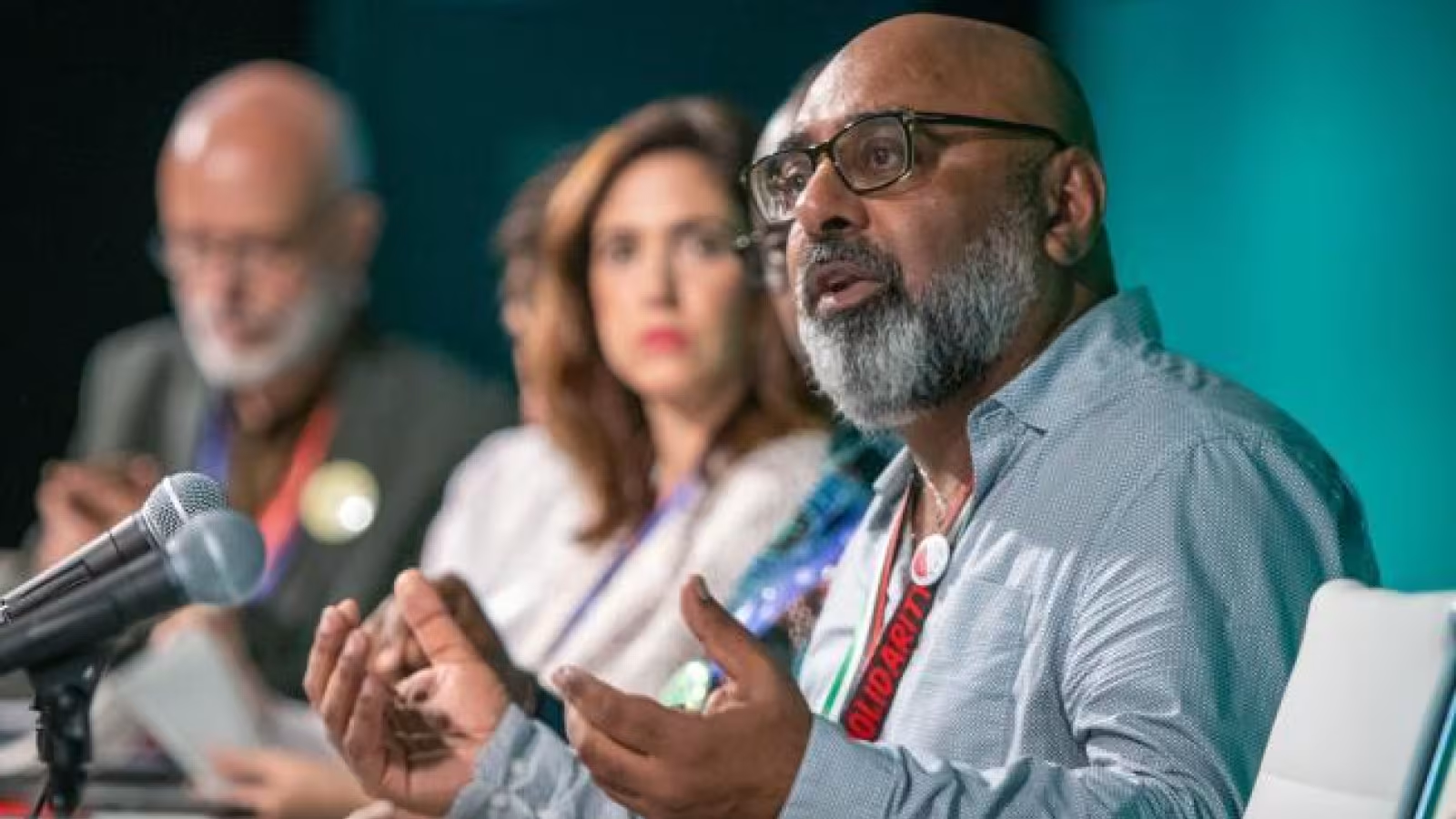
As part of COP31, we speak with Asad Rehman, Executive Director of Friends of the Earth, about the inseparable link between climate justice and human rights, environmental racism, racial capitalism, inequalities in the Global South, enforced disappearances in Balochistan, and the importance of international solidarity in the face of growing authoritarian repression worldwide.
Asad Rehman: Yep, my name's Asad Rehman. I'm the Chief Executive at Friends of the Earth. Thank you.
Waseem Ahmad Siddiqui: No climate justice without human rights. Today, Saturday, the 14th of November, a climate march will be held in a couple of hours at Karaalioğlu Park in Antalya, organized by the People's Summit, Climate Action Now, and many others, where I believe the slogan "No climate justice without human rights" will also be raised. We are joined by Asad Rehman, Executive Director of Friends of the Earth. Asad, thank you for joining us. It's great to see you in person.
A.R.: It's a real pleasure to be here with you.
W.A.S.: Asad, this is a very different kind of summit, as what is being put on the table, not by states but by civil society, is that human rights and climate justice must be considered as one. Could you speak about that and also about those who were not allowed to attend COP31 in Antalya, those activists who were imprisoned? Are you aware of their situation?
A.R.: So I think if you think about the struggle for climate justice, it has been one that many of us have been fighting for decades, as much about how we understand the climate crisis. Now, there were some in mainstream environmentalism who only understood the climate crisis as being an issue about reducing carbon. But when the climate justice movement was formed, bringing together justice movements of the Global South and environmental justice movements in the Global North, our demand was: We are not simply cutting carbon; we are cutting injustice.
And we recognized that the climate crisis was a systemic crisis that brought together many other crises. It amplified all other existing inequalities and injustices. And we know that the vulnerabilities people talk about are overlaid with race, class, gender, disability, and sexual orientation. It's the people who are on the front lines who face compounding inequalities.
And of course, the climate crisis is the greatest inequality in itself, in that the people who are most impacted are always the people who are least responsible for it.
But we are also at a time when these crises are now at such a level that they are coming together. We're about to breach the 1.5-degree guardrail. We can see the devastating impacts of that crisis, whether it's killer floods, droughts, or famines. We see how many people's lives and livelihoods are being impacted, not just in the Global South, but increasingly in the poorest parts of the Global North as well.
We know our ecosystems, the very things that humanity needs to survive, let alone thrive, are unraveling before our eyes. Our air, our water, our land, our forests, even our food. All of these things are at risk, but they're all overlaid with a world that is riven by deep economic inequality as well.
Look, half the world still struggles to barely survive. Even though we live in a world of absolute abundance, we see that the rich are getting richer, and of course, more and more people are struggling simply to make ends meet, feed their families, or heat their homes.
So in that context, the question of human rights is a very central one. Now, we're not simply talking about it in a very narrow sense, because again, some people think about human rights only in a very narrow civil and political sense.
Human rights are about the right of people to live with dignity. And living with dignity is about the expression of their full rights: the right to housing, to food, to health, to education, to income. But it's also about recognizing how questions of gender, race, and class interplay with people's ability to achieve all of these rights.
So in that sense, the call that there is no climate justice without human rights has been a very central part of both trying to ensure that there is a better understanding of human rights in their full, comprehensive sense and locating human rights within this fight.
Because one of the things about the climate crisis that I think many of us would say was a mistake by mainstream environmentalism is that they thought the climate crisis was something that, as long as we produced the evidence, did the reports, and showed the research, governments would somehow act rationally and act on it.
Rather than understanding that this was a deeply political issue, because there were powerful vested interests, institutions, people, and companies who were amassing so much wealth from exploiting the planet and people that they would never give up that power.
And this, therefore, was a battle about power as well, between ordinary people and these elites. And in that sense, that struggle for power would always result in the repression of those voices who spoke up about it.
And that's why we see the repression of land defenders, of people who are drawing and joining the dots between their realities and the climate crisis, and of those who are speaking up in solidarity and saying, "Even though this might not necessarily be me now, I know that tomorrow what is happening in Palestine is going to be transferred to the streets of New York or London or everywhere else."
If the state, if Europe, can turn its guns and its batons on its young people for standing up for Palestine, of course they're going to do the same when the climate crisis starts to divide our own communities in the Global North.
So we know now that our struggles and our fights are all interrelated.
And so, for the last few years, particularly when we went to the climate talks in Egypt, one of the things that the climate justice movement there said very explicitly, because we understood that one of the things about the climate summit is that this is an opportunity for the international community and movement to come here to stand in solidarity with our national and domestic movements in their fights, help amplify their voices, and even provide a safer space for them to organize.
Because, of course, the world's attention and the world's media are there, and we're able to lift up the voices of those who are being repressed, people who are in prison, and call for the release of political prisoners.
We're able to highlight how a state that may host climate negotiations is, at the same time, imprisoning its own people for speaking out.
And in Egypt, we really spoke about that and said there is no climate justice without human rights, and called for the release of Alaa and other political prisoners, because we knew that the Egyptian movements had been so repressed that they were unable to effectively have their voices heard.
And so they required the international climate justice movement to amplify their voices. And that's been an issue, whether it's been in Dubai or in Azerbaijan.
W.A.S..: Yeah.
A.R.: And of course, now here in Turkey. But this is not just something that's happening in the Global South. This is increasingly, as we know, an issue even in the Global North, where more and more young people are now being imprisoned, people who are speaking out about Palestine and people who are speaking out about climate.
In both of those areas, anti-terror legislation and arguments about national security are being used, and those are then legitimizing governments and regimes in other countries who say, "Well, if Britain can imprison people, so can we. If Germany can silence people and use riot police to break up demonstrations, why can't we?"
And so what you see is a globalization of repression and authoritarianism. And that requires us to also globalize our resistance and globalize our stand for justice.
W.A.S.: Yeah, yeah, exactly. That's what we were talking about: internationalism on our side, among those who are in opposition.
Eren İleri: And I'm sure that internationalism played a pivotal role in shifting towards the climate justice framing. But can you tell us a bit more about the narrative work and the agenda-setting that needed to happen to bring mainstream Global North environmentalists into the fold, to recognize that climate is a justice issue and not just a question of ppm?
A.R.: So, thinking way back to 2006 and 2007, when there was a major break from what we call mainstream climate environmentalism, a number of organizations, Friends of the Earth International, La Via Campesina, and many others from the Global South came together and said, "We need to create a new space, and we're going to call ourselves the climate justice movement."
And the reason they did that was because, for too long, people had been told that justice was a distraction, that the most important thing was simply to follow a straight line towards reducing carbon.
And many movements in the Global South made an argument: Why is it that in the Global North, you are running campaigns calling on your governments to act, but then don't say what that action should be?
And it was really apparent on this one major issue, which was that the European Union and major environmental organizations in the Global North, primarily in the US, Europe, et cetera, were calling for a 2-degree target.
And the movements in the Global South were already saying every tenth of a degree increase is not only dangerous, but deadly for us. And we're already on the front lines of that.
And so the climate justice movement stood with countries like Bolivia and other countries of the Global South in calling for temperature increases to be limited to well below 1 degree.
And the reason why that encapsulated this moment was that the 2-degree target had no real basis in science. It was largely an economic target. It was seen as a target that the Global North could live with because it would cause the least amount of economic disruption to their economies.
Basically, in that logic, you sacrificed millions, if not billions, of people in the Global South because their lives were simply not seen as being as valuable.
And that contradiction between people who were calling for climate action but were then willing to turn a blind eye to the injustices of the climate crisis spurred the climate justice movement and put the question of justice at the very center.
But it also said, actually, we have to understand what the solutions to the climate crisis are. We have to move beyond simply saying no and calling for an end to fossil fuels.
We actually have to start putting forward a vision of the world that we're trying to fight for. What does that fair, just, and better world look like? What does it mean for us as a climate movement to make these certain demands?
And secondly, how do we shift the economic system that has, for centuries, locked the Global South into commodity dependency, unsustainable debt, and tax regimes that allow multinationals to exploit their resources and take all of the finance back to the capitals of the Global North?
So that, I think, was a really pivotal moment that drew the threads together between economic justice, social justice, and, interestingly, racial justice as well.
Because there was a moment back at the climate summit in Copenhagen in 2009 when the then ambassador from Sudan, who was the chair of the G77 and China, which is the umbrella body for basically all the countries of the Global South, 134 countries, or more now, was Ambassador Lumumba.
And he sat at this press conference, and I still remember it vividly. He had his head in his hands. He lifted his head, and there were tears rolling down his face.
And he said, "We are being asked to sign a suicide pact, a pact that will send my people to the furnace. Two degrees will kill Africa. And the money that's been put on the table is not even enough for the coffins of my people. I refuse to do this."
And there we coined the term "climate apartheid."
Yes, there is a reality that the climate crisis will ultimately affect all of humanity. But there's also a recognition that the citizens of the Global North are still sipping cocktails and listening to orchestral music on the deck of the Titanic, while down in the hold, the poor, largely Black and brown people of the Global South, are already drowning.
So that reality shifted the argument. This is not a crisis about your children's children's children. This is a crisis that's already playing out in countries like Pakistan.
You only need to go to Pakistan, and you see 53-degree heat waves, and at the same time, floods that cover a third of the country.
E.İ.: Can I add something? I'm sorry, because it flows into this question. For those at home who are hearing about these topics for the first time, can you give us a quick-fire definition of environmental racism and racial capitalism?
A.R.: Sure. So racial capitalism is the idea of how race was codified to justify the economic exploitation of people. And there's a huge body of work on it, but you could say that, basically, if you go back to a moment like the papal encyclical, where the kings and queens of Europe, together with the Pope, justified the exploitation of people in the Global South during the wave of colonialism, they basically said that their mission was one in which Black and brown people in the places that Europeans were discovering had no intrinsic value, that you could turn them into slaves, you could take their land.
And it's the first time you see race being used to justify economic exploitation in a way that is really codified. And many people would argue that this is where the origins of racial capitalism begin.
And from that, you see the justification that then sweeps through the next 500 years, through wave after wave of colonialism, imperialism, and even neoliberalism, to where we are now, in this moment of unraveling.
Environmental racism was a concept really put forward more in the Global North. And it came about because many communities, particularly Black, brown, working-class, and poorer communities, were trying to understand how it was that where they lived, there were the highest cancer rates, the highest asthma rates, the most polluted land, and the most polluted water.
And they came up with this understanding that, basically, environmental injustices don't land on an equal playing field. They land on the fissures of inequality that are already there.
And so, if you're Black or brown, you're more likely to be living in a place with the poorest housing. You're more likely to be living in a place that's closest to the most polluting factories. You're more likely to be living next to polluting infrastructure.
Now, that is no longer just a historical fact. Earlier this year, Friends of the Earth in the UK did a piece of work. We called it the Index of Multiple Environmental Deprivation, where we overlaid all of the environmental injustice data: air pollution, whose homes would be at risk of flooding, who had a lack of tree cover during heat waves, where the most extreme temperatures were, asthma, all of these things.
And then we overlaid that with economic data, and then with race and ethnicity data. And it's no surprise that, basically, the poorest neighborhoods are the ones that are most vulnerable to environmental inequalities.
And of those neighborhoods, 60% are neighborhoods where Black and brown people live.
So the poorest neighborhoods are the ones that are most vulnerable, and within those, Black and brown people are the most vulnerable because, within society, we are often the most exploited.
So environmental racism and environmental justice were ways of understanding how the environment intersects with race and class and produces these inequalities.
And it spurred the movement, particularly in the US and increasingly in the Global North, of a whole new wave of environmentalism that wasn't classic environmentalism around conservation, but that put people and communities alongside the environment.
And it's one of the reasons why Friends of the Earth was founded as an environmental justice movement that basically looked at those issues and said, actually, we have to understand that this is no longer just about the environment in the abstract. We have to understand how inequality and injustice play out in these things.
And in the UK, you can be in the same town and have a difference in life expectancy of between 15 and 20 years between poorer and richer neighborhoods because of those environmental injustices.
In the heat wave that we saw during the summer in Europe, and this is a correlation you'll see in all European countries, the poorest communities were the ones whose homes were like ovens during the summer.
And because they're poor, they can't afford fans or air conditioning. They don't have gardens. They don't have anywhere to escape.
And those same homes will be like fridges in the winter because the housing is so poor and isn't insulated. And those things will have detrimental impacts on their health and the health of their children.
So this is where the compounding inequalities play out. And that's what we really understand as both environmental racism and environmental injustice.
And environmental racism is now understood at a global level as well. At a global level, it's about understanding why, when people talked about the climate crisis, they talked about it as being something way in the future, even when movements were already saying, "But people in our countries are already losing their lives and their livelihoods."
So it was a way to understand that, within this framework, not all people are treated equally and not all lives are valued the same.
And that is the understanding that underpinning the climate crisis is also a crisis of racism.
W.A.S.: Yeah. Asad, one very last question, but I find it really important to talk about.
Let's go to Pakistan, where your origins are also from. Right now, Balochistan is facing an escalating climate catastrophe, including devastating droughts, water scarcity, extreme heat, floods, and the destruction of livelihoods.
Yet these climate emergencies unfold alongside decades of political marginalization, militarization, allegations of enforced disappearances, repression of peaceful political dissent, and the denial of communities' rights to control their land and natural resources.
A leading human rights activist who has spent years campaigning against enforced disappearances in the Pakistani province of Balochistan, Mahrang Baloch, is currently in prison.
Swedish activist Greta Thunberg also criticized the proceedings by posting a statement describing the trial as a mockery of justice conducted in utter secrecy and accusing the Pakistani state of criminalizing dissent.
In late 2023, she led hundreds of women on a 1,600-kilometer march to the capital, Islamabad, to seek justice for missing family members.
Could you speak about this? Speak about Mahrang Baloch and the intersection of human rights, enforced disappearances, and the climate summit today. Where are we heading?
A.R.: Well, as somebody who's been to Balochistan, I've actually campaigned a lot on the reality of enforced disappearances across South Asia. And you see a pattern, right? Whether it's in Pakistan, India, Bangladesh, or Sri Lanka, you see that it's the poorest areas, areas that are being exploited for their natural resources, that face huge state repression and militarized repression.
And of course, the story of Balochistan echoes in many places, like the story, for example, of the Niger Delta and the Igbo people.
You could say it's the resource curse, right? It's where there are resources, and whether it's corporate giants or states, their goal is to exploit those resources. And people who live there, who are indigenous to that land, who nurture it or look after it, are seen as obstacles in the way.
And the way to then move them is to repress them, to forcibly disappear them. And we've seen that pattern throughout Latin America, we've seen that pattern across South Asia.
So this is the reality: at the very moment that our ecosystems are unraveling, those people who are standing on the front lines trying to protect the land, the land defenders, are the ones being criminalized, unjustly imprisoned, and disappeared.
And this tactic of disappearance, as we know, is utterly devastating, and it was deliberately constructed. We saw that pattern of disappearances, particularly in Latin America in the 1970s, when the fascist governments there would disappear people.
Because it's not simply that they are committing grave human rights violations by killing people. Through the act of disappearance, they never allow the family to know: Has that person been killed, or is that person being secretly tortured somewhere, or is that person sitting in a prison cell?
That therefore becomes a life sentence for the family as well. And this is deliberately done because it's a way of sowing terror beyond just the person who's speaking out. And it's why it's a tactic that is being used increasingly by repressive governments.
And look, we are in a moment where the rulebook of authoritarianism is being rolled out absolutely everywhere. And we see authoritarian repression and governments turning their own military power against their own citizens. We see it in India, we see it in Pakistan.
But interestingly, I also want to say there are moments where our movements can come together and put an end to this, but it requires a movement of movements.
And when we see what happened in Bangladesh or Nepal or Sri Lanka, even in countries where you had a really authoritarian regime in power that was using the state apparatus to repress people, there is a moment when people will always say enough is enough.
And I think there is something about the human spirit that is so amazing, that throughout the whole history of humanity, the oppressed will never stop seeking justice and freedom.
And the oppressors, whilst they may have much of the power of the state, they fear us, which is why they use so much repression.
So our job as a movement in these critical moments is to make sure we lift up those voices and shine a light, particularly in regimes where they think they can do these things in the darkness and nobody will ever know.
Because who will ever know if there was a Baloch prisoner? Because, oh well, that's far away.
So our role is to make sure we stand with our sister organizations, our partners in the climate justice movement in all of these parts of the world, and say that when there is repression, we need to speak out.
We need to act in solidarity. We need to make sure we're raising our voices in our own capitals, but also in places like these international summits.
And I would just say, in the last three or four years, obviously, we've been living through the midst of a genocide in Palestine.
And the climate movement was instrumental in raising the question of genocide at these climate summits because we understood that there were very few spaces where our movement was able to speak out about what was going on.
And whether it was the huge protests at the Dubai COP, in Azerbaijan, or at all of these summits, the climate movement has made sure that it has basically said, "We will not be silenced. We will not allow a genocide to take place and be complicit in it."
Because we cannot fight for climate justice whilst the same instruments that we rely on, the rule of law, multilateralism, and the human rights framework, are being dismantled or burnt to the ground to allow Israel impunity.
And I think that's why these international spaces are really important, because they're an opportunity for parts of our movement who are often besieged and beleaguered in their own countries to be able to come and be part of a bigger movement, and see that they're actually part of something larger.
And that movement can put its arms around them and say, "We're here with you. We hear you, we see you, and we will amplify your voice."
And I think that's an important part of what's going to happen at the People's Summit, at these demonstrations, etc.
Now look, recognizing that there is power and privilege that comes with the Global North movements being here, because regimes are obviously worried about adverse press and publicity, because the BBC will be here, The Guardian will be here.
And so this is an opportunity and a space also for the most marginalized in these countries, whether it's LGBTQI campaigners, anti-racist campaigners, feminists, or people who are often on the front lines of repression in their own countries, to have a space where they can say, "We can breathe again. We can share what's happening to us, and we can have other people use their voices to speak about what's happening to us so that we are not necessarily always on the front lines, putting ourselves in personal danger."
And that's a responsibility that the climate movement has: to speak out on behalf of those who are on the front lines facing injustice and repression.
W.A.S.: I reiterate: No climate justice without human rights. Asad Rehman, the Executive Director of Friends of the Earth, thank you so much.
E.İ.: Thank you.
A.R.: My pleasure. Thank you, comrades.
Who is Asad Rehman? Asad Rehman is a British climate justice and human rights advocate of Pakistani origin. Since 2025, he has served as Executive Director of Friends of the Earth (England, Wales and Northern Ireland). Previously Director of War on Want, Rehman has worked on climate justice, racism, economic inequality and human rights for nearly 40 years.
COP31'de neler konuşuluyor, hangi kararlar alınıyor? Resmî müzakerelerden alternatif zirvelere, iklim hareketinin seslerinden gezegenin geleceğini belirleyecek tartışmalara, Antalya'dan gelişmeleri COP31 Özel Yayını'nda takip ediyoruz.