Image
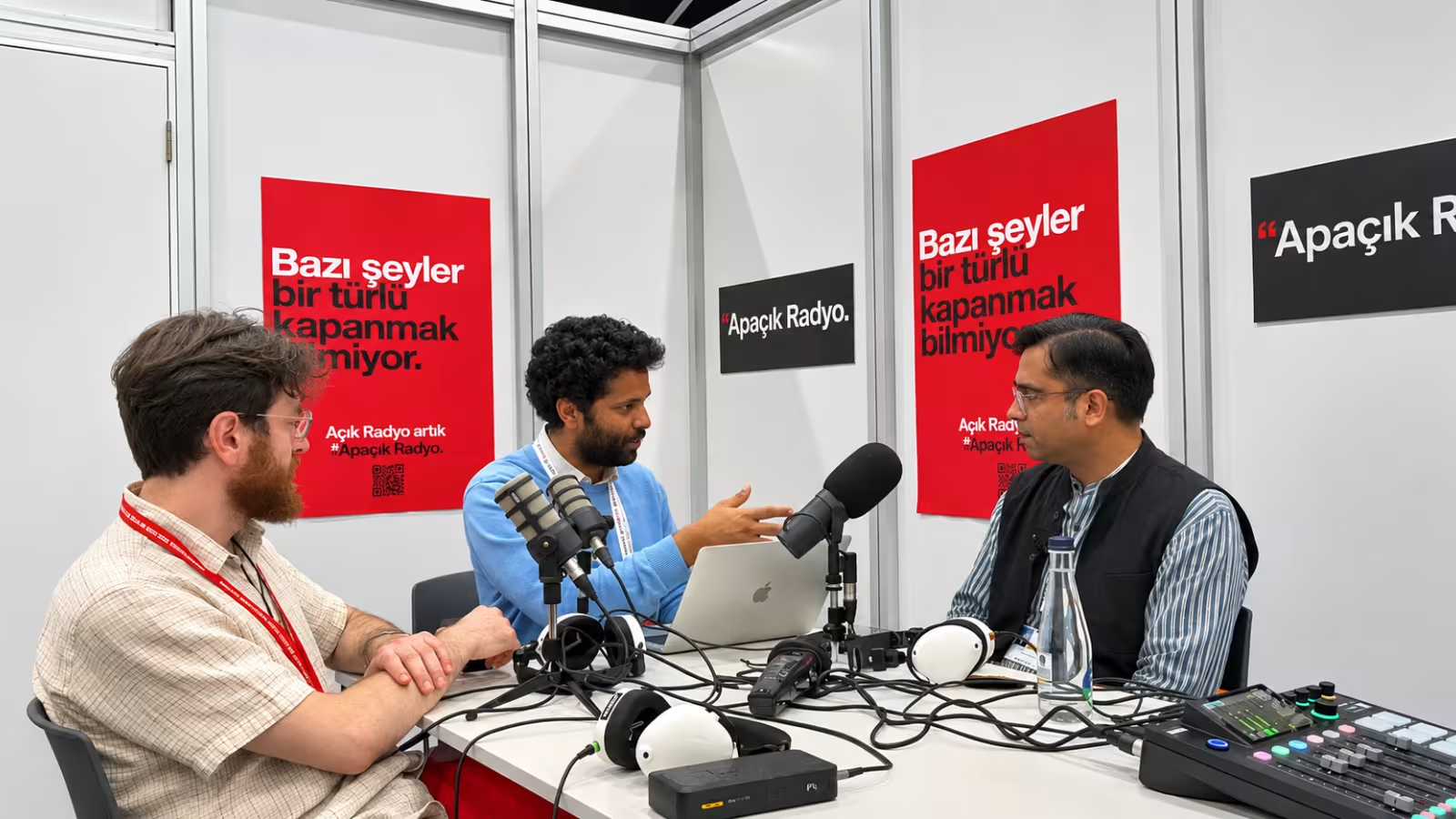
As part of COP31, we speak with Amitabh Behar, Executive Director of Oxfam International, about the relationship between the climate crisis and economic inequality, the responsibility of the super-rich for carbon emissions, wealth taxes and climate finance, the importance of ensuring that Palestinians have a say in the reconstruction of Gaza, and the role of global solidarity in the face of growing authoritarianism.
Waseem Ahmad Siddiqui: Oxfam's latest report, titled Disaster Divide: How Climate Chaos Deepens Inequality and Enriches the Few, was published on October 27, 2026. It is an extremely important report as we enter the second week of COP31 in Antalya. The report reveals that the richest 0.1% of the world's population, approximately 8 million people, produce more carbon emissions than the poorest 3.5 billion people combined. It also finds that deaths from flooding are seven times higher in more unequal countries. Meanwhile, some of the wealthiest people are profiting from the economic consequences of climate disasters. To discuss this further, we are joined by Amitabh Behar, Executive Director of Oxfam International, here in Antalya at COP31. Thank you for being with us.
Amitabh Behar: Thank you for inviting me.
W.A.S.: Disaster Divide exposes a disturbing reality. As I mentioned earlier, the wealthiest 0.1% of the world's population produce more carbon emissions than the poorest 3.5 billion people combined. Yet it is primarily the poorest and most vulnerable communities who bear the brunt of floods, droughts, extreme heat, food insecurity, and displacement. Amitabh, your focus is on deepening inequality around the world. Could you lay out the key facts and findings of this report?
A.B.: Thank you for inviting me. I'm glad you've chosen to discuss this report because, in many ways, it is revealing and brings to light the stark realities of the world. Let me start with the first fact you mentioned.
The richest 0.1% of the global population, the super-rich, are responsible for more carbon emissions than the bottom half of the world's population, which is almost 4 billion people. This essentially tells us something about the climate catastrophe we are witnessing around the world and the increasingly real possibility that global warming will exceed 1.5°C. We are seeing massive floods in different places, droughts in others, and extreme heat elsewhere. We've seen what happened in Nepal, where flash floods killed thousands of people.
It is not ordinary people who are responsible for this climate catastrophe. I think that's the key point we're making. It is the super-rich, their extremely opulent and polluting lifestyles, and their investments in the oil and gas sector. The report essentially tells us that we cannot understand the climate catastrophe without understanding the political economy behind it.
W.A.S.: Exactly.
A.B.: The political economy in which we operate essentially favors a very small minority at the expense of everyone else. There are different ways of describing it. Some would call it an economy for the top 1%, not the other 99%. What we're seeing is wealth continuing to concentrate at the top, rather than trickling down, as we've been led to believe. That's the reality we're looking at. And if we are to address the climate catastrophe, especially as we sit here at COP31 in Antalya, I believe this report and our work show that we must also address economic inequality. Economic inequality and climate justice are inseparable.
W.A.S.: Exactly. And one of the most striking findings of your report is that the super-rich are not only disproportionately responsible for emissions but can also profit from the consequences of climate disasters. It's extraordinary. I mean, this includes rising food prices and reconstruction efforts. Doesn't this demonstrate that the climate crisis is fundamentally a crisis of economic and social injustice?
A.B.: Oh, absolutely. That's precisely the point we're making. We have a political economy that is completely unjust, one that exploits the resources of Mother Earth for the benefit of a very small minority. And that must change.
As you said, it's not just that global common goods serve the interests of a privileged few. We're actually seeing them profit from the climate crisis.
Let me first give you a broader picture. Billionaires have added $1 trillion to their wealth in just one year. One trillion dollars. In the last three months alone, they've added $300 billion to their wealth. On the other hand, we're also seeing the massive windfall profits that the oil and gas industry is making in the wake of the war.
So, instead of creating opportunities to redistribute these resources, we're seeing an even greater concentration of wealth. That's really the big story.
And let me say why this is so important to highlight. We keep hearing governments, particularly those in the Global North, acknowledge that there is a climate crisis and that they have obligations under the Paris Agreement to provide climate finance, but then claim there's no money.
That's a myth that needs to be busted. We keep saying that inequality is a political choice. It is not inevitable. It is the result of policies pursued by governments, and those policies can be changed.
We have very concrete proposals for mobilizing resources for climate finance, which could help address the realities faced by countries like Tuvalu and Nepal, where we saw those devastating flash floods.
W.A.S.: Would you like to elaborate on those concrete solutions?
A.B.: Yes, absolutely. We are currently working on three very specific proposals.
The first is taxing the super-rich. That needs to be done. I've already talked about the enormous increase in their wealth. Let me give you another figure. Some of these numbers are jaw-dropping. There are only 3,000 billionaires in the world, and their combined wealth stands at $18.3 trillion. That's equivalent to China's GDP. We're not talking about the GDP of the third- or fourth-largest economy. That's the GDP of China. That's how much wealth they hold. And their wealth has doubled since COVID. So, in the last five or six years, they've doubled their wealth. This kind of disproportionate, monopolistic accumulation of wealth must be taxed. That's the first proposal.
The second is taxing windfall profits. We're seeing companies, particularly oil and natural gas companies, making enormous profits while the world is going through a climate catastrophe. And it's not just Nepal and Tuvalu. Let's not forget what happened in Europe this summer. There were thousands of excess deaths because of the heatwaves. Perhaps because they didn't occur in a single city, people don't fully grasp the scale of the tragedy. But we're talking about thousands of deaths. I don't remember the exact figure, but I think it was close to 30,000. We need to ensure that at least these windfall profits are taxed.
The third proposal is to impose levies on extremely opulent lifestyles, such as the use of private jets. I think it's high time we did that. Our study shows that if we simply imposed a levy reflecting the actual environmental damage caused by private jets, rather than a higher tax, we could raise $48 billion in a single year. Just from that one levy.
These are very concrete proposals that can and must be implemented. But we're not seeing the political will to do so from governments almost anywhere.
W.A.S.: Yes, except for the recent protests in Delhi and elsewhere. That's where we see real hope for change.
A.B.: Yes, of course. Now you're broadening the conversation, and I'm happy to go there. But let me just say that even the outgoing UN Secretary-General has repeatedly said in his speeches, "Make polluters pay."
W.A.S.: Make polluters pay.
A.B.: It's important to remember that we have the UN Secretary-General backing this. A few governments, including those of Brazil, Spain, and South Africa, have also expressed their support.
But coming to your broader question, I'm glad you asked. We also publish an annual inequality report, which we release at Davos every year. This year's report reveals a very brutal reality of our times: the super-rich, the billionaires, are no longer content with simply being wealthy. They have started buying political power.
What we're essentially seeing is a shift from the super-rich to oligarchies. These oligarchs are now effectively buying elections, judges, and policies. This is cronyism at its worst, leading to an even greater concentration of wealth and political power in the hands of a few.
And that's where I think the protests you mentioned, from Delhi to France to Spain and across the world, come in. They are an expression of people's anger. In fact, we often say that economic poverty leads to hunger, while political poverty leads to anger. And that's precisely what we're witnessing at the moment.
Eren İleri: So you're essentially saying that billionaires are killing for business, pleasure, and power. And I really like the idea of taxing windfall profits, wealth, and the billionaire lifestyle. But how do we ensure that these taxes don't simply become a cost of doing business, and that they actually change behavior, discourage these ultra-opulent lifestyles, and curb the power of billionaires to buy political influence?
A.B.: Yes. First, let me say that anything that helps eliminate these ultra-opulent, polluting lifestyles is a good thing. It's important that we move away from them. There is no justification for such lifestyles. When I go to Davos, I go with a lot of pain because thousands of private jets land there. That certainly needs to change.
But your question is broader, and I think that's where regulation comes in. The state has a responsibility. Governments are making a choice. They're choosing to help the super-rich become even richer instead of standing with their people. And that's the choice they need to reconsider.
Taxation is one way to address this: inheritance taxes, wealth taxes, and higher tax rates. And let's not forget that even in a country like the United States, which many would consider the ultimate temple of capitalism, tax rates reached as high as 90% in the postwar period. So that's something we need to consider.
And to quote Warren Buffett, one of the richest men in the world, he himself has pointed out how strange the system we've created is, where his secretary pays a higher tax rate than he does.
So a fundamental shift is needed, and taxation is one way to achieve it. But there are also initiatives underway, such as the UN Tax Convention. These are efforts moving in the right direction. Let's hope they gain more momentum and influence.
W.A.S.: I want to ask you about Israel's genocidal war against Palestinians. On September 1, 2026, Oxfam released a statement titled Palestinians Should Lead the Rebuilding of Gaza. How would you compare Oxfam's vision of what needs to be done with that of President Trump's so-called Board of Peace?
A.B.: It's very clear. If you look at the Board of Peace, it's been operating for more than a year now, and it hasn't been able to deliver any peace. The killings continue. Humanitarian aid still isn't reaching people, and they're now preparing for a really harsh winter.
We've seen people in Gaza living with a complete lack of food. Hunger has been deliberately created, and that hasn't changed.
We don't believe things will improve unless the people of Gaza themselves take the lead. It's absolutely essential that those whose futures are at stake are the ones making the decisions, not outsiders who might see this as a business opportunity.
That's unacceptable. This is about people's lives, about children, women, and human dignity. And I think the people of Gaza must be the ones to lead the reconstruction.
W.A.S.: Before I move on to the last question, would you like to ask anything?
E.İ.: Of course. I'm basing this on your question about the so-called Board of Peace. We know that billionaires like Peter Thiel have been promoting the idea of network states, city-states that would be owned and controlled by billionaire CEOs. We have examples like Próspera and the project Trump is trying to develop in Albania, zones where they would have control over economic policies and taxation.
It seems that they're trying to find ways to escape the regulations that may be introduced in response to this rampant inequality. Could you speak a little about this coordinated effort among billionaires to create new havens for their wealth and political power, and how we can effectively challenge it?
A.B.: Listen, I don't know enough about the details of this, but I think the idea that billionaires can run cities or regions is fundamentally flawed. Our experience tells us that we need real accountability, and that accountability must be to the people, because people must be able to decide their own future. It shouldn't be a handful of individuals sitting around deciding what the world should look like.
And we have plenty of experience with the welfare state. Just look at the last century. We created more equal societies, where there was investment in public healthcare, public education, and social security. We were able to ensure that everyone received a living wage and that workers had fundamental rights.
E.İ.: What changed?
A.B.: Human rights, though. I must say, I can be cynical when I see the injustice around the world.
But if you take a broader view of the world, things have changed. I come from a country where people could be killed simply because of the caste they belonged to. Caste-based atrocities continue, but they have declined.
Let me give you an even more striking example. I often use this example when I'm in Switzerland. Do you know when women were granted the right to vote in Switzerland? In the mid-1970s? It's that recent. Things have changed. Until the 1970s, women in Switzerland didn't even have the right to vote. In much of Europe, women began gaining voting rights in the 1910s and 1920s.
So things have changed, and I don't want to be cynical. I truly believe in what Martin Luther King Jr. said: "The arc of the moral universe is long, but it bends toward justice." That's what I believe.
Yes, the situation is extremely oppressive at the moment. If you're an ordinary person, you face injustice every day. You wake up feeling hopeless. But I think it's our job to fight, and we will build a more equal and just future.
W.A.S.: Great. And that's exactly what I was going to ask you in my final question. At a time when global solidarity appears increasingly fragile, multilateral institutions are struggling to respond to humanitarian catastrophes, and economic and political power remains concentrated in the hands of a few, do you still believe that a more just and equal world is achievable? What gives you hope, and where should citizens and people's movements look for change?
You've already touched on this, but perhaps we can explore it a little further.
A.B.: Yes, I'm happy to talk more about it. First, I think there is no alternative to multilateralism. We cannot live in a unipolar world. The experience of the World Wars, particularly the Second World War, taught us that we need a multilateral mechanism. The UN is a product of the postwar consensus, which has brought us peace to some extent. I know you could challenge me by pointing out that wars are happening everywhere, but compared to the past, their number has declined.
The problem is that the postwar consensus, which was rooted in multilateralism, human rights, and the rule of law, is now being eroded.
So it's our responsibility, as people's movements and social movements around the world, to come together, build new solidarities, and articulate a new vision rooted in justice. A vision of justice for everyone and human rights for everyone.
And you ask me where I find hope. Just look around. Young people are rising up. They're not going to accept the control of these tech billionaires. They're not going to accept authoritarian regimes. We're already seeing change happen, and that gives me enormous hope. Enormous hope.
And let me just add something, to end on a calmer note.
E.İ.: Please do.
A.B.: Yes, seeing thousands of young people taking to the streets gives me enormous hope. But I've also spent time with ordinary, poor people in my country and other parts of the world. They don't even earn a basic living wage, yet they wake up every morning and work tirelessly for a better future.
Just spend some time with them, and the cynicism that develops in air-conditioned rooms will evaporate. Spend time with them, and you'll realize that we have no choice but to fight for a fair and just future.
W.A.S.: I agree. Amitabh Behar, Executive Director of Oxfam International, thank you so much.
A.B.: Thank you.
W.A.S.: Thank you.
E.İ.: Thank you.
W.A.S.: It was great speaking with you. Thank you.
Who is Amitabh Behar? Amitabh Behar is an Indian human rights and social justice advocate. He is the Executive Director of Oxfam International. His work focuses on economic inequality, poverty alleviation, climate justice, and democratic rights.
COP31'de neler konuşuluyor, hangi kararlar alınıyor? Resmî müzakerelerden alternatif zirvelere, iklim hareketinin seslerinden gezegenin geleceğini belirleyecek tartışmalara, Antalya'dan gelişmeleri COP31 Özel Yayını'nda takip ediyoruz.