Image
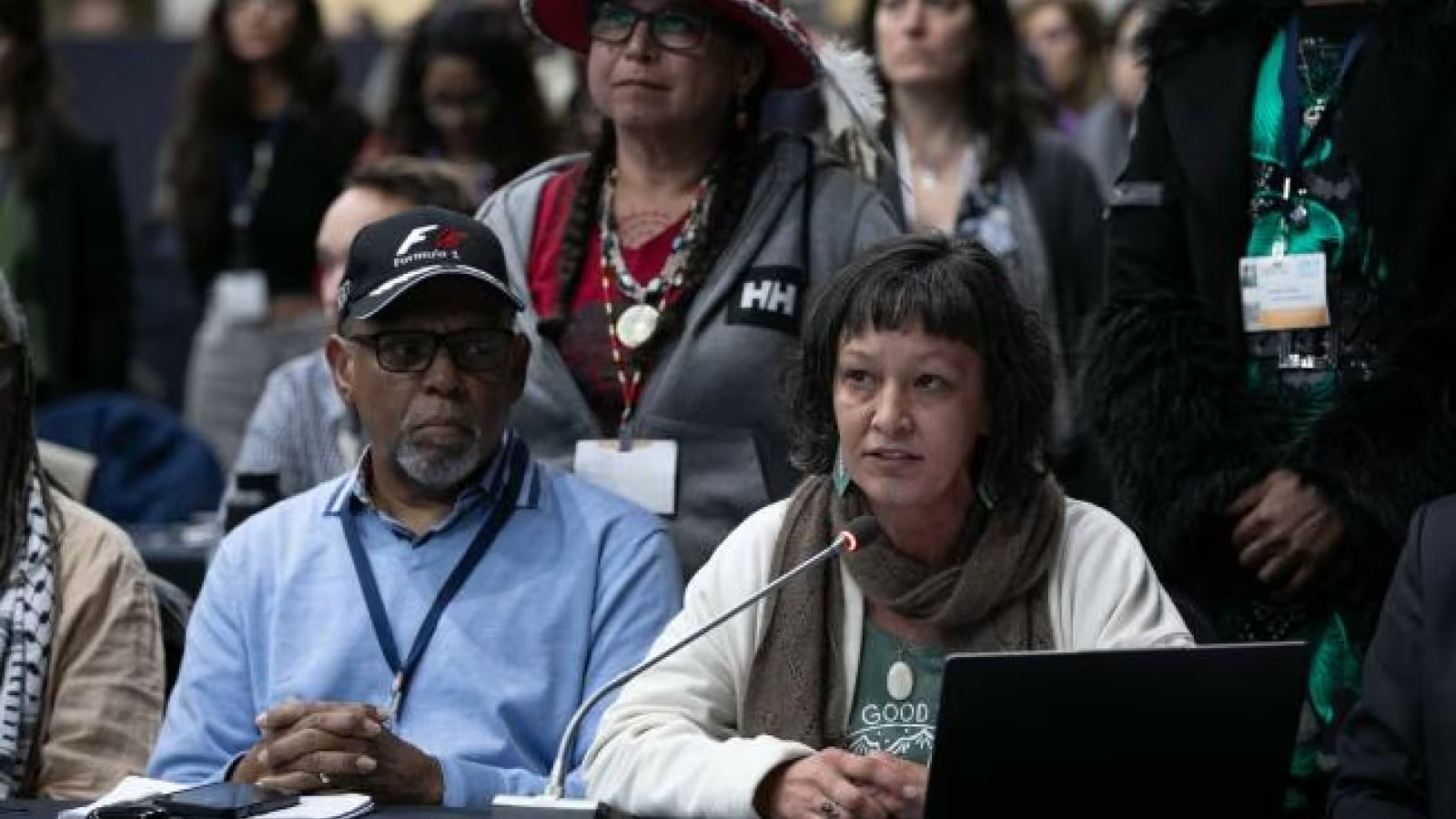
As part of COP31, we speak with Aakaluk Adrienne Blatchford from the Indigenous Environmental Network about the ecological threats posed by geoengineering and AI data centers, the impacts of fossil fuel operations in Alaska on Indigenous peoples’ lives and cultures, and the importance of cultural resistance and solidarity in confronting the climate crisis.
Eren İleri: Hello and welcome to Apaçık Radyo. Could you please introduce yourself and tell us about the work you do?
Aakaluk Adrienne Blatchford: My name is Aakaluk Adrienne Blatchford, and I am a geoengineering outreach organizer with the Indigenous Environmental Network.
E.İ.: And where are you from?
A.A.B.: Unalakleet, Alaska. In our language, it's Unalakleet.
E.İ.: We just came from a really impressive creative action about false solutions. You're a geoengineering outreach organizer, and we hear so much about geoengineering as a false solution. Can you explain what a false solution means and how we're harming our Earth with false solutions?
A.A.B.: As a geoengineering educator, we break it down. Basically, it's a techno-fix, a climate mitigation techno-fix. They implement these false solutions by using emerging technologies, including carbon capture, utilization and storage, carbon capture and storage, solar radiation management, marine geoengineering, geothermal energy, and marine carbon dioxide removal, to name a few.
As we continue to move forward with addressing the climate crisis that we're in, we're seeing high-ambition parties and the 1%, the rich of the world, come together and push these false climate solutions. They want to form governance around them to implement them worldwide.
Because they aren't regulated in most parts of the world, we're already seeing these experiments, I call them glorified science experiments, being tested in areas like Nepal, the Arctic, and Australia. There's a lot of small-scale testing, but they want to do large-scale global testing.
What's happening right now with the extractive industries, in the search for fossil fuels and so-called critical minerals, is that they want to continue doing business as usual, emitting carbon dioxide and other pollutants, while using these techno-fixes to mitigate climate change.
So when we look at the overarching goal of reducing carbon emissions, it's not addressing the root cause of the problem, which is the fossil fuel industry and the critical mineral industry. And now a tech regime, right? We're seeing AI data centers connected to that, as well as small nuclear reactors, the use of drones, and many other technologies being developed by engineers from these high-ambition parties.
E.İ.: You talked about AI data centers. Can you tell us a bit more about the climate impact of these projects?
A.A.B.: Goodness, yes. They use large amounts of water and electricity, as well as critical minerals and other materials to build these data centers. Of course, you have to mine and produce plastics. Droughts in the areas where they've already started operating are so severe, and freshwater has already become an issue in so many places. The flora and fauna surrounding these areas have started to die off. We know that this is harmful, yet they want to continue building these hyperscale data centers in critical ecosystems that the world depends on to thrive.
E.İ.: You're from the Western Arctic. How has climate change been impacting your community?
A.A.B.: We live under the constant threat of flooding and coastal erosion in the community I'm from. We're seeing landslides and sinkholes. The permafrost is melting, and our lakes are drying up. We've seen more intense storms. We're seeing silt and sediment build up in our river, making it harder for fish and migratory birds to thrive in our ecosystems. Mass fish die-offs, mass bird die-offs, you name it. Climate change has accelerated four times faster in the North than in the Global South. And it's only moving further south as this industrial complex grows.
E.İ.: Earlier this year, we saw some harrowing footage of a massive oil rig tipping over, “the Beast,” I think they call it, by Doyon. Can you tell us what happened and what this tells us about the industry?
A.A.B.: Doyon had brought one of the largest oil rigs in North America up, and they were transporting it outside the village of Nuiqsut when it tipped over. There were no repercussions for Shell Oil after that, and they continued business as usual, even though it impacted the community in the North Slope, which surrounds this area where they're exploring for oil and gas.
Oftentimes, when disasters like this happen, it's easier to pay a fine and move on, continuing business as usual without regard for human life or human health impacts, the ecosystems, or the impacts on the animals that we depend on not only for food sovereignty but also for our cultural survival as people of the North.
E.İ.: Cultural survival. Can you describe that a bit more for our listeners at home?
A.A.B.: I'm getting really emotional. When we talk about ourselves as Inuit, we're one with the land and what it provides. We recognize that we're a part of the land. Without the animals, the water, and our land that have helped us thrive in our homeland since time immemorial, we will no longer exist without those connections to the drums that we use to sing and dance, or to the salmon and the caribou that we use in our ceremonies, and the ways we've always been able to create that relationship with the land, the waters, and what they provide.
E.İ.: Thank you so much, and thank you for being so emotionally vulnerable. I know that we're talking about genocide here, and that's difficult to talk about. You talked about Nuiqsut. Can you describe for our listeners at home, if you feel comfortable, what it's like to be in Nuiqsut? The sounds, the smells, the sights, and how you get in and out?
A.A.B.: It's a fly-in-only community located on the eastern North Slope of Alaska. It's a very isolated community surrounded by oil rigs and large dump trucks that come in and out of town, hauling hundreds of tons of gravel daily. Dynamite is blown up every day at 5 p.m., and these dump trucks haul hundreds of tons of gravel to lay the roads for the new oil rigs.
You can smell the exhaust and the oil. You can taste it while you're there. It almost makes it hard to breathe every time you go outside. And the constant hum of those oil rigs never stops.
Every single day, the earth shakes, the air is polluted, and there's constant activity that interrupts the migration of the caribou and the birds. I mean, if you think of sitting next to a passing train, that's what it feels like: the shaking of the earth and the noise. It's like a train is constantly going by your house.
E.İ.: Thank you for setting the scene for us. I have one last question for you, and I hope it's a bit more hopeful than the previous ones. Our friends at Sovereign Iñupiat for a Living Arctic are doing some cultural organizing right now and, if I'm not mistaken, hosting a music event. Can you tell us a bit more about the importance of cultural organizing and these events, especially for Inuit youth?
A.A.B.: Cultural organizing is one of the most important aspects of grassroots movements. It allows for expression in a way that is vulnerable and truthful. Through art and music, folks are often able to really open up in a way that's relatable to the rest of the world. I think music speaks volumes.
SILA was actually invited to this music festival in Nome, where other artists from around the Arctic have come to share that time, love, and expression, and to be able to regenerate through music. It also gives us that connection to who we are, who we've always been, and who we'll always be.
E.İ.: Thank you so much for sharing your voice and your experiences. Is there anything you'd like to leave our listeners with, or any question we should have asked but didn't?
A.A.B.: Remain hopeful and optimistic, and encourage young people to have intergenerational interactions and to be thirsty for knowledge, to always ask questions. Don't just settle for what is being projected to the masses. Always use your voice, and always remind yourself that when you find yourself in difficult places where difficult decisions are being made, and you feel intimidated, look down at your feet. That's right where they're supposed to be. And you are always surrounded by an army of 10,000 when you walk into that room alone.
E.İ.: And that really reminds me of an expression we say in Turkish: “Love the youth, respect the elders.” Thank you so much.
A.A.B.: Thank you.
Who is Aakaluk Adrienne Blatchford? Aakaluk Adrienne Blatchford is an Iñupiaq Indigenous environmental and climate justice activist from Unalakleet, Alaska. As part of the Indigenous Environmental Network (IEN), she works to raise public awareness and organize communities against geoengineering and false climate solutions. For over a decade, she has been advocating for Indigenous peoples’ rights, addressing the ecological impacts of the fossil fuel industry, protecting traditional knowledge, and advancing climate justice in the Arctic.
COP31'de neler konuşuluyor, hangi kararlar alınıyor? Resmî müzakerelerden alternatif zirvelere, iklim hareketinin seslerinden gezegenin geleceğini belirleyecek tartışmalara, Antalya'dan gelişmeleri COP31 Özel Yayını'nda takip ediyoruz.